


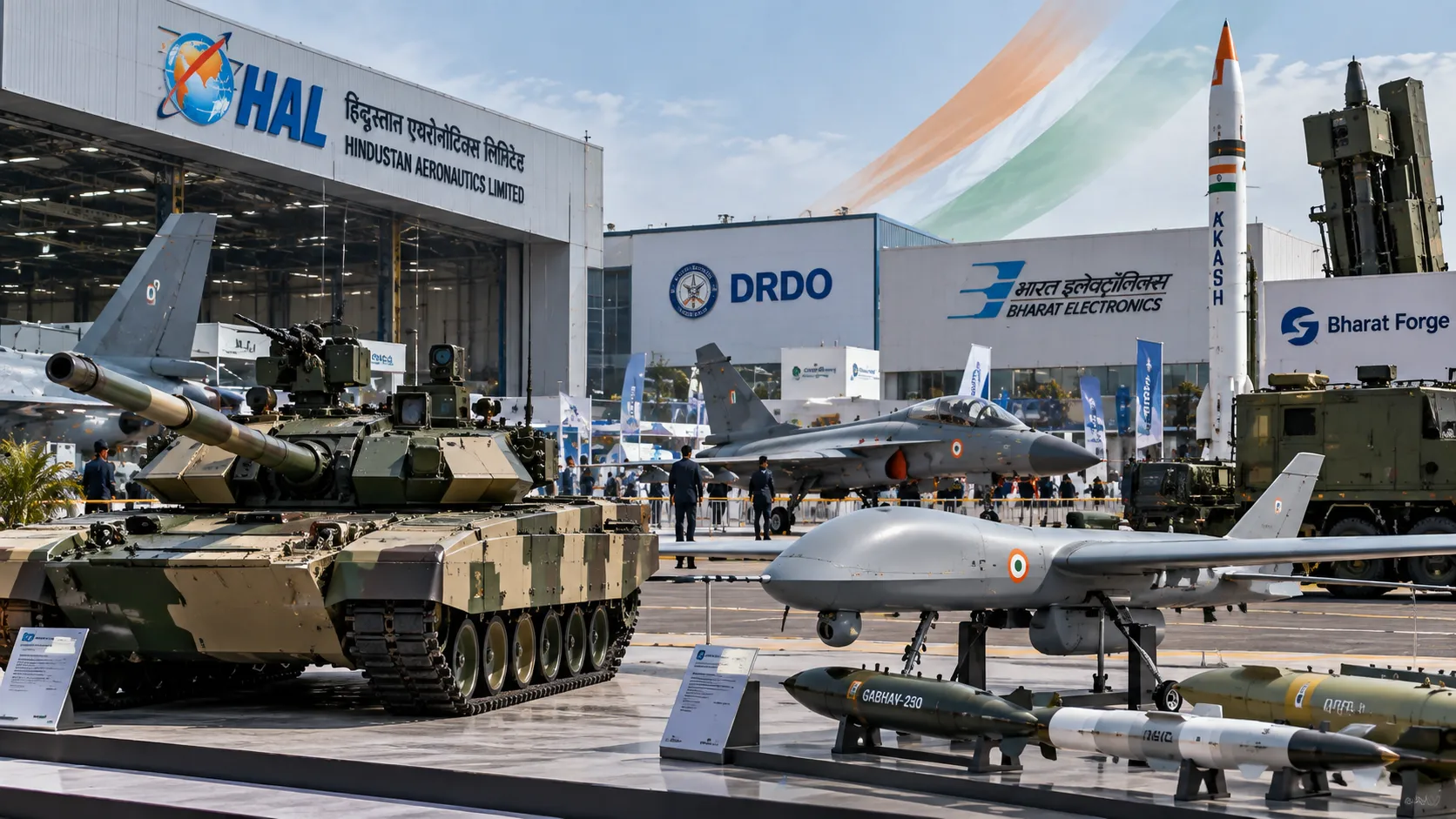
India’s defence industry is no longer defined only by government-owned factories producing equipment for the armed forces. Today, the ecosystem stretches from aircraft and warship builders to missile manufacturers, electronics companies, ammunition producers, drone firms, engineering companies, start-ups and thousands of smaller suppliers.
The scale of that industrial base has also changed. India’s annual defence production reached a record ₹1.78 lakh crore in FY 2025-26, according to the Ministry of Defence, with the private sector accounting for about 24% of output and public-sector entities contributing the remaining 76%. Defence exports also reached a record ₹38,424 crore in FY 2025-26, with Indian defence products reaching more than 80 countries. The government reported 145 defence exporters during the year. The Ministry of Defence’s 2026 production figures and its FY 2025-26 export data provide the latest official figures.
But those headline numbers need context. Defence production value is not the same thing as indigenous technology. A platform may be manufactured or assembled in India while still containing imported components, technologies or subsystems. The real evolution of the industry is therefore happening at several levels: design, engineering, manufacturing, systems integration, supply chains, testing, maintenance and exports.
How India’s Defence Industry Is Organised
India’s defence manufacturing base can broadly be understood as four interconnected layers.
| Layer | What it includes | Examples |
|---|---|---|
| Public-sector manufacturers | Large government-owned defence and strategic manufacturers. | HAL, BEL, BDL, MDL, GRSE and other defence-sector enterprises. |
| Private prime contractors | Companies capable of designing, integrating or manufacturing complete systems and platforms. | Tata Advanced Systems, L&T, Bharat Forge/Kalyani and Adani Defence. |
| MSMEs and specialist suppliers | Components, electronics, materials, machined parts, software, subsystems and specialised equipment. | Thousands of Indian industrial and technology suppliers. |
| Start-ups and technology companies | Drones, AI, autonomy, sensors, communications, cyber and other emerging technologies. | iDEX-supported and other Indian defence technology companies. |
As of 2026, government material describes an ecosystem containing 16 Defence Public Sector Undertakings, around 500 licensed defence companies and more than 16,000 MSMEs. The number of defence industrial licences had reached 834 by March 2026. These figures describe the broader industrial base rather than the number of companies that manufacture complete weapons or platforms themselves. The Ministry of Defence’s 2026 overview of the defence industrial ecosystem provides the latest figures.
Major Public-Sector Defence Companies in India
India’s public sector remains central to the defence manufacturing ecosystem, particularly in strategically important areas such as combat aircraft, defence electronics, missiles and submarines.
Hindustan Aeronautics Limited (HAL)
HAL is India’s principal public-sector aerospace manufacturer. Its activities span the design, development, production, repair, overhaul and upgrade of aircraft, helicopters, aero-engines, avionics and associated systems.
Its portfolio and industrial role extend across programmes such as the Light Combat Aircraft Tejas, helicopters including the Advanced Light Helicopter family, and multiple aircraft and engine support programmes for the armed forces.
HAL also illustrates an important distinction in Indian defence manufacturing: being an Indian manufacturer does not necessarily mean every underlying technology originated in India. Industrial capability can include indigenous design, licensed production, technology absorption, integration and progressively greater localisation.
HAL’s official company profile describes its aircraft, helicopter, aero-engine, avionics, repair and overhaul capabilities.
Bharat Electronics Limited (BEL)
BEL is one of the most important companies in India’s defence-electronics ecosystem.
Its portfolio includes radars, missile systems, military communications, naval systems, electronic warfare, avionics, C4I systems, electro-optics, tank electronics and weapon-system upgrades.
This makes BEL particularly important to the part of modern warfare that is less visible than a fighter jet or tank. Sensors, communications, electronic warfare and command systems determine how effectively different platforms can detect, communicate and operate together.
BEL’s official company information lists its principal defence technology areas.
For a deeper look at one of the technologies produced by India’s defence-electronics ecosystem, see Defence Cafe’s explanation of how radar works.
Bharat Dynamics Limited (BDL)
BDL was established as a public-sector manufacturing base for guided missiles and related systems. Its current capabilities cover guided missiles, underwater weapons, airborne weapon systems and allied defence equipment.
BDL’s role also shows how India’s defence industry can connect research and production. It works with organisations including DRDO and has developed manufacturing capabilities around a broad range of guided-weapon programmes.
BDL’s official company profile details its missile, underwater-weapons and allied manufacturing activities.
Mazagon Dock Shipbuilders Limited (MDL)
Mazagon Dock Shipbuilders Limited is one of India’s principal builders of complex naval platforms. Its core defence role includes the construction of warships and submarines for the Indian Navy.
Shipbuilding is particularly demanding because a modern warship combines structural engineering, propulsion, radar, communications, weapons, sensors, electrical systems, combat-management systems and thousands of components into one integrated platform.
MDL’s official website provides its corporate and shipbuilding information.
Garden Reach Shipbuilders & Engineers (GRSE)
GRSE is another major Indian naval shipbuilder. Its portfolio includes warships, anti-submarine warfare vessels, survey ships and other maritime platforms.
In June 2026, GRSE reported that it had reached a cumulative milestone of 118 warships delivered, including 80 for the Indian Navy. The company also highlighted extensive participation by Indian suppliers and indigenous equipment in its vessels.
GRSE’s official company profile describes its integrated shipbuilding capabilities and defence projects.
Cochin Shipyard Limited (CSL)
Cochin Shipyard Limited demonstrated the level of industrial complexity India can now undertake with the construction of INS Vikrant, India’s first indigenous aircraft carrier.
The project required detailed engineering, large-scale fabrication, system integration, specialist steel, extensive cabling and piping, aviation systems and a nationwide vendor network. CSL stated that approximately 550 indigenous vendors supported the aircraft-carrier project, including nearly 100 MSMEs.
Cochin Shipyard’s official account of the INS Vikrant project provides details of the carrier’s construction and industrial ecosystem.
Major Private Defence Companies in India
The private sector now occupies a significantly larger role in Indian defence manufacturing than it did in earlier decades. Private companies contributed about 24% of total defence production in FY 2025-26, according to the Ministry of Defence.
The growth is not concentrated in one product category. Private-sector companies are active in aerospace, land systems, missiles, ammunition, electronics, unmanned systems, shipbuilding, components and maintenance.
| Company | Major defence areas | Industrial role |
|---|---|---|
| Tata Advanced Systems | Aerospace, defence systems, aerostructures, airborne platforms and land mobility. | Systems integration, manufacturing and partnerships with global aerospace and defence companies. |
| Larsen & Toubro | Marine platforms, land systems, aerospace and defence electronics. | Engineering, systems integration, shipbuilding and large defence programmes. |
| Bharat Forge / Kalyani Strategic Systems | Artillery, protected and armoured vehicles, naval systems and defence engineering. | Platform manufacturing, metallurgy, engineering and defence-system development. |
| Adani Defence & Aerospace | Ammunition, missiles, UAVs, counter-drone systems, small arms and aircraft services. | Integrated manufacturing, technology partnerships and expansion of export-oriented capability. |
| Mahindra Defence | Armoured vehicles and defence mobility solutions. | Land-system manufacturing and specialised military vehicles. |
| ideaForge | Unmanned aerial systems. | Indigenous UAV design and production. |
The Government of India’s official Defence Exports Promotion product catalogue illustrates the breadth of the private-sector ecosystem, listing Indian products ranging from Tata’s defence vehicles and artillery systems to L&T defence shipbuilding, Adani missile and UAV systems, Kalyani armoured vehicles, Mahindra armoured personnel carriers and ideaForge unmanned systems.
Tata Advanced Systems
Tata Advanced Systems Limited (TASL) is the strategic aerospace and defence arm of the Tata Group. Its official profile describes capabilities covering systems, hardware, software and digital solutions across land, sea and air applications.
TASL is also significant because modern defence manufacturing increasingly involves integration into international supply chains. A company can simultaneously produce systems for Indian forces, manufacture components for global original equipment manufacturers and participate in international partnerships.
Tata Advanced Systems’ official profile describes its aerospace and defence capabilities and global partnerships.
Larsen & Toubro
L&T has built a broad defence portfolio spanning marine platforms, land systems, aerospace and electronics.
Its defence business includes engineering and manufacturing for artillery, air defence, armoured platforms, weapon-delivery systems and combat engineering. The company’s shipbuilding capability extends to large warships and conventional submarines.
L&T’s FY 2025-26 Annual Report provides its current defence and aerospace business structure.
Bharat Forge and Kalyani Strategic Systems
Bharat Forge combines decades of heavy manufacturing and metallurgy experience with defence and aerospace activities. Its defence capabilities cover areas such as artillery systems, protected and armoured vehicles, naval utility platforms and defence consumables.
Its industrial story is particularly relevant because metallurgy, precision manufacturing, materials science and testing are often the less visible foundations of complex defence equipment.
Bharat Forge’s FY 2025-26 company profile describes its current defence and aerospace capabilities.
Adani Defence & Aerospace
Adani Defence & Aerospace has expanded into ammunition, missiles, UAVs, counter-drone systems, small arms and aircraft-related services.
Its current industrial footprint includes facilities in areas such as Kanpur, Hyderabad and Gwalior, while the company has also announced further investments in missile and ammunition manufacturing.
Adani Enterprises’ FY 2025-26 defence and aerospace report outlines its current capabilities.
Why MSMEs Matter to Defence Manufacturing
A fighter aircraft, submarine or missile may carry the name of a major prime contractor, but the industrial chain behind it can involve hundreds or thousands of smaller suppliers.
These companies can manufacture machined components, castings, forgings, cables, electrical assemblies, electronics, sensors, software, hydraulic equipment, specialised materials, vehicle parts and other subsystems.
This is one reason why indigenous production is more than a question of whether a country can build a finished platform. A resilient defence industry also needs a domestic ecosystem capable of producing critical parts when demand increases or foreign supply chains become disrupted.
Government initiatives such as the SRIJAN Defence Portal are designed to connect defence organisations with Indian companies, MSMEs and start-ups for import substitution and indigenous development.
As of 2026, government material stated that more than 33,000 defence items had been offered through SRIJAN for indigenisation, with more than 15,700 items indigenised over the previous five years. SRIJAN DEEP had also accumulated a large digital database of Indian defence vendors and products. The Department of Defence Production’s 2026 indigenisation update provides the latest figures.
How Defence Manufacturing Is Becoming More Indigenous
India’s push for self-reliance is not based on a single policy. Several mechanisms work together.
Positive Indigenisation Lists
The Positive Indigenisation Lists identify categories of equipment, components and sub-systems for which domestic development and production are encouraged or prioritised.
In August 2026, the Department of Defence Production notified a sixth Positive Indigenisation List containing 405 strategically important items. These included components associated with aircraft such as the Su-30MKI and LCA, armoured platforms, warships, missile systems, radars, sonars and other defence equipment.
The latest list also makes an important point about how localisation actually happens: indigenisation is not limited to building complete platforms. It also involves replacing imported components, sub-assemblies, line-replaceable units, spares and raw materials.
Read the Ministry of Defence release on the sixth Positive Indigenisation List.
Domestic Procurement
Industrial growth depends partly on having a predictable domestic market.
For FY 2026-27, the government earmarked ₹1.39 lakh crore, or around 75% of the Capital Acquisition budget, for procurement through domestic defence industries.
This does not mean that every rupee goes to privately owned companies. Domestic procurement can involve public-sector manufacturers, private-sector companies, shipyards, MSMEs and other Indian suppliers depending on the acquisition category and contract.
The Ministry of Defence’s FY 2026-27 budget explanation details the domestic procurement allocation.
iDEX and Defence Innovation
Not every important defence technology begins inside a large established manufacturer.
India’s Innovations for Defence Excellence (iDEX) framework was created to bring start-ups, innovators and smaller technology companies into the defence-development process.
This matters particularly in fields where technology cycles are shorter than the traditional platform-development cycle, including drones, artificial intelligence, sensors, communications, cyber technologies and autonomous systems.
Defence manufacturing therefore increasingly involves a combination of large companies and smaller specialist firms rather than a simple prime-contractor model.
Defence Cafe has also examined this wider transition from research to deployable capability in From Laboratory to Battlefield: How Defence Technology Reaches the Armed Forces.
India’s Defence Industrial Corridors
Two dedicated Defence Industrial Corridors have been established in Uttar Pradesh and Tamil Nadu.
The idea is to create geographic clusters in which manufacturers, suppliers, testing infrastructure and other industrial capabilities can operate closer together.
| Defence Industrial Corridor | Latest reported investment commitments | Reported investment on ground |
|---|---|---|
| Uttar Pradesh Defence Industrial Corridor | ₹42,057 crore | ₹4,409 crore |
| Tamil Nadu Defence Industrial Corridor | ₹32,699 crore | ₹6,446 crore |
These figures were reported by the government for April 2026. Investment commitments and investment actually grounded are different measures, so they should not be treated as the same thing.
The Ministry of Defence’s 2026 defence-industry overview provides the corridor data.
What Does India Actually Manufacture?
The phrase “defence manufacturing” covers a much wider range of products than fighter aircraft and tanks.
| Sector | Examples of Indian industrial activity |
|---|---|
| Aerospace | Fighter aircraft, helicopters, trainers, aircraft structures, engines, avionics and aerospace components. |
| Naval | Aircraft carriers, destroyers, frigates, corvettes, submarines, patrol craft, support vessels and naval systems. |
| Missiles & weapons | Surface-to-air missiles, anti-tank missiles, air-to-air weapons, torpedoes and associated systems. |
| Defence electronics | Radars, communications, electronic warfare systems, electro-optics, command systems and weapon electronics. |
| Land systems | Artillery systems, armoured vehicles, military trucks, weapon platforms and engineering equipment. |
| Unmanned systems | UAVs, surveillance drones, loitering systems and counter-drone technologies. |
| Ammunition | Small-arms ammunition, artillery ammunition, specialised munitions and related components. |
| Materials & components | Special alloys, forgings, composites, cables, electronics, precision-machined parts and other subsystems. |
The official Defence Exports Promotion catalogue gives a useful real-world view of this range, listing Indian products from Tejas and naval platforms to radars, artillery, UAVs, counter-drone systems, armoured vehicles and electronic systems.
Defence Production vs Defence Exports: What Is the Difference?
These two numbers are often mentioned together, but they measure different things.
| Measure | What it tells us | Latest official figure |
|---|---|---|
| Defence production | Total annual value of defence equipment produced in India. | ₹1.78 lakh crore in FY 2025-26 |
| Defence exports | Value of defence equipment and related products exported from India. | ₹38,424 crore in FY 2025-26 |
The distinction is important because a large domestic production value does not automatically mean an equally large export business. A substantial share of production serves the Indian armed forces, while exports are determined by international demand, product approvals, contracts, financing, regulatory requirements and the ability of companies to compete globally.
India’s Defence Exports in 2026
Defence exports have become one of the clearest indicators of the industry’s expansion.
According to the Ministry of Defence, Indian defence exports reached ₹38,424 crore in FY 2025-26, an increase of ₹14,802 crore or 62.66% over FY 2024-25.
Public-sector and private-sector companies both contributed:
| Exporter group | FY 2025-26 exports | Share |
|---|---|---|
| Defence Public Sector Undertakings | ₹21,071 crore | 54.84% |
| Private sector | ₹17,353 crore | 45.16% |
| Total | ₹38,424 crore | 100% |
The export base also expanded to 145 exporters, compared with 128 in the previous financial year, while Indian defence equipment was exported to more than 80 countries. The Ministry of Defence’s FY 2025-26 export release contains the official breakdown.
What Does India Export?
India’s defence-export basket is much broader than complete combat aircraft.
Indian companies and public-sector organisations supply a mixture of missiles, radars, ammunition, protective equipment, naval platforms, electronic systems, vehicles, components and other defence equipment.
Some exports involve complete systems, while others involve sub-systems or components that enter larger international supply chains.
This second category matters because becoming part of a global aerospace or defence supply chain can create industrial demand even when India is not exporting an entire weapons platform.
How Defence Exports Are Regulated
Defence equipment cannot generally be exported in the same way as ordinary commercial goods.
Many controlled defence items fall under Category 6 of the SCOMET framework, which covers the munitions list and military items or items intended for military end use. Export authorisations are managed through the Department of Defence Production under the relevant delegated powers.
The government uses an online Defence Exim Portal for export authorisations. Depending on the item and applicable framework, exporters may need to provide an End User Certificate and comply with other regulatory requirements.
India also uses the Open General Export Licence (OGEL) framework for specified controlled items and specified destination countries. An OGEL can simplify the process for eligible exports instead of requiring a separate individual authorisation for every transaction.
The Department of Defence Production updated the Defence Export SOP and OGEL framework in August 2026, with the stated aim of reducing procedural burden and improving market access while retaining national-security controls.
The official Defence Exports Promotion portal, its export-promotion page and the official OGEL information page explain the current framework.
For the latest August 2026 procedural reform, see the Ministry of Defence release on the revised Defence Export SOP and OGEL framework.
What Is Driving the Rise in Defence Exports?
Several factors are interacting.
More Products Available for Export
Indian companies now have a broader catalogue of products that can potentially enter overseas markets, ranging from electronics and ammunition to missiles, drones and naval platforms.
Larger Domestic Production Capacity
Export competitiveness is difficult without sufficient manufacturing capacity. The rise in annual domestic production therefore gives companies a larger industrial base from which to approach foreign markets.
Private-Sector Participation
The private sector’s growing role has expanded the number of companies pursuing international customers. In FY 2025-26, private companies accounted for 45.16% of defence exports.
Integration Into Global Supply Chains
India’s defence industry is increasingly participating not only in direct government-to-government equipment sales but also in international manufacturing and technology supply chains.
Export-Promotion Infrastructure
The Department of Defence Production operates dedicated export-promotion mechanisms, including engagement with prospective buyer countries, defence attaches, exhibitions and industry coordination.
This creates an important distinction between having an exportable product and being able to sell it internationally. The second requires certification, regulatory clearance, after-sales support, financing, diplomatic relationships and sustained manufacturing quality.
The Su-30 MKI and the Industrialisation Question
The Su-30 MKI is a useful example of why defence manufacturing should not be reduced to a simple “foreign versus Indian” question.
The aircraft originated from a Russian design lineage, but India developed extensive industrial capability around the programme, including licensed production through HAL and the integration of Indian systems over time.
The broader lesson is that industrial capability can accumulate through multiple stages: licensed manufacturing, assembly, component production, technology absorption, local engineering, system integration and eventually indigenous development.
That distinction is important when evaluating India’s broader defence-industrial transition. A country’s industrial maturity cannot be measured only by the nationality of the original designer of a platform.
Challenges That Still Matter
Rapid production and export growth do not mean that every part of the defence-industrial problem has been solved.
Critical Technologies
Some technologies remain particularly difficult to develop and industrialise, including advanced engines, specialised materials, high-end sensors, certain semiconductor technologies and other complex subsystems.
Developing a prototype is also different from creating a reliable product that can be manufactured repeatedly, maintained for decades and supported during wartime conditions.
Scale and Consistency
Defence customers need predictable quality, delivery schedules, spare-parts support and long-term sustainment. A company may have a technically promising product but still need to demonstrate that it can manufacture and support it at scale.
Testing and Certification
Defence equipment goes through demanding testing and evaluation before entering military service. Increasing domestic testing capacity is therefore an industrial requirement, not merely a research requirement.
The government has been expanding access to defence testing infrastructure and has also opened part of the defence R&D ecosystem to private industry, start-ups and academia.
Export Competition
Winning an export contract is different from simply having a product available. Indian manufacturers compete against established global suppliers that often have decades of international relationships, mature support networks and financing mechanisms.
What India’s Defence Industry Could Look Like Next
The next phase will likely be less about simply increasing the number of platforms produced and more about increasing the complexity of what the domestic ecosystem can design, integrate and sustain.
Several areas deserve attention:
- Higher indigenous content: moving from assembly and component localisation toward greater domestic ownership of critical technologies and intellectual property.
- More private-sector prime contractors: allowing private companies to take responsibility for larger systems while integrating MSMEs and specialised technology firms.
- Unmanned and autonomous systems: expanding domestic capability in drones, counter-drone systems, autonomy and AI-enabled military technologies.
- Global supply-chain participation: increasing Indian participation in international aerospace and defence manufacturing beyond direct exports.
- Export-oriented product development: designing some systems from the beginning with international customers and certification requirements in mind.
For a long-term defence ecosystem, the strategic question is therefore not simply how much India manufactures. It is what India owns technologically, how efficiently it can manufacture it, how resilient the supply chain is and whether the resulting products can compete internationally.
Defence Industry and India’s Strategic Autonomy
A strong defence-industrial base has implications beyond industrial output.
Domestic manufacturing can shorten supply chains for critical equipment, reduce exposure to foreign restrictions and provide greater control over maintenance, upgrades and spares.
At the same time, strategic autonomy does not necessarily mean eliminating every foreign relationship. Modern defence systems are built through international technology, component and supply-chain networks. The practical challenge is to identify the areas where domestic control matters most and develop sufficient capability in those areas.
India’s current policy direction reflects that approach: increase domestic procurement, expand indigenous manufacturing, encourage private investment, connect MSMEs and start-ups to the defence sector, develop export markets and gradually increase domestic control over critical technologies.
Why the Defence Industry Matters Beyond the Armed Forces
The defence industry has a wider industrial footprint because complex military systems depend on capabilities that also exist in civilian engineering: precision manufacturing, metallurgy, electronics, software, robotics, composites, machine tools, shipbuilding and advanced testing.
That means a successful defence supply chain can create capability in industries outside the defence sector itself.
The opposite is also true. Weak domestic capability in areas such as advanced materials, electronics or precision manufacturing can become a constraint on defence programmes.
This is why India’s defence-industrial transformation is better understood as an industrial ecosystem project rather than simply a procurement programme.
Frequently Asked Questions
What is India’s defence industry?
India’s defence industry is the network of public-sector enterprises, private companies, MSMEs, start-ups, research organisations and suppliers involved in designing, developing, manufacturing, integrating, maintaining and exporting defence equipment.
How much was India’s defence production in FY 2025-26?
India’s annual defence production reached a record ₹1.78 lakh crore in FY 2025-26, according to the Ministry of Defence.
How much did India export in defence during FY 2025-26?
Defence exports reached a record ₹38,424 crore in FY 2025-26. The government reported 145 exporters and exports to more than 80 countries.
Which are the major defence companies in India?
Important public-sector manufacturers include HAL, BEL, BDL, Mazagon Dock and GRSE, while Cochin Shipyard plays a major role in naval shipbuilding. Private-sector participants include Tata Advanced Systems, L&T, Bharat Forge/Kalyani, Adani Defence, Mahindra Defence and specialised technology companies such as ideaForge.
What is the role of HAL in India’s defence industry?
HAL designs, manufactures, repairs, overhauls and upgrades aircraft, helicopters, aero-engines, avionics and related systems for the Indian armed forces and other customers.
What does BEL manufacture?
BEL manufactures defence electronics including radars, missile systems, military communications, naval systems, electronic warfare equipment, avionics, electro-optics and command-and-control systems.
What are Defence Industrial Corridors?
India has two Defence Industrial Corridors, in Uttar Pradesh and Tamil Nadu. They are intended to create concentrated manufacturing ecosystems with infrastructure, suppliers, investment and supporting industrial capabilities.
Does defence production in India mean everything is made with Indian technology?
No. Domestic production measures output manufactured in India; it does not by itself establish that every component or underlying technology is indigenous. Greater indigenous design, technology ownership and local sourcing are separate aspects of self-reliance.
How are Indian defence exports regulated?
Controlled military exports are governed by applicable export-control rules, including Category 6 of the SCOMET framework. The Department of Defence Production manages relevant authorisations, while the OGEL framework provides a simplified route for specified eligible items and countries.
Conclusion
India’s defence industry has moved well beyond a model dominated by a small number of government factories.
The country now has a broad industrial network involving public-sector aerospace and electronics companies, specialised shipyards, large private engineering groups, ammunition and missile manufacturers, drone companies, start-ups and thousands of MSMEs.
The headline numbers underline the scale of the change: ₹1.78 lakh crore in defence production and ₹38,424 crore in defence exports in FY 2025-26. But the more meaningful story lies underneath those figures — the growing number of companies involved, the expansion of domestic supply chains, the increasing role of private industry, the development of export markets and the effort to localise critical components and technologies.
The next test will be deeper than production volume alone. India’s defence-industrial base will increasingly be judged by its ability to design complex systems, own critical technologies, manufacture reliably at scale, sustain equipment through its lifecycle and compete in international markets.
That is the transition from being a country that manufactures defence equipment to becoming a country with a mature defence-industrial ecosystem.
Sources & Further Reading
- Ministry of Defence / PIB — Defence Production Reaches Record ₹1.78 Lakh Crore in FY 2025-26
- Ministry of Defence / PIB — Defence Exports Reach Record ₹38,424 Crore in FY 2025-26
- Ministry of Defence / PIB — 2026 Overview of India’s Defence Industrial Ecosystem
- Ministry of Defence / PIB — Sixth Positive Indigenisation List of 405 Strategically Important Items
- Ministry of Defence / PIB — FY 2026-27 Domestic Defence Procurement Allocation
- Ministry of Defence / PIB — Defence Export SOP and OGEL Framework Reforms, August 2026
- Department of Defence Production — Defence Exports Promotion Portal
- Department of Defence Production — Indian Defence Industry Export Product Catalogue
- Hindustan Aeronautics Limited — Official Company Profile
- Bharat Electronics Limited — Official Company Information
- Bharat Dynamics Limited — Official Company Profile
- Mazagon Dock Shipbuilders Limited — Official Website
- Garden Reach Shipbuilders & Engineers — Official Company Profile
- Cochin Shipyard Limited — Indigenous Aircraft Carrier INS Vikrant Project
- Tata Advanced Systems — Official Company Profile
- Larsen & Toubro — FY 2025-26 Annual Report
- Bharat Forge — FY 2025-26 Defence & Aerospace Profile
- Adani Enterprises — FY 2025-26 Defence & Aerospace Business
