


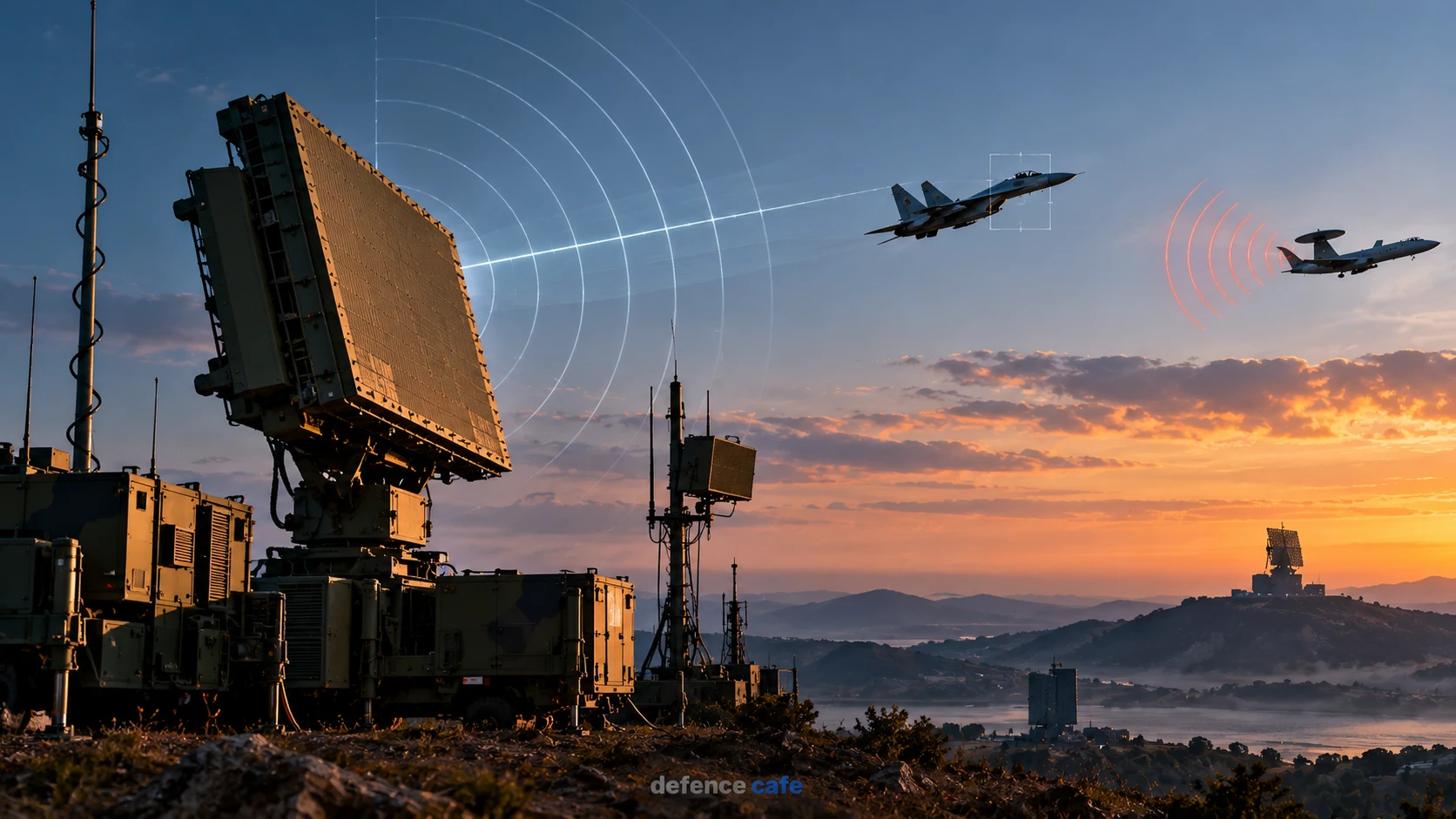
Modern military forces do not simply ask, “Can we see the enemy?” They have to answer several harder questions: what is out there, where is it, what is it doing, what kind of system is it, and how can friendly forces protect themselves while operating in the same electromagnetic environment?
That is where radar and electronic warfare (EW) come together.
Radar uses electromagnetic waves to detect and track objects. Electronic warfare deals with the electromagnetic spectrum itself — detecting emissions, identifying their sources, protecting friendly systems and, where authorised, disrupting or deceiving hostile systems. Modern forces increasingly combine both into a wider network of sensors, communications and decision-making systems.
India has developed capabilities in both areas through organisations such as DRDO, DARE, LRDE, DLRL and BEL. Systems including Uttam AESA, Arudhra, Ashwini, DR-118 and Shakti illustrate different parts of this technology ecosystem.
What Is Radar?
Radar is short for Radio Detection and Ranging. The basic idea is straightforward: a radar transmits electromagnetic energy, receives energy reflected from an object, and processes the returned signal to estimate information such as distance and direction.
The US Federal Aviation Administration’s radar reference explains the basic principle: range can be calculated from the time taken for a radio signal to travel to an object and return, while direction is derived from the radar beam’s orientation.
Military radar systems take that basic principle much further.
Detection Is Only the Beginning
A radar contact is not automatically a complete identification.
A modern radar may first detect energy consistent with a target. Signal processing can then help establish whether the contact is real, estimate its position and motion, and maintain a track as the target moves through successive observations.
Additional information from other sensors, identification systems and communications networks can then help determine what the contact actually is.
| Stage | What it means |
|---|---|
| Detection | A radar observes a return or signature that may correspond to an object. |
| Tracking | The system maintains a continuous estimate of the object’s position and movement. |
| Classification | Processing and other information are used to determine the likely type or category of the contact. |
| Identification | The system seeks to establish whether the contact is friendly, hostile or unknown using available identification mechanisms. |
How Does a Military Radar Actually Work?
At a simplified level, a radar system contains four essential functions:
- Transmit: send electromagnetic energy into a selected part of the environment.
- Receive: collect the small portion of energy returned from objects or other relevant signals.
- Process: separate useful information from noise, clutter and interference.
- Display and track: turn the processed information into contacts and tracks that an operator or combat system can use.
The physics become more complicated when the environment contains mountains, buildings, weather effects, sea clutter, multiple aircraft and hostile electronic interference. Radar engineering is therefore as much about signal processing as it is about transmitting power.
What Determines What Radar Can See?
Radar performance depends on much more than transmitter power.
Factors include antenna characteristics, frequency, waveform, processing quality, target size and aspect, atmospheric conditions, terrain, background clutter and the sophistication of the software processing the returned signal.
This is one reason it is misleading to treat a published “radar range” as a single universal number. Detection performance changes with the target and the operating conditions.
Mechanical Radar, PESA and AESA
Not all radars steer their energy in the same way.
Mechanically Scanned Radar
A mechanically scanned radar physically moves its antenna or reflector to change the direction of its beam.
The basic technology remains useful, but the physical movement introduces mechanical constraints on how rapidly the system can redirect or revisit different areas.
PESA: Passive Electronically Scanned Array
A Passive Electronically Scanned Array uses an electronically steered antenna array, but its architecture relies on a common transmitter feeding multiple elements.
Electronic steering removes the need to swing a large antenna mechanically for every beam movement.
AESA: Active Electronically Scanned Array
An Active Electronically Scanned Array uses many transmit/receive elements distributed across the antenna aperture.
Because the beam is electronically controlled, an AESA radar can move its attention rapidly without physically turning the entire antenna. Depending on its design and software, it can support multiple functions in quick succession, including search, tracking and other specialised modes.
That flexibility has made AESA technology important for modern fighter aircraft and advanced surveillance radars.
India’s DRDO describes Uttam as a multi-mode, solid-state active phased-array fire-control radar with scalable architecture that can be adapted for fighter-class aircraft. The system was also among the advanced technologies publicly displayed by DRDO in 2026.
DRDO’s April 2026 exhibition release lists Uttam AESA among the systems being showcased.
Why AESA Matters on Fighter Aircraft
A fighter radar does not simply need to find a large object directly ahead. It may have to manage multiple contacts, deal with clutter, change modes and continue tracking while the aircraft itself is moving rapidly.
AESA architecture can provide several advantages in this environment:
- Rapid beam steering: the radar can electronically redirect its energy.
- Multi-function operation: the same radar can support different modes without relying on a large mechanically moving antenna.
- Greater flexibility: software can play a major role in how the radar uses its hardware.
- Resilience: the distributed architecture can provide useful redundancy compared with a single large transmitting source, although exact resilience depends on the system design.
AESA should not, however, be treated as a magic word that automatically makes one radar superior in every situation. Performance depends on the entire radar — antenna, transmit/receive modules, processing, cooling, software, power supply and integration with the aircraft.
Indian AESA and Surveillance Radars
India’s radar development is broader than fighter aircraft.
Uttam AESA
Uttam is the best-known Indian fighter AESA programme. Developed by DRDO’s Electronics and Radar Development Establishment (LRDE), it is intended to provide a modern electronically scanned fire-control radar capability for fighter aircraft.
Its development is significant not simply because of the radar itself, but because fighter AESA technology requires expertise in radio-frequency electronics, antenna design, signal processing, embedded computing, thermal management, software and systems integration.
Arudhra Medium Power Radar
Arudhra is a larger ground-based radar rather than a fighter radar.
The Ministry of Defence describes Arudhra as a 4D multi-function phased-array radar using electronic steering in both azimuth and elevation for surveillance, detection and tracking of aerial targets. Its development was led by DRDO, with BEL as the manufacturing partner.
The Ministry of Defence’s Arudhra and DR-118 release provides the official programme description.
Ashwini Low-Level Transportable Radar
Ashwini is another indigenous ground-based radar developed by LRDE.
DRDO describes it as a rotating active phased-array multifunction 4D radar designed for automatic detection and tracking of aerial targets. Its architecture includes digital beamforming and electronic scanning in both azimuth and elevation.
The official DRDO Ashwini technology document provides the system’s development and architecture details.
The important point is that India is developing radar families for different environments rather than trying to solve every surveillance problem with a single type of sensor.
What Is Electronic Warfare?
Electronic warfare is the use of electromagnetic energy and related techniques to understand, protect or influence activity within the electromagnetic spectrum.
The NATO overview of electromagnetic warfare describes EW as including activities that exploit the electromagnetic environment for situational awareness and offensive or defensive effects.
A useful way to understand the discipline is through three broad functions:
| EW function | Plain-language explanation |
|---|---|
| Electronic Support | Find, intercept, identify and analyse electromagnetic emissions to build awareness of the environment. |
| Electronic Attack | Use electromagnetic effects to interfere with or degrade hostile systems. |
| Electronic Protection | Protect friendly equipment and communications from interference, deception or hostile electromagnetic effects. |
These categories are widely used in military doctrine, although specific terminology can vary between countries and organisations.
Electronic Support: Listening Without Broadcasting
One of the most important ideas in electronic warfare is that a system does not always need to transmit to learn something about its environment.
An electronic-support system can listen for electromagnetic emissions from radar, communications equipment and other emitters. The signal can then be processed to estimate properties such as its direction and characteristics.
This is why systems such as Radar Warning Receivers (RWRs) are important on combat aircraft.
What Does a Radar Warning Receiver Do?
A radar warning receiver is designed to detect electromagnetic emissions associated with radar systems and present a warning to the crew or wider defensive suite.
BEL describes its fighter-aircraft RWR architecture as a system that can intercept, detect and identify airborne and ground-based emitters and present threat information through cockpit displays and audio cues.
BEL’s Radar Warning Receiver reference provides the manufacturer’s description.
Earlier and continuing Indian development in this field includes the TARANG family and the DR-118 digital radar warning receiver.
DRDO’s DARE states that it has developed radar warning receivers, direction-finding systems and airborne jammers for a range of Indian Air Force aircraft.
DRDO’s DARE achievements page provides the official development history.
Electronic Intelligence and ESM
Electronic Support Measures (ESM) are broader than a simple warning light in a cockpit.
An ESM system can collect and analyse electromagnetic emissions in order to understand what is happening around a platform. Depending on the system, it may help with detection, direction finding, emitter identification and the development of a wider electronic picture.
India is also developing larger ground-based electronic-intelligence systems.
In May 2026, Bharat Electronics Limited announced a Ministry of Defence contract for a Ground Based Mobile ELINT System (GBMES) for the Indian Army. BEL describes the indigenous networked system as capable of detecting, classifying and locating radars and intercepting and analysing communication signals.
BEL’s May 2026 announcement on GBMES records the contract and system description.
Electronic Attack: What Does Jamming Mean?
Jamming is one of the best-known forms of electronic attack.
In simple terms, a jammer deliberately introduces electromagnetic energy that interferes with the ability of a hostile system to use its signals effectively.
Electronic attack does not necessarily mean “turning off” a radar. The effect can depend on the radar, the environment, the technique being used and the amount of information the defender has about the threat.
This is why modern EW systems increasingly rely on fast digital processing and detailed databases.
Jamming Versus Deception
Jamming and deception are related but not identical.
Jamming broadly seeks to reduce the usefulness of a hostile signal or system through interference.
Deception attempts to cause the hostile system to interpret information incorrectly.
The exact techniques and implementation details of operational EW systems are often classified, so public descriptions generally focus on system-level capabilities rather than mission-specific methods.
Electronic Protection: The Other Half of the Problem
If one side can interfere with the electromagnetic spectrum, the other side has to keep its own systems functioning in the same environment.
Electronic protection can include resilient communications, frequency management, emission control, signal processing techniques, hardware protection and other measures intended to preserve friendly capability.
Modern aircraft and ships therefore do not treat EW as an add-on. Radar, communications, self-protection systems and mission computers increasingly have to operate as one integrated architecture.
India’s Shakti Electronic Warfare System
One of India’s clearest examples of naval electronic warfare is Shakti.
DRDO’s Defence Electronics Research Laboratory developed Shakti for Indian Navy capital warships. Government descriptions say the system is designed to intercept, detect, classify and identify radar emissions and support electronic countermeasures.
The system combines electronic-support functions with countermeasure capabilities and is intended to improve the survivability of naval platforms operating in a contested electromagnetic environment.
In February 2024, the Ministry of Defence signed a contract with BEL for the procurement of 11 Shakti Electronic Warfare Systems and associated equipment for the Indian Navy under the Buy (Indian-IDDM) category.
The Ministry of Defence’s February 2024 release on Shakti provides the official procurement and system description.
Where the Su-30 MKI Fits Into India’s EW Story
The Su-30 MKI is a useful example of how radar and electronic warfare have to work together on a fighter.
A fighter may use its radar to search and track while its electronic-support sensors monitor the electromagnetic environment. If another radar illuminates or searches for the aircraft, the warning and electronic-support systems can provide information to the aircraft’s defensive architecture.
In 2024, the Defence Acquisition Council granted Acceptance of Necessity for an Electronic Warfare Suite for Su-30 MKI aircraft, including external airborne self-protection jammer pods, a next-generation radar warning receiver and associated equipment.
It is important to distinguish an Acceptance of Necessity from a completed contract or an operationally fielded system. An AoN is an acquisition milestone rather than proof that the complete capability is already deployed across the fleet.
The December 2024 Ministry of Defence release records the AoN for the Su-30 MKI EW suite.
Radar and EW Work Together
The most important concept is that radar and electronic warfare should not be thought of as completely separate systems.
A modern aircraft or warship may simultaneously:
- search the environment with active radar;
- listen for external radar emissions through electronic-support sensors;
- use infrared or electro-optical sensors to detect targets passively;
- receive information from other friendly aircraft, ships or ground systems;
- combine the information inside mission computers; and
- use defensive electronic or physical countermeasures when required.
This creates a much richer picture than any single sensor could provide.
Why Sensor Fusion Matters
Imagine an aircraft approaching an area where another radar may be operating.
The fighter’s own radar may search for contacts. At the same time, its electronic-support system may detect emissions from another radar without the fighter actively broadcasting. An infrared sensor could provide another source of information. A network connection could provide a track generated by another sensor hundreds of kilometres away.
None of those sources is necessarily perfect on its own.
The value comes from combining them intelligently.
How Militaries Counter Radar
Countering radar is not one single technology. It is a contest between detection, signature management, signal processing, electronic warfare and tactics.
Electronic Countermeasures
Jammers and other electronic countermeasures can attempt to reduce the effectiveness of hostile radar systems.
Decoys
Decoys can create additional signatures or otherwise complicate a hostile sensor’s picture. Aircraft and ships can carry different types of defensive countermeasure systems depending on their design and mission.
Low Observability
Stealth or low-observable design attempts to reduce the amount of energy reflected back toward a radar receiver. It does not mean an aircraft becomes literally invisible to every radar.
The practical objective is to make detection, classification, tracking or engagement more difficult under the relevant conditions.
Passive Sensing
Passive systems such as IRST and electronic-support sensors do not need to transmit radar energy in order to collect useful information.
This can complement active radar and create a more complicated detection problem for an adversary.
Radar Has Limitations Too
Radar is powerful, but it does not provide perfect visibility.
One major limitation is line of sight. The Earth’s curvature and terrain can hide low-flying objects from ground-based sensors. Buildings, mountains and other physical obstacles can create shadows.
Radar also has to deal with clutter: reflections from terrain, sea surfaces, weather and other objects that are not the intended target.
Electronic interference can further complicate the problem.
The result is that “radar coverage” should never be interpreted as an impenetrable dome in which every object is automatically visible.
Why Electronic Warfare Is Becoming More Important
Military forces increasingly depend on electromagnetic systems for radar, navigation, communications, identification, weapons, data links and command-and-control.
That means the electromagnetic spectrum has become a contested operational environment in its own right.
India’s technology programmes reflect that trend.
DRDO’s current electronic-warfare technology roadmap includes work in areas such as AI/ML for EW applications, wideband digital receivers, electronic-support systems, direction finding, smart jamming, threat-radar fingerprinting and signal processing.
The DRDO Electronic Warfare technology-foresight page lists these areas of research.
India has also been transferring EW technologies to industry. In October 2025, DRDO announced Licensing Agreements for Transfer of Technology covering systems including the D-29 Electronic Warfare Suite and technology associated with electronic-support systems.
The Ministry of Defence’s SAMANVAY 2025 release records those technology-transfer activities.
Artificial Intelligence and Cognitive Electronic Warfare
The next step is making EW systems better at dealing with complex and changing signal environments.
Traditional electronic-warfare systems relied heavily on known threat libraries. A known radar could be recognised from characteristics stored in a database and associated with a defined response.
Modern environments can be more complicated because emitters may change frequencies, waveforms or operating modes.
That is driving research into cognitive electronic warfare and AI-assisted signal processing.
India’s iDEX challenge framework describes cognitive EW as a system architecture involving antennas, receivers, processors and databases capable of intercepting, identifying, analysing and locating electromagnetic energy and using that information to support countermeasures.
The challenge is not simply adding AI to an EW system. It is building trustworthy processing that can operate quickly in an environment where false detections, unfamiliar emitters and rapidly changing signals can all matter.
Radar, EW and the Modern Battlespace
The old mental model of a radar operator looking at a screen and then pointing a weapon system at a target is incomplete for modern forces.
Today’s architecture is increasingly networked.
A ground radar may detect an aircraft. Another sensor may provide electronic intelligence. A fighter may contribute its own radar track. An airborne early-warning platform can supply another layer of information. Communications networks can distribute the resulting picture to other units.
At the same time, EW systems may be listening for hostile emitters and protecting friendly systems from interference.
The resulting architecture resembles a distributed sensor network rather than a single radar station.
India’s Emerging Radar and EW Ecosystem
India’s programmes show how wide the technology base has become.
| System / programme | Area | What it illustrates |
|---|---|---|
| Uttam | Fighter AESA radar | Indigenous active electronically scanned radar technology for fighter-class aircraft. |
| Arudhra | Ground-based radar | 4D multifunction phased-array surveillance and tracking. |
| Ashwini | Low-level transportable radar | Mobile active phased-array surveillance and tracking. |
| TARANG | Radar warning receiver | Detection and identification of radar emissions for aircraft protection. |
| DR-118 | Digital RWR | Indigenous radar-warning capability for fighter aircraft. |
| Shakti | Naval electronic warfare | Shipborne interception, identification and electronic countermeasure capability. |
| GBMES | Ground-based ELINT | Networked detection, classification and location of radar emitters and analysis of communication signals. |
These systems are not interchangeable. They solve different problems at different levels of the military sensor and information architecture.
Why Radar and EW Matter Beyond Fighters
Although fighter aircraft receive much of the public attention, radar and EW technologies matter across almost every military domain.
Air Defence
Ground radars build the air picture while electronic-support systems can add information about hostile emitters. Integrated command networks then help air-defence forces understand the environment.
Naval Warfare
Warships depend on radar for air and surface surveillance and on EW systems for awareness of the electromagnetic environment. India’s Shakti system is an example of this shipborne integration.
Army Operations
Ground formations use surveillance radars for air and battlefield awareness, while electronic-intelligence systems can monitor relevant electromagnetic activity.
Airborne Operations
Aircraft combine active sensors, passive sensors, communications and self-protection systems. The trend is toward greater integration rather than isolated sensor boxes.
What to Watch Next
Several trends are likely to shape radar and electronic warfare development in India over the coming years.
- More electronically scanned radars: AESA and related active-array architectures will continue expanding across aircraft and ground systems.
- More indigenous EW: systems such as RWRs, EW suites, naval EW and ELINT platforms are moving deeper into domestic design and manufacturing.
- AI-assisted processing: machine learning and faster signal processing will become increasingly relevant to threat recognition and spectrum management.
- Sensor fusion: radar, infrared, electronic support, communications and off-board sensors will increasingly contribute to common operational pictures.
- Industry participation: technology transfer from DRDO to companies such as BEL will remain important for taking laboratory-developed systems into production.
Frequently Asked Questions
What is the difference between radar and electronic warfare?
Radar primarily uses electromagnetic energy to detect and track objects. Electronic warfare is broader: it includes detecting and analysing electromagnetic emissions, protecting friendly systems and using electromagnetic effects to disrupt or deceive hostile systems.
What does AESA stand for?
AESA stands for Active Electronically Scanned Array. It uses multiple transmit/receive elements and electronic beam steering rather than relying on a mechanically moved antenna to point the radar beam.
What is a radar warning receiver?
A Radar Warning Receiver, or RWR, detects and analyses radar emissions and provides warning information to a platform or crew. It is an important component of aircraft self-protection and electronic support.
What is ESM in electronic warfare?
Electronic Support Measures, or ESM, involve collecting and analysing electromagnetic emissions to help detect, locate and understand emitters in the surrounding environment.
What is jamming?
Jamming is an electronic-attack technique that introduces electromagnetic interference intended to reduce the effectiveness of a hostile electronic system.
Does stealth make an aircraft invisible to radar?
No. Low-observable design attempts to reduce radar detectability or make tracking more difficult under particular conditions. It does not make an aircraft universally invisible to every radar.
What is India’s Uttam radar?
Uttam is an indigenous active electronically scanned array radar developed by DRDO’s LRDE for fighter-class aircraft.
What is India’s Shakti EW system?
Shakti is an indigenous electronic warfare system developed by DRDO for Indian Navy capital warships. Government descriptions say it provides capabilities including interception, detection, classification and identification of radar emissions together with electronic countermeasures.
Conclusion
Radar and electronic warfare are two sides of the modern electromagnetic battlespace.
Radar provides an active way to search and track. Electronic-support systems listen for emitters. Electronic attack attempts to interfere with hostile systems. Electronic protection keeps friendly networks and sensors functioning. Sensor fusion then brings these streams together into a more useful picture.
For India, the significance goes beyond any individual radar or EW suite. Programmes such as Uttam, Arudhra, Ashwini, DR-118, Shakti and GBMES demonstrate an expanding domestic ecosystem spanning antennas, radio-frequency electronics, digital processing, software, signal intelligence and electronic warfare.
The future of military sensing will therefore depend less on one extraordinary sensor and more on how quickly and reliably many different sensors can work together in a contested electromagnetic environment.
Sources & Further Reading
- US Federal Aviation Administration — Surveillance Systems: Radar
- NATO — Electromagnetic Warfare
- Ministry of Defence / PIB — Arudhra Medium Power Radar and DR-118 Radar Warning Receiver
- DRDO — Low Level Transportable Radar (LLTR) Ashwini
- Ministry of Defence / PIB — DRDO technology showcase, including Uttam AESA Radar, 2026
- DRDO — DARE Achievements: Radar Warning Receivers and Electronic Warfare Systems
- Bharat Electronics Limited — Radar Warning Receiver for Fighter Aircraft
- Ministry of Defence / PIB — Procurement of 11 Shakti Electronic Warfare Systems for the Indian Navy
- Ministry of Defence / PIB — Acceptance of Necessity for Electronic Warfare Suite for Su-30 MKI
- Bharat Electronics Limited — Ground Based Mobile ELINT System, May 2026
- DRDO — Electronic Warfare Technology Foresight
- iDEX — Cognitive Electronic Warfare System Challenge
- Ministry of Defence / PIB — DRDO Technology Transfer under SAMANVAY 2025
