


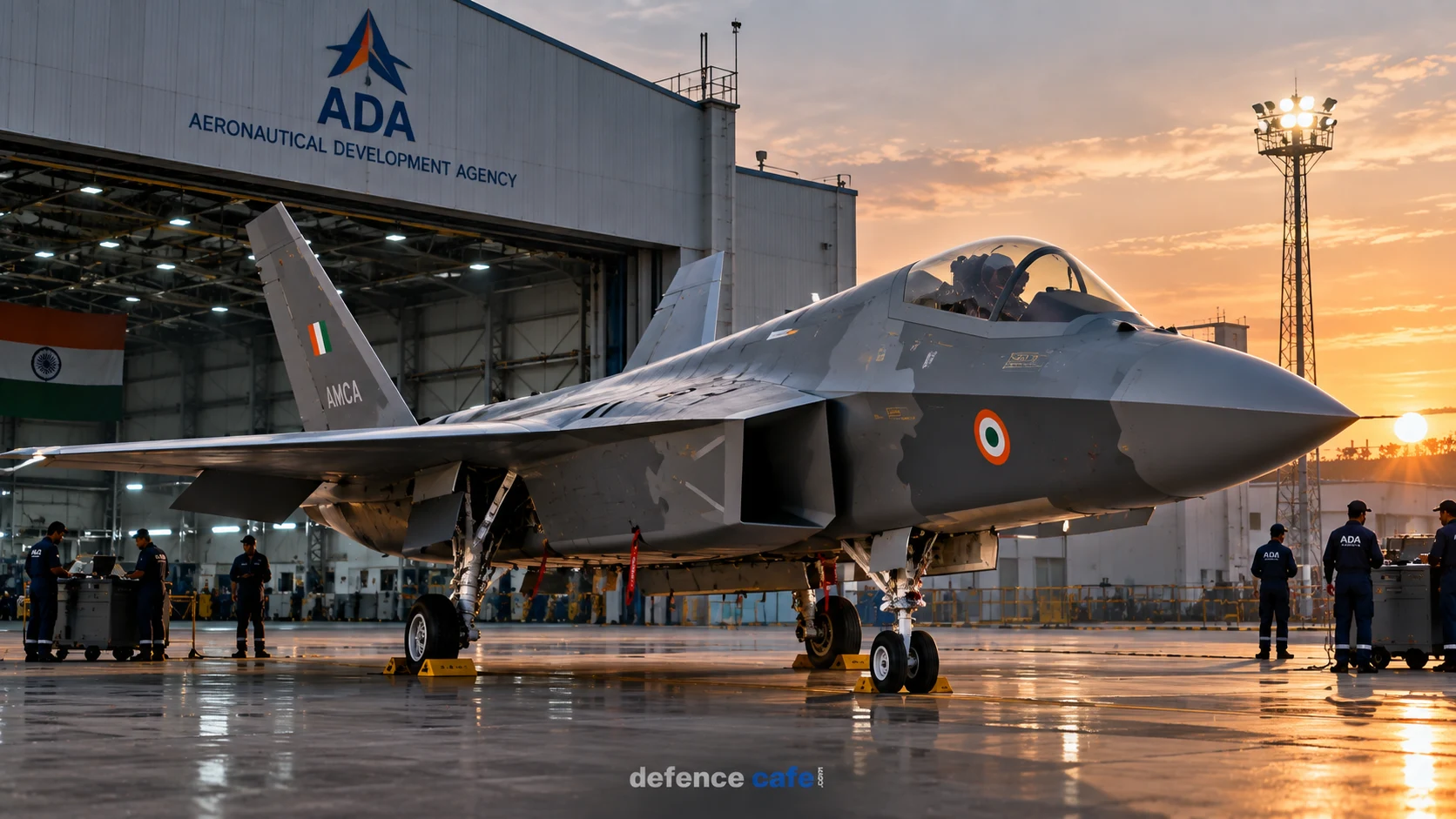
The Advanced Medium Combat Aircraft (AMCA) is India’s planned indigenous fifth-generation fighter for the Indian Air Force. Designed as a twin-engine, multi-role combat aircraft with low-observable features, internal weapon carriage and advanced avionics, the programme is intended to take Indian fighter design into a much more demanding technological category.
AMCA is no longer only a concept on a display model. Its prototype-development programme was sanctioned in 2024, the government changed the execution model in 2025 to bring Indian industry into the development phase through competition, and the Ministry of Defence issued the prototype-development RFP in May 2026.
As of 30 September 2026, the programme is still in the development and industry-selection stage. Three Indian industry teams have been shortlisted for the development competition, while a dedicated Aircraft Integration and Flight Testing Centre is being developed at Puttaparthi in Andhra Pradesh.
What Is the AMCA Fighter Jet?
AMCA stands for Advanced Medium Combat Aircraft. It is an Indian programme to develop a modern, twin-engine, medium-weight, multi-role fighter aircraft with fifth-generation characteristics.
The programme is being designed by the Aeronautical Development Agency (ADA), an organisation under the Defence Research and Development Organisation (DRDO). The wider AMCA effort covers much more than airframe design: propulsion, avionics, sensors, electronic warfare, weapons integration, flight testing, manufacturing and certification all have to come together before the aircraft can enter operational service.
The Ministry of Defence approved the AMCA Programme Execution Model in May 2025. Under that model, ADA would execute the programme through competitive participation by Indian industry. Companies could bid independently, as joint ventures or as consortia, provided the bidder was an Indian company compliant with Indian law.
The Ministry of Defence’s May 2025 announcement on the AMCA execution model marked a significant change in how the country’s major fighter-development programmes could be industrially structured.
Why Does India Need a Fifth-Generation Fighter?
Fourth-generation fighters can be highly capable, but the air-combat environment is changing. Modern air forces increasingly depend on low observability, long-range sensors, electronic warfare, networked operations and the ability to detect and engage targets while reducing their own exposure.
A fifth-generation fighter attempts to combine these capabilities into one aircraft architecture.
There is no single universally enforced checklist that makes an aircraft “fifth generation”. In general, the term is associated with several technologies working together:
| Capability | Why it matters |
|---|---|
| Low observability | Reduces the aircraft’s detectability by hostile sensors across relevant parts of the electromagnetic spectrum. |
| Internal weapons carriage | Allows weapons to be carried inside the airframe when maintaining a low-observable configuration is important. |
| Advanced sensors | Combines radar, infrared and other sensors to improve awareness of the battlespace. |
| Sensor fusion | Combines information from multiple sensors and sources into a more useful picture for the pilot. |
| Network connectivity | Allows the aircraft to share and receive information from other aircraft, ground systems and force elements. |
| Advanced avionics | Supports navigation, mission management, electronic warfare, targeting and flight operations. |
AMCA is being designed around this broader systems approach rather than simply being a new fighter with a more powerful engine.
Who Is Developing the AMCA?
Aeronautical Development Agency
The ADA is the design and development authority at the centre of the AMCA programme. It operates under DRDO and has longstanding experience in India’s indigenous combat-aircraft development ecosystem.
Its role extends into aircraft design, systems integration and the development programme itself.
Defence Cafe has also covered the wider work of DRDO defence-development programmes, which provides useful context for understanding how large Indian military technology programmes are structured.
Indian Industry
In 2025, the government moved away from an execution structure in which a major fighter programme would automatically centre on one public-sector production agency. The new AMCA model opens prototype development to competition between Indian companies and consortia.
In May 2026, the Ministry of Defence issued the RFP to three shortlisted bidders.
| Shortlisted bidder / team | Structure |
|---|---|
| Tata Advanced Systems Limited | Standalone Indian private-sector bidder. |
| Larsen & Toubro-led team | L&T with Bharat Electronics Limited and Dynamatic Technologies. |
| Bharat Forge-led team | Bharat Forge with BEML and Data Patterns. |
The Indian Express report on the May 2026 RFP and Business Standard’s coverage of the tender identify the three shortlisted teams and describe the prototype-development competition.
What Happened to HAL in the AMCA Programme?
Hindustan Aeronautics Limited (HAL) has played a major role in India’s fighter-aircraft production ecosystem, including the Tejas programme. But the 2026 AMCA prototype-development competition was structured differently.
HAL was not among the three shortlisted bidders for the initial development competition. That does not mean HAL has disappeared from the wider AMCA industrial ecosystem. Public reporting has indicated that HAL could still participate in future production or licensed manufacturing arrangements.
The significance of the new model is therefore less about replacing one company with another and more about creating an additional Indian industrial pathway for advanced fighter development and manufacturing.
AMCA Design and Stealth Features
The AMCA’s most important difference from conventional Indian fighters is its emphasis on low observability.
Stealth is not the same thing as invisibility. A stealth aircraft can still be detected under the right conditions. Its purpose is to reduce the distance and circumstances at which hostile sensors can reliably detect, track and identify it.
The aircraft’s design therefore has to manage radar reflection, infrared signatures, external stores and other observable characteristics.
One of the most visible features of the AMCA concept is its internal weapons bay. Carrying weapons inside the fuselage avoids the external protrusions created by conventional underwing weapon carriage and helps preserve the aircraft’s low-observable configuration.
Publicly described AMCA design parameters have also included an internally carried fuel load and a substantial internal weapons capability. These figures have appeared in programme reporting and design discussions, but they should not be confused with certified operational specifications before the final prototype configuration is frozen.
AMCA Sensors and Avionics
A stealthy airframe is only one part of a fifth-generation fighter.
AMCA is intended to use a sophisticated sensor and mission-system architecture so that the pilot is not forced to treat radar, infrared, electronic-warfare and external information as completely separate streams.
AESA Radar
Active Electronically Scanned Array, or AESA, radar uses electronically steered beams rather than physically moving the entire antenna to point in different directions.
This can support rapid scanning, multi-target tracking and flexible use of the radar for different missions.
The AMCA programme has long been associated with an indigenous advanced AESA radar and a wider sensor suite, although the exact production configuration remains a development matter.
Infrared Search and Track
An IRST system detects the heat and infrared signature of objects rather than depending solely on radar emissions.
This is useful because relying on multiple sensing methods can improve situational awareness in environments where radar use may be constrained or where an operator wants another source of information.
Electronic Warfare
Electronic warfare systems are expected to help the aircraft detect, classify and respond to activity in the electromagnetic spectrum.
For a modern fighter, electronic warfare is not simply a defensive add-on. It is part of the aircraft’s broader ability to understand the environment, protect itself and support mission execution.
AMCA and Internal Weapons
The aircraft is intended to operate in more than one configuration.
In a low-observable configuration, the emphasis is on keeping weapons inside the aircraft wherever possible. This preserves the aerodynamic and signature advantages of the stealth design.
In situations where stealth is less important than maximum payload, external weapon stations can be used. That gives the aircraft more flexibility, because a fighter does not need to fly every mission in the same configuration.
The concept is therefore similar to a trade-off:
| Configuration | Main priority |
|---|---|
| Low-observable configuration | Reduced signature and internal carriage. |
| External-load configuration | Greater flexibility in overall external weapon carriage when signature reduction is less critical. |
This flexibility is important because fifth-generation fighters are not designed to perform only one mission.
AMCA Engine: Why Propulsion Is One of the Biggest Challenges
One of the hardest technologies in advanced fighter development is not the airframe. It is the engine.
India has been developing indigenous gas-turbine technology for decades, but producing a modern high-thrust fighter engine remains a major engineering challenge.
AMCA Mk1 and the GE F414
Current programme reporting associates the initial AMCA variants with the GE F414 family. The engine is in the roughly 90-kilonewton thrust class and is already associated with India’s future Tejas Mk2 programme.
Using an existing foreign engine for the initial variant reduces some development risk compared with waiting for a completely new domestic engine before the aircraft can enter flight testing.
As of 2026, however, engine arrangements remain a major programme issue involving technology transfer, licensed production and the longer-term transition to an Indian high-thrust powerplant.
Business Standard’s June 2026 report on the F414 described the initial AMCA variants as planned around the GE F414 while noting that a more powerful indigenous engine is intended for later variants.
AMCA Mk2 and the Indigenous Engine Ambition
The longer-term objective is a higher-thrust indigenous engine for the later AMCA configuration.
Public reporting has generally placed that future engine in the 110–120 kN-plus class, although the final architecture, industrial arrangement and development timeline remain matters for the programme.
In August 2026, Reliance Industries and Rolls-Royce announced a strategic intent to work together on an indigenous combat engine proposition for the AMCA programme.
The Rolls-Royce announcement described plans to explore a dedicated aerospace gas-turbine complex in India. This is a proposed partnership, not evidence that the final AMCA engine has already been selected.
Other international engine companies, including Safran, have also been publicly associated with discussions around a future Indian high-thrust combat engine.
How AMCA Is Being Tested
Building the first prototype is only the beginning.
A fighter aircraft has to pass structural testing, ground tests, taxi trials, flight testing, systems integration, weapon integration and certification before operational induction.
The 2026 RFP calls for five flying prototypes and a structural test specimen. Multiple prototypes allow different parts of the development programme to proceed in parallel, including flight-envelope expansion, avionics testing and weapons or systems trials.
This is why a prototype programme cannot be judged simply by the date on which an aircraft first leaves a hangar.
Puttaparthi Aircraft Integration and Flight Testing Centre
A dedicated Aircraft Integration and Flight Testing Centre is being developed at Puttaparthi in Andhra Pradesh to support AMCA and future indigenous aircraft programmes.
The Ministry of Defence laid the foundation stone for the facility in May 2026. The government said the centre itself would cost approximately ₹2,000 crore, while the overall AMCA programme has an outlay of around ₹15,000 crore.
The Ministry of Defence release on the Puttaparthi facility describes the centre as a vital component for aircraft integration, testing, validation and certification.
AMCA Development Timeline
The AMCA programme has existed in various forms for many years, so the easiest way to understand its progress is through major programme milestones rather than relying on one old first-flight estimate.
| Year | Milestone |
|---|---|
| 2000s–2010s | India developed and refined the concept of an indigenous medium-weight fifth-generation fighter. |
| 2023 | Detailed design work and industry-participation planning had advanced significantly. |
| 2024 | The AMCA prototype-development programme received government approval. |
| May 2025 | The Defence Ministry approved a competitive industry-partnership execution model. |
| May 2026 | The Ministry of Defence issued the RFP to three shortlisted Indian bidders. |
| May 2026 | Foundation stone laid for the Puttaparthi Aircraft Integration and Flight Testing Centre. |
| September 2026 | The AMCA industry-partner selection process remains underway. |
The timeline is worth reading carefully because older AMCA projections have repeatedly moved as the programme’s design, sanctioning and industrial structure evolved. Future dates should therefore be treated as programme targets rather than guaranteed milestones.
Where Does the AMCA Programme Stand in 2026?
As of late September 2026, India has not yet publicly finalised the company that will become the AMCA development partner.
The current RFP process remains active. The latest public tender records show the bid submission deadline has been extended into October 2026, with bid opening scheduled after the submission deadline.
A current public tender record lists 30 October 2026 as the bid-submission deadline and 31 October 2026 as the opening date. The official Ministry of Defence eProcurement system also records the AMCA development tender and subsequent corrigenda.
Because this process is still live at the time of publication, the eventual development partner should not be stated until the government formally announces the result.
The Ministry of Defence eProcurement system is the relevant government procurement portal. Current public tender records also track the latest extended closing date for the AMCA development tender.
What Will Make AMCA Different From Tejas?
The AMCA and Tejas programmes belong to different weight and technology categories.
| Feature | Tejas Mk1/Mk1A | AMCA |
|---|---|---|
| Engine configuration | Single engine | Twin engine |
| Design generation | Fourth-generation / advanced fourth-generation family | Planned fifth-generation fighter |
| Primary design emphasis | Lightweight multi-role fighter capability | Low observability, sensor fusion and high-end multi-role capability |
| Weapons carriage | Primarily external stations | Internal bay plus external carriage when required |
| Development objective | Expand India’s indigenous light-fighter ecosystem | Develop an indigenous high-end stealth fighter ecosystem |
The distinction is important because AMCA is not simply a larger Tejas. It represents a much more demanding class of aircraft, particularly in stealth, systems integration, propulsion and manufacturing complexity.
AMCA and the Indian Air Force
The AMCA is being developed for the Indian Air Force, where it is intended to add a future indigenous fifth-generation capability to the fighter fleet.
Its value would not come only from the aircraft’s own weapons or manoeuvrability. A stealth fighter can contribute to a wider air campaign by operating with other fighters, airborne surveillance assets, ground-based systems and networked sensors.
That makes AMCA part of a larger shift in Indian combat aviation — from individual platforms toward connected air operations.
Complementing Existing Fighters
India is simultaneously operating and developing several fighter families, including the Su-30MKI, Rafale and Tejas variants. The AMCA is intended to add a different capability rather than make every other fighter obsolete.
A practical air force requires a mix of aircraft because different platforms offer different combinations of cost, range, payload, availability, sensors and mission suitability.
Why AMCA Matters Beyond One Fighter
The AMCA programme is also an industrial project.
Designing and manufacturing a fifth-generation fighter requires capabilities in advanced composites, flight-control computers, sensors, electronic warfare, precision manufacturing, software, materials, testing and propulsion.
A successful programme could therefore create knowledge and industrial capacity that extends beyond AMCA itself.
The 2025 industry-partnership model and the 2026 prototype competition are especially significant because they bring multiple Indian companies into direct competition for a major high-technology aerospace programme.
What to Watch Next
The next AMCA milestones are likely to come from the programme’s industrial and engineering process rather than from an operational squadron.
- Industry partner selection: the conclusion of the current competitive prototype-development process.
- Prototype manufacturing: tooling, structures, composite work, systems integration and assembly after the development contract is awarded.
- Flight-test infrastructure: continued development of the Puttaparthi integration and flight-testing ecosystem.
- Propulsion: progress on the initial engine arrangement and the longer-term indigenous high-thrust fighter-engine pathway.
- Systems integration: maturation of radar, electronic warfare, communications, mission computers and other advanced avionics.
The timing of later milestones will depend on engineering progress, contract execution, testing and certification. For that reason, future prototype-flight and induction dates should be treated as programme targets until formally confirmed.
Frequently Asked Questions
What is AMCA?
AMCA, or Advanced Medium Combat Aircraft, is India’s programme to develop a twin-engine, multi-role fifth-generation fighter aircraft for the Indian Air Force.
Who is developing the AMCA?
The programme is being led by the Aeronautical Development Agency under DRDO, with Indian industry being brought into prototype development and future production through a competitive partnership model.
Is AMCA a fifth-generation fighter?
Yes. The Government of India and DRDO describe AMCA as a fifth-generation fighter programme. Its planned characteristics include low observability, internal weapon carriage, advanced sensors and sophisticated avionics.
How many AMCA prototypes will be built?
The 2026 development RFP calls for five flying prototypes and one structural test specimen.
Which engine will power the AMCA?
The initial AMCA variants are associated with the GE F414 family, while later variants are intended to use a more powerful indigenous engine developed through Indian and international collaboration. The final long-term propulsion arrangement remains under development.
Will AMCA replace Tejas?
No. AMCA and Tejas occupy different capability classes. Tejas is a single-engine light fighter family, while AMCA is being developed as a twin-engine fifth-generation aircraft.
When will AMCA enter the Indian Air Force?
AMCA is still in development, so an operational induction date should not be treated as fixed. Public programme planning has generally placed production and induction in the mid-2030s, but the schedule depends on the outcome of development, flight testing and certification.
Is AMCA being built only by HAL?
No. The 2026 prototype-development competition involves three shortlisted Indian industry teams, while ADA retains the programme’s development and design authority. HAL was not shortlisted in the initial prototype-development competition.
Conclusion
The AMCA fighter jet represents India’s attempt to move from developing capable fourth-generation combat aircraft to building a much more complex fifth-generation combat system.
Its importance lies in several technologies working together: low observability, internal weapon carriage, advanced sensors, electronic warfare, network connectivity, sophisticated avionics and eventually a stronger indigenous engine.
But the aircraft itself is only one part of the story. The real test will involve turning an advanced design into a repeatable industrial capability — with the engineering, testing, certification, supply chain and propulsion ecosystem needed to support it over decades.
As of September 2026, AMCA has crossed important administrative and industrial milestones, but it remains a programme under development. The next major step is the conclusion of the industry-partner process and the transition from programme planning to prototype construction and flight testing.
Sources & Further Reading
- Ministry of Defence / PIB — AMCA Programme Execution Model Through Industry Partnership, 27 May 2025
- Ministry of Defence / PIB — Foundation Stone for AMCA Core Integration & Flight Testing Centre, 15 May 2026
- Ministry of Defence — eProcurement System for Organisations under MoD
- The Indian Express — Defence Ministry Issues AMCA RFP to Three Shortlisted Industry Bidders, May 2026
- Business Standard — Government Issues RFP for Fifth-Generation AMCA Jet Programme, May 2026
- Business Standard — AMCA F414 Engine and Future Indigenous Powerplant, June 2026
- Rolls-Royce — Reliance Industries and Rolls-Royce Strategic Intent for an Indigenous AMCA Combat Engine, August 2026
- The Times of India — AMCA Industry-Partner Selection Status, September 2026
