


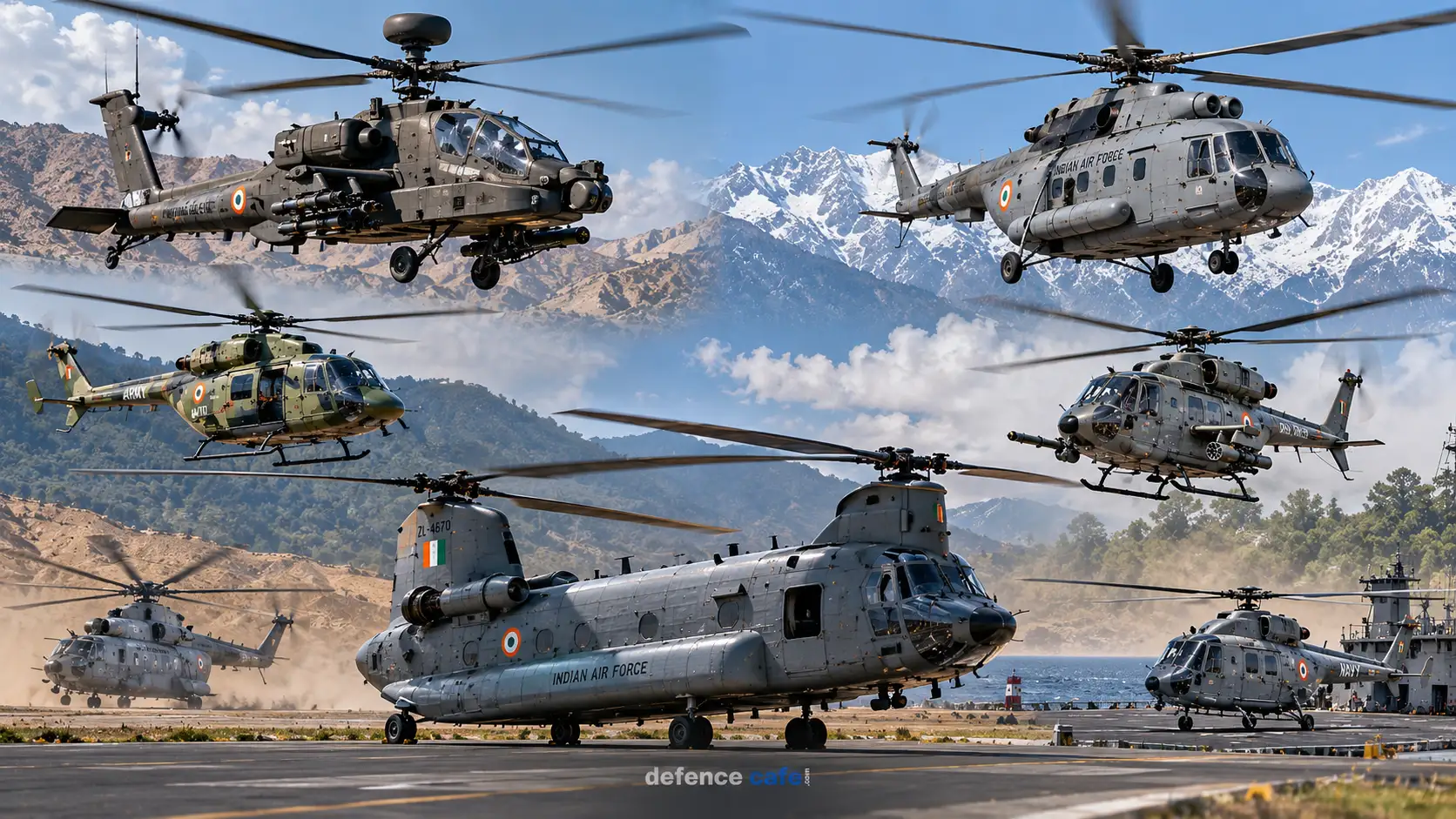
Helicopters occupy a unique place in India’s military because they can do something fixed-wing aircraft generally cannot: operate close to the ground, land in confined areas and move people, weapons and supplies without a conventional runway.
That makes military helicopters useful across a remarkably wide range of missions. The Indian Army uses aviation assets to support ground forces, reconnaissance and battlefield mobility. The Indian Air Force operates attack, medium-lift and specialised helicopters for air-land operations, logistics, rescue and other missions. The Indian Navy uses helicopters to extend the reach of ships, particularly for surveillance, anti-submarine warfare, search and rescue and other maritime tasks.
India’s helicopter fleet is also changing. The indigenous Light Combat Helicopter (LCH) Prachand has entered service, the ALH Dhruv and its armed Rudra variant provide a domestic multi-role family, the Mi-17 V5 remains an important medium-lift platform, and the CH-47F Chinook provides heavy-lift capability. The Navy has added the MH-60R Seahawk to its shipborne aviation arm, while HAL continues development of the Light Utility Helicopter and Indian Multi-Role Helicopter.
What Are the Main Types of Military Helicopters?
The simplest way to understand India’s helicopter fleet is to classify helicopters by mission rather than by manufacturer.
| Type | Primary role | Representative Indian platforms |
|---|---|---|
| Attack helicopter | Armed support, anti-armour missions, battlefield attack and protection of ground forces. | LCH Prachand, AH-64E Apache, ALH Rudra |
| Utility helicopter | Troop movement, reconnaissance, casualty evacuation, liaison, logistics and general-purpose missions. | ALH Dhruv, LUH, Chetak, Cheetah family |
| Medium-lift helicopter | Movement of larger numbers of personnel, supplies and equipment over longer distances. | Mi-17 V5 |
| Heavy-lift helicopter | Transport of heavy equipment and outsized loads, particularly where road or ground access is difficult. | CH-47F Chinook |
| Naval multi-role helicopter | Anti-submarine warfare, anti-surface warfare, search and rescue, surveillance and ship support. | MH-60R Seahawk, ALH Mk III and other naval helicopters |
The categories overlap. A helicopter developed primarily for utility missions can receive weapons or specialised sensors, while a naval helicopter may perform both combat and humanitarian missions. HAL’s helicopter division itself describes the Dhruv, Rudra, LCH, LUH, Cheetah, Chetak and related helicopters as serving different operational requirements.
Attack Helicopters: Built to Fight Alongside Ground Forces
Attack helicopters are designed around a fundamentally different mission from troop transport. Their emphasis is on weapons, sensors, survivability and the ability to operate close to the battlefield.
India’s attack-helicopter capability combines indigenous systems with the AH-64E Apache. The most important indigenous development is the HAL LCH Prachand.
LCH Prachand
The Light Combat Helicopter, officially named Prachand, is India’s indigenous dedicated combat helicopter. HAL describes it as a 5.8-ton-class combat helicopter designed for anti-infantry and anti-armour missions and for operation in high-altitude environments.
The LCH has particular relevance for India because helicopter operations in mountainous areas impose unusual demands. Low temperatures, thin air, restricted landing areas and difficult terrain all affect lift, payload and aircraft performance.
The Ministry of Defence describes Prachand as India’s first indigenously designed and developed combat helicopter and says it is capable of operating at altitudes above 5,000 metres. The government has also highlighted its suitability for high-altitude operations.
In March 2025, the Ministry of Defence signed two contracts with HAL for 156 LCH Prachand helicopters: 66 for the Indian Air Force and 90 for the Indian Army. The government said deliveries would begin from the third year and continue over five years. It also stated that the programme was planned to achieve more than 65% indigenous content during execution and involve more than 250 domestic companies, mostly MSMEs.
The Ministry of Defence announcement on the 156 LCH contract provides the procurement and indigenous-content details.
How Prachand Fits Into Army Aviation
The LCH is not simply another aircraft in the inventory. Its value comes from being able to provide armed aviation support where conventional fixed-wing aircraft or heavier helicopters may face limitations.
In February 2026, President Droupadi Murmu undertook a sortie in a two-aircraft formation of LCH Prachand at Air Force Station Jaisalmer. The aircraft also demonstrated an attack against a simulated tank target during the mission.
The President’s Secretariat release on the February 2026 LCH sortie records the event and confirms the aircraft’s operational presence in the Indian Air Force.
AH-64E Apache
The AH-64E Apache is a dedicated attack and reconnaissance helicopter developed by Boeing. India inducted the Apache into the Indian Air Force beginning in 2019, under a government-to-government and Boeing procurement programme.
The IAF’s original contract covered 22 Apache helicopters. The aircraft brings a combination of sensors, weapons, target acquisition systems and networked battlefield information to helicopter operations.
Apache also became part of the Indian Army’s aviation ecosystem. A government release on the 2026 Republic Day parade described Army aerial support involving both Apache AH-64E and Prachand, alongside the indigenous Dhruv and armed Rudra.
The Ministry of Defence’s 2026 Republic Day release documents the Army’s display of these helicopter types.
Rudra: The Armed Dhruv
The Rudra is the Weapon System Integrated version of the HAL Advanced Light Helicopter, commonly known as Dhruv.
This distinction is important. Rudra is not a completely separate helicopter family from Dhruv; it is an armed missionised version of the indigenous ALH platform.
HAL lists both Dhruv and Rudra within its military helicopter product family, while government material has also identified Army Aviation units operating ALH-WSI aircraft.
This approach gives India a domestic helicopter family that can be adapted into different operational configurations rather than developing an entirely separate airframe for every mission.
Utility Helicopters: The Workhorses of Military Aviation
Utility helicopters are perhaps the least glamorous category, but they are among the most frequently used military aviation platforms.
They carry troops, commanders, medical teams, supplies and specialist personnel. They can conduct reconnaissance, casualty evacuation, liaison flights and disaster-relief missions. In mountainous regions, their ability to reach isolated positions can be strategically important.
ALH Dhruv
The Advanced Light Helicopter Dhruv is India’s most important indigenous multi-role helicopter family.
HAL’s Helicopter Division describes the Dhruv as part of its current production portfolio alongside Rudra, LCH and LUH. The platform has been developed in multiple configurations for India’s armed forces and other government operators.
The Dhruv’s importance extends beyond the helicopter itself. It established an Indian design, manufacturing and support ecosystem around a common rotary-wing platform.
The HAL Helicopter Division overview provides the official list of helicopter families and explains the role of the Dhruv, Rudra, LCH and LUH programmes.
Light Utility Helicopter
The Light Utility Helicopter (LUH) is intended to fill the light end of the military helicopter spectrum.
It is a three-ton-class single-engine helicopter designed and developed by HAL for operating conditions specific to India. Government certification material says the LUH was conceived as a replacement for the ageing Cheetah and Chetak fleets and is designed for utility, observation and reconnaissance roles.
The importance of the LUH is therefore less about raw payload and more about replacing ageing light helicopters with a modern indigenous platform.
The Ministry of Defence’s LUH certification release describes the aircraft’s class, development and intended replacement role.
Cheetah and Chetak
The Cheetah and Chetak represent an older generation of light utility helicopters that has served Indian military and government organisations for decades.
Their importance is especially visible in difficult terrain, where smaller helicopters can access locations unavailable to larger aircraft.
Government documents have repeatedly identified the Cheetah and Chetak fleets as platforms requiring eventual replacement, with the LUH forming part of that modernisation effort.
Their continued utility also illustrates why replacing a helicopter fleet is not simply a matter of ordering a newer aircraft. Training, spares, maintenance infrastructure, pilot conversion and operational availability all have to transition together.
Medium Transport Helicopters: Mi-17 V5
If light utility helicopters handle smaller missions, the Mi-17 V5 occupies a much larger transport category.
The IAF describes the Mi-17 V5 as a modernised member of the Mi-17 medium-lift family. Government material notes its payload-carrying capability, glass cockpit, navigation systems and ability to operate day and night.
In operational terms, the Mi-17 V5 is useful because it can move larger personnel and logistics loads than a light utility helicopter while retaining the ability to operate from relatively austere locations.
Its utility extends beyond combat. In 2026, IAF Mi-17 V5 helicopters were used in aerial firefighting operations in Himachal Pradesh, demonstrating how the same medium-lift platform can be employed in humanitarian and civil-support missions.
The May 2026 Ministry of Defence release records the use of Mi-17 V5 helicopters in the Kasauli firefighting operation.
Heavy Lift: Why the Chinook Matters
The CH-47F Chinook belongs to a completely different class of helicopter.
Its defining characteristic is heavy lifting. Tandem rotors allow the Chinook to carry large loads internally and externally, making it particularly useful for moving equipment into areas where conventional road transport is slow, difficult or impossible.
For India, this capability has special relevance in high-altitude and mountainous regions. The helicopter can support the movement of artillery, engineering equipment, supplies and personnel without depending entirely on road infrastructure.
Government material identifies the Chinook as part of India’s heavy-lift helicopter capability. Its utility was also demonstrated during disaster-relief operations, where Chinook helicopters have been used alongside Mi-17 platforms.
A 2025 IAF flood-relief operation in northern Punjab and Jammu involved both Mi-17 and Chinook helicopters in rescue and evacuation missions.
The Ministry of Defence’s 2025 flood-relief release records their use in the operation.
Indian Naval Helicopters
Naval helicopters face a different operating environment from land-based Army and Air Force helicopters.
A shipborne helicopter has to operate from a moving deck, tolerate maritime weather, handle salt-water exposure and support a fleet whose operating area may be hundreds of kilometres from land.
That is why naval helicopters often carry specialised sensors that have little to do with troop transport.
MH-60R Seahawk
The MH-60R Seahawk is the Indian Navy’s modern multi-role shipborne helicopter designed for missions including anti-submarine warfare, anti-surface warfare, search and rescue, medical evacuation and vertical replenishment.
The Navy commissioned its first MH-60R squadron, INAS 334 Seahawks, at INS Garuda, Kochi, in March 2024. Its second squadron, INAS 335 Ospreys, was commissioned at INS Hansa, Goa, in December 2025.
The Navy’s original programme involved 24 helicopters. By the end of 2024, official government material stated that the first nine had been operationalised onboard fleet ships.
The Ministry of Defence release on INAS 335 records the commissioning of the second MH-60R squadron, while the 2024 MH-60R induction release explains the helicopter’s intended naval missions.
ALH Mk III in Maritime Operations
The indigenous ALH Mk III also has a maritime role.
Government material describes the naval version as equipped with maritime surveillance radar and electro-optical systems and capable of performing surveillance, armed patrol, casualty evacuation and search-and-rescue missions.
The broader ALH family therefore demonstrates another important principle in helicopter design: a common basic airframe can be adapted for different services and operating environments.
In March 2026, the Ministry of Defence signed a contract with HAL for six ALH Mk III (Maritime Role) helicopters for the Indian Coast Guard. The government described these as twin-engine helicopters capable of maritime-security missions from shore-based airfields and ships.
The March 2026 Ministry of Defence release provides the latest official information on the maritime-role ALH Mk III contract.
How Helicopters Support India’s Army
For the Indian Army, aviation is closely connected to ground manoeuvre.
A helicopter can move troops around terrain that would slow a ground convoy. It can insert or extract specialised teams, conduct reconnaissance and observation, evacuate casualties and provide armed support.
The Army Aviation Corps therefore operates more than one helicopter category. Government records identify Army Aviation units operating utility helicopters, reconnaissance and observation helicopters and ALH-WSI variants.
The Army’s 2026 Republic Day display also brought together Dhruv, Rudra, Apache and Prachand, illustrating how indigenous and imported helicopter families now coexist in the Army’s aviation architecture.
High-Altitude Helicopter Operations
High altitude is one of the defining challenges of Indian military aviation.
As altitude increases, air density decreases. That affects rotor performance and the amount of useful payload that an aircraft can carry. Mountainous terrain also creates difficult weather, narrow landing zones and fewer alternatives when an aircraft needs to divert.
This helps explain why India has invested heavily in specialised indigenous rotorcraft.
The LCH Prachand’s stated ability to operate above 5,000 metres is particularly significant in this context. The LUH has also been designed around India’s diverse operating conditions, including high-altitude requirements.
These requirements make India’s helicopter-development experience distinct from simply importing an aircraft designed around lower-altitude operating environments.
Helicopters Are Also Humanitarian Assets
A military helicopter’s value is not limited to combat.
The same features that make helicopters useful on the battlefield — vertical take-off and landing, access to isolated areas and the ability to carry people and supplies — also make them extremely valuable during natural disasters.
Indian military helicopters have been repeatedly used for flood relief, rescue operations, evacuation, firefighting and logistics support.
Recent examples include Mi-17 V5 helicopters employed in 2026 aerial firefighting operations and Mi-17 and Chinook helicopters participating in flood-relief operations in 2025.
This dual-use capability is one reason helicopter fleets remain important even as long-range drones, transport aircraft and other technologies become more capable.
India’s Indigenous Helicopter Ecosystem
The larger story behind India’s military helicopters is the gradual creation of a domestic rotary-wing design and manufacturing ecosystem.
HAL’s Helicopter Division currently lists Dhruv, Rudra, LCH, LUH, Cheetah, Chetak, Cheetal and Lancer among its helicopter products and programmes.
That ecosystem matters because building a helicopter domestically involves much more than assembling the airframe. Engines, transmissions, avionics, flight-control systems, sensors, composites, weapons integration, maintenance and component supply chains all have to develop together.
The LCH programme is particularly important because the March 2025 contract explicitly involved a large network of Indian companies and a planned increase in indigenous content.
The Next Step: Indian Multi-Role Helicopter
India is also working toward a larger indigenous helicopter family.
HAL’s Indian Multi-Role Helicopter (IMRH) is a proposed 13-ton-class helicopter intended to meet requirements of the Indian Army and Indian Air Force. HAL says the preliminary design is nearly complete.
For naval requirements, HAL is developing the Deck-Based Multi-Role Helicopter (DBMRH), a 12.5-ton-class design intended for ship-deck operations and incorporating features such as folding rotor blades.
The future significance of these programmes is that they could eventually provide India with a wider indigenous helicopter family spanning the light, attack, medium and deck-based categories.
The official HAL IMRH programme page provides the current programme description and design status.
Where VAYU Fits Into India’s Aviation Story
Military aviation is not only about aircraft and weapons; it also becomes part of the wider culture surrounding India’s air displays, squadrons and aviation heritage. That is where aviation-themed collectibles can have a natural connection to this subject.
What Is Changing in India’s Military Helicopter Fleet?
The biggest change is the increasing role of indigenous design and production.
Instead of depending on separate foreign platforms for every category, India is building a family of domestic programmes around the Dhruv architecture, while adding specialised designs such as Prachand and LUH.
At the same time, foreign-origin platforms continue to perform important roles where India has selected mature capabilities such as Apache, Chinook and MH-60R.
The result is a mixed fleet — indigenous and imported — that is gradually becoming more specialised and technologically integrated.
What to Watch Next
- LCH Prachand production: deliveries under the 2025 156-helicopter contract will be an important measure of India’s ability to scale indigenous combat-helicopter manufacturing.
- Light utility replacement: the LUH programme remains important for the long-term replacement of ageing light helicopters.
- IMRH development: progress on the Indian Multi-Role Helicopter could eventually address a major gap in India’s indigenous medium-lift helicopter portfolio.
- Naval aviation: continued integration of MH-60R and indigenous maritime helicopters will expand the Navy’s shipborne aviation capability.
- Technology integration: future helicopter fleets will increasingly depend on better sensors, communications, electronic warfare, data links and uncrewed systems rather than relying only on airframe performance.
Frequently Asked Questions
What are the main Indian military attack helicopters?
India’s major attack-helicopter types include the indigenous LCH Prachand, the AH-64E Apache and the armed ALH Rudra. The three represent different design philosophies and levels of indigenous development.
What is the Prachand helicopter?
Prachand is the Indian name for the HAL Light Combat Helicopter. It is an indigenous dedicated combat helicopter designed for missions including anti-infantry and anti-armour operations and for demanding high-altitude conditions.
What is the difference between Dhruv and Rudra?
Dhruv is HAL’s Advanced Light Helicopter family. Rudra is the Weapon System Integrated armed version of the Dhruv platform, configured for military missions requiring integrated weapons and mission systems.
Which helicopter is used for heavy lifting in India?
The CH-47F Chinook provides India’s heavy-lift helicopter capability. It is suited to moving heavy equipment, supplies and personnel, including in difficult terrain.
What is the Mi-17 V5 used for?
The Mi-17 V5 is a medium-lift helicopter used for transport and logistics missions, with additional utility in rescue, disaster relief and other support operations.
What helicopters does the Indian Navy use?
Indian naval aviation includes the MH-60R Seahawk and indigenous ALH Mk III variants, alongside other naval helicopter types. Their missions include anti-submarine warfare, surveillance, search and rescue and ship support.
What is India’s future indigenous helicopter programme?
HAL is developing the Indian Multi-Role Helicopter (IMRH), a proposed 13-ton-class helicopter for the Army and Air Force, along with the deck-based DBMRH concept for naval requirements.
Conclusion
India’s military helicopter fleet is best understood as a layered system rather than a list of aircraft.
Prachand and Apache provide dedicated attack capability. Rudra and Dhruv demonstrate the flexibility of India’s indigenous helicopter ecosystem. LUH and the Cheetah/Chetak replacement effort address the light utility segment. Mi-17 V5 provides medium-lift mobility, while Chinook fills the heavy-lift role. At sea, the MH-60R and maritime ALH variants extend the reach of naval ships far beyond their decks.
The larger trend is just as important as the individual platforms. India is gradually moving from an inventory dominated by imported helicopter families toward a broader domestic rotary-wing ecosystem in which design, production, maintenance and technology development increasingly take place within the country.
For a nation with high mountains, long coastlines, remote border areas and demanding disaster-response requirements, that helicopter capability will remain an important part of military mobility and aviation power.
Sources & Further Reading
- Ministry of Defence / PIB — Contracts for 156 LCH Prachand helicopters for the Indian Armed Forces
- President’s Secretariat / PIB — President’s sortie in indigenous LCH Prachand, February 2026
- Ministry of Defence / PIB — 2026 Republic Day presentation of Dhruv, Rudra, Apache and Prachand
- Hindustan Aeronautics Limited — Helicopter Division: Dhruv, Rudra, LCH, LUH and other helicopter programmes
- Ministry of Defence / PIB — Light Utility Helicopter Army Variant and its intended replacement role
- Ministry of Defence / PIB — Mi-17 V5 and Cheetah helicopter operations in 2026 aerial firefighting
- Ministry of Defence / PIB — Mi-17 and Chinook helicopters in 2025 flood-relief operations
- Ministry of Defence / PIB — MH-60R Seahawk missions and Indian Navy induction
- Ministry of Defence / PIB — Commissioning of the second MH-60R naval helicopter squadron
- Ministry of Defence / PIB — Contract for ALH Mk III Maritime Role helicopters, March 2026
- Hindustan Aeronautics Limited — Indian Multi-Role Helicopter (IMRH) programme
- Ministry of Defence / PIB — Apache AH-64E programme for the Indian Air Force
- VAYU by Defence Cafe — Suryakiran 3D Silicon Keychain
