


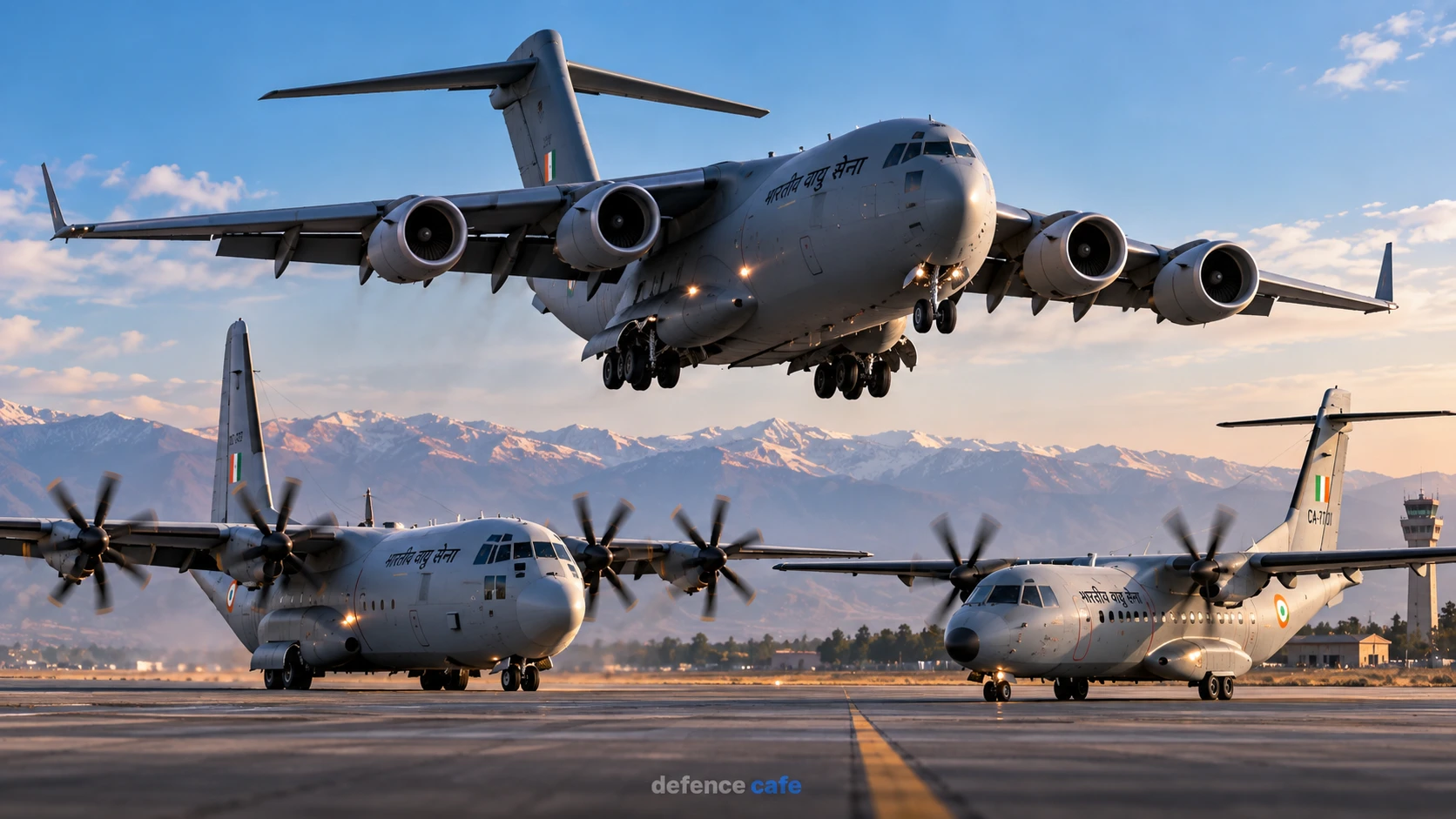
A military transport aircraft rarely gets the same attention as a fighter jet, but it is one of the foundations of modern air power. Fighters can dominate the air only if fuel, weapons, personnel, spare parts and support equipment can reach the right place at the right time.
For the Indian Air Force, that job is divided among aircraft of very different sizes and designs. The C-17 Globemaster III provides heavy strategic and tactical airlift, the C-130J Super Hercules is built around tactical mobility and operations from demanding airfields, while the C-295 occupies the medium tactical-transport segment and is replacing the IAF’s ageing Avro fleet.
These three aircraft should therefore not be viewed simply as competitors. They are designed for different parts of the air-mobility problem.
What Is Military Airlift?
Military airlift is the movement of troops, vehicles, ammunition, equipment, supplies and other essential cargo by aircraft.
It is generally divided into two broad concepts: strategic airlift and tactical airlift.
| Type | Basic idea | Typical requirement |
|---|---|---|
| Strategic airlift | Moving large quantities of people or equipment over long distances. | Large aircraft, long range, heavy payload and rapid movement between major airfields. |
| Tactical airlift | Moving forces and supplies closer to the operational area. | Ability to operate from shorter, austere or semi-prepared airfields and support specialised missions. |
The distinction is not absolute. Modern transport aircraft can perform multiple types of missions, and the same aircraft may move between strategic and tactical tasks depending on the operation.
C-17 Globemaster III: India’s Heavy Airlift Platform
The Boeing C-17 Globemaster III is the largest transport aircraft in the IAF’s current three-aircraft group examined here.
India approved the acquisition of 10 C-17 aircraft in 2011. The first aircraft arrived in India in June 2013, and the aircraft was formally inducted into the IAF in September 2013. The Ministry of Defence described the C-17 as an important part of India’s strategic airlift capability.
The original Ministry of Defence induction release on the C-17 records the purchase of 10 aircraft and its intended role in rapidly moving troops and equipment.
What Makes the C-17 Different?
The C-17 combines very large cargo capacity with the ability to operate into relatively austere airfields. Boeing describes it as a high-wing, four-engine transport designed to move large equipment, supplies and troops directly to small or austere airfields.
Boeing’s current aircraft information lists a maximum payload of 164,900 pounds, or about 74.8 tonnes. Its design also includes a rear loading ramp and systems for troop and cargo airdrop.
The Boeing C-17 specifications and capabilities page provides the manufacturer’s current performance and payload information.
Strategic Reach
A heavy airlifter becomes especially useful when a country has to move a large amount of equipment quickly without relying entirely on sea transport or long road movements.
For India, that can mean moving large consignments between distant parts of the country, supporting overseas evacuation or relief missions, or reinforcing a theatre where time matters.
The C-17 has also been used for humanitarian assistance and disaster-relief missions. During the 2021 COVID-19 response, for example, IAF C-17 aircraft were used to move oxygen equipment and supplies within India and internationally.
The Ministry of Defence’s 2021 review of IAF airlift operations records the use of C-17 and C-130J aircraft for evacuation and the wider COVID-related airlift effort.
C-130J Super Hercules: Tactical Airlift With a Different Philosophy
The Lockheed Martin C-130J Super Hercules is smaller than the C-17, but that does not make it a lesser transport aircraft. Its design philosophy is different.
India operates a fleet of 12 C-130J aircraft, according to Lockheed Martin. The company identifies the Indian fleet as part of the wider global Super Hercules community and describes its role in tactical airlift and missions ranging from cargo delivery to humanitarian assistance.
Lockheed Martin’s India overview states that the Indian Air Force operates 12 C-130Js.
Why the C-130J Is Important for Tactical Operations
The C-130J is designed around flexibility. It can transport personnel and cargo, conduct airdrops and support operations into difficult locations where a much larger aircraft may not be practical.
Lockheed Martin’s C-130J-30 data lists a maximum allowable payload of about 19.96 tonnes. The aircraft can carry combinations of pallets, troops, paratroopers or medical loads depending on configuration.
The manufacturer provides detailed specifications for the C-130J-30 Super Hercules.
The DBO Landing Demonstrated Its Tactical Value
One of the best-known demonstrations of the C-130J’s utility in India took place in August 2013, when an IAF C-130J-30 landed at Daulat Beg Oldie in Ladakh at an elevation of 16,614 feet.
The Ministry of Defence said the aircraft could carry up to 20 tonnes of load and that its ability to operate from difficult or semi-prepared surfaces provided an important airlift option for forces deployed in high-altitude areas.
The official Ministry of Defence account of the DBO landing documents the operation and the role it demonstrated.
The C-130J has also been used in humanitarian missions. During the Uttarakhand floods in 2013, C-130Js were used to support relief operations, including operations from demanding landing grounds.
Special Operations Capability
The C-130J has another important role: supporting special operations.
The IAF’s C-130J force has been associated with rapid insertion of specialised forces, airdrops and air-landed operations. This requires an aircraft that can combine cargo handling with relatively short-field performance and sophisticated navigation and self-protection systems.
In 2024, the IAF and Army also used a C-130J to carry out a high-altitude precision para-drop of the BHISHM critical trauma-care cube at approximately 15,000 feet.
The Ministry of Defence release on the BHISHM air-drop provides the official details of that operation.
C-295: India’s New Medium Tactical Transport
The Airbus C295 fills a different space again.
It is a twin-engine turboprop tactical transport aircraft designed for medium-lift missions. For the IAF, its importance is not just the aircraft itself but the industrial ecosystem being created around it in India.
In September 2021, the Cabinet Committee on Security approved the acquisition of 56 C-295MW aircraft to replace the ageing Avro fleet of the Indian Air Force.
Under the contract, the first 16 aircraft were to be delivered from Spain in fly-away condition, while the remaining 40 aircraft are being manufactured and assembled in India by Tata Advanced Systems Limited in partnership with Airbus.
The Ministry of Defence announcement on the 56-aircraft C-295 programme records the original procurement structure and replacement of the Avro fleet.
What Can the C-295 Do?
Airbus describes the C295 as a multi-mission tactical transport aircraft capable of carrying troops, cargo and specialised mission equipment.
Depending on configuration, the aircraft can carry up to 9 tonnes of payload, accommodate up to 71 personnel or up to 50 paratroopers, and support missions such as medical evacuation.
Its rear ramp is especially useful for loading and unloading cargo and for airborne delivery of personnel or supplies.
The Airbus C295 aircraft page provides the manufacturer’s current mission and performance information.
Short-Field and Semi-Prepared Operations
One of the C295’s major advantages for the IAF is its ability to operate from relatively short or semi-prepared runways.
That matters in a country with very different operational environments. A transport aircraft designed only for large conventional airbases would not provide the same flexibility as one designed to reach forward locations and smaller landing grounds.
Government descriptions of the C-295 programme specifically highlight its ability to operate from unprepared or semi-prepared landing grounds and its suitability for tactical airlift.
The C-295 Is Also an Aerospace Manufacturing Programme
The C-295 story is bigger than an aircraft order.
The Tata-Airbus programme created a Final Assembly Line in Vadodara for the Indian military aircraft programme. The facility represents the first private-sector final assembly line for military aircraft in India.
The programme covers more than final assembly. Airbus and Tata have been developing an industrial chain involving detailed parts, tooling, sub-assemblies, major components, testing and eventual lifecycle support.
Airbus says the programme for the 40 Indian-built aircraft involves the manufacture of 13,000 detail parts in India, with more than 85% structural and final assembly of those 40 aircraft taking place in India. The company says 37 Indian suppliers, from both private and public sectors, have been onboarded.
The Airbus release on the Vadodara Final Assembly Line explains the industrial structure of the programme.
The Tata Group’s C295 programme overview provides additional details on the Indian production ecosystem.
India’s First Privately Manufactured Military Aircraft Programme
The significance of the C295 programme lies partly in the fact that it broadens India’s military aerospace manufacturing base beyond traditional public-sector production.
The project is intended to build capability across the supply chain, from detailed component manufacturing to final assembly, testing and support. That can matter for future aircraft programmes because manufacturing know-how, quality systems, tooling and supplier capability accumulate over time.
That is one reason the C295 programme is frequently discussed as an industrial-development project as well as a transport-aircraft acquisition.
C-17 vs C-130J vs C-295
| Aircraft | Primary role | India-specific position | Why it matters |
|---|---|---|---|
| C-17 Globemaster III | Heavy strategic and tactical airlift | 10 aircraft acquired by IAF | Moves very large loads, troops and equipment over long distances and can operate from austere airfields. |
| C-130J Super Hercules | Tactical airlift and specialised operations | 12 aircraft operated by IAF | Combines tactical mobility, airdrop capability and operations from demanding or semi-prepared airfields. |
| Airbus C295 | Medium tactical transport | 56-aircraft programme; 16 from Spain and 40 made in India | Replaces the Avro fleet while adding a modern medium-lift capability and creating a domestic military-aircraft manufacturing ecosystem. |
Why India Needs Three Different Transport Aircraft
The easiest way to understand the fleet is to imagine three different logistics problems.
Problem 1: Move Very Large Loads Across Long Distances
This is where the C-17 is most useful. Large vehicles, substantial cargo loads and large numbers of personnel can be moved rapidly without splitting everything into many smaller sorties.
Problem 2: Reach a Difficult Forward Location
This is where the C-130J becomes especially valuable. Its tactical design is better suited to missions where the aircraft has to operate closer to the operational area, work from demanding airfields or conduct airdrops.
Problem 3: Move Medium Loads Frequently and Efficiently
The C295 addresses another requirement: transporting moderate quantities of troops and cargo to locations that do not require a much larger airlifter.
This is particularly relevant to a large country with a diverse geography and many smaller operational airfields. A medium tactical transport can complement rather than replace the heavy airlifters.
How These Aircraft Support India’s Armed Forces
Military transport aviation is not limited to wartime logistics.
Transport aircraft can move troops between theatres, deliver supplies to isolated areas, support exercises, evacuate civilians, transport medical equipment and assist during natural disasters.
India’s transport fleet has repeatedly been used for humanitarian assistance and disaster relief. In 2021, C-17 and C-130J aircraft were used in evacuation operations and the movement of COVID-related medical supplies.
During high-altitude operations, airlift can become even more important because difficult terrain can severely restrict road transport. Aircraft can reduce the time required to move essential supplies and personnel into remote areas.
High-Altitude Operations and India’s Geography
India presents a particularly demanding transport-airlift environment.
The country includes Himalayan regions with high-altitude landing grounds, long coastlines, remote northeastern areas, deserts and island territories. An aircraft optimised only for long-distance heavy lifting would not necessarily be the ideal aircraft for every location.
That is why tactical characteristics such as runway requirements, cargo-loading systems, airdrop capability, endurance and ability to operate in difficult weather conditions matter alongside payload.
The C-130J’s 2013 landing at Daulat Beg Oldie demonstrated the usefulness of tactical airlift in extremely high-altitude conditions, while the C295 programme is intended to provide another modern tactical-transport option for the IAF.
C-295 and the Future of India’s Transport Fleet
The most important long-term question around the C295 may not be simply how many aircraft enter service. It is whether India can use the programme to establish a deeper indigenous ecosystem for military transport-aircraft manufacturing.
That includes detailed parts production, assembly, quality control, tooling, engineering, maintenance and supplier development.
The programme is also significant because it creates practical experience in building a complete military aircraft in India under a private-sector-led industrial partnership.
The first India-manufactured C295 completed its maiden test flight from Vadodara in June 2026. Earlier government programme timelines had scheduled the first Made-in-India aircraft for the September 2026 period.
A contemporary report from ETInfra reported the successful maiden test flight in June 2026, while the official programme documents continue to describe the broader production schedule through 2031.
Transport Aircraft and the Wider IAF
Transport aircraft do not operate as a separate world from fighters and helicopters. They are part of the same air-power ecosystem.
Fighter squadrons require fuel, weapons, ground equipment, spare engines, maintenance teams and other supplies. Transport aircraft can move these people and materials quickly between bases and theatres.
The IAF’s 2026 Vayushakti exercise also demonstrated the breadth of the service’s aviation fleet, listing C-17, C-130J and C-295 alongside fighters, helicopters and remotely piloted aircraft in its planned operational display.
The Ministry of Defence’s Vayushakti-26 release provides the official list of aircraft participating in the exercise.
What to Watch Next
- C295 Indian production: the first India-manufactured aircraft has already entered flight testing, while the remaining 40 aircraft are scheduled to be produced through the Tata-Airbus industrial programme.
- Fleet modernisation: the gradual replacement of legacy transport aircraft will determine how effectively the IAF balances heavy, medium and tactical airlift requirements.
- Indigenous aerospace manufacturing: the C295 programme will be an important test of India’s ability to move from component production and assembly toward deeper aircraft-manufacturing capability.
- Operational integration: transport aircraft will increasingly operate alongside fighters, helicopters, drones and other networked systems rather than as isolated logistics platforms.
Frequently Asked Questions
How many C-17 aircraft does India have?
India acquired 10 C-17 Globemaster III aircraft for the Indian Air Force. The government approved the purchase in 2011 and the aircraft entered Indian service beginning in 2013.
How many C-130J aircraft does the Indian Air Force operate?
India operates 12 C-130J Super Hercules aircraft, according to Lockheed Martin.
How many C-295 aircraft is India buying?
India has a contract for 56 C-295 aircraft. Sixteen were to be delivered from Spain in fly-away condition, while the remaining 40 are being manufactured and assembled in India by Tata Advanced Systems in partnership with Airbus.
What is the difference between C-17 and C-130J?
The C-17 is a much larger heavy airlifter designed for very large cargo loads and strategic reach. The C-130J is smaller and more focused on tactical mobility, including operations from demanding airfields and specialised airdrop missions.
What is the role of the C-295 in India?
The C-295 is a medium tactical transport aircraft intended to replace the IAF’s Avro fleet. It is designed to move troops and cargo and operate from relatively short or semi-prepared airfields.
Why is the C-295 programme important beyond the aircraft itself?
The programme is also an industrial project. Forty aircraft are being manufactured and assembled in India, alongside the development of an Indian supply chain involving detailed parts, sub-assemblies, tooling, testing and support.
Can the C-130J and C-295 replace the C-17?
They are not direct substitutes. The C-17 provides a much larger payload and heavy-airlift capability, while the C-130J and C295 are smaller tactical transports designed for different operating requirements.
Conclusion
India’s transport-aircraft fleet is built around different answers to the same fundamental problem: how to move people, equipment and supplies quickly across a large and geographically diverse country.
The C-17 provides the heavy-lift backbone. The C-130J adds tactical mobility and specialised operating capability. The C295 brings a modern medium tactical transport into service while simultaneously creating a new aircraft-manufacturing ecosystem in India.
Taken together, these aircraft show why airlift capability cannot be measured simply by the size of an aircraft or the number of platforms. What matters is the combination of payload, range, runway flexibility, speed of deployment and the industrial system that keeps the fleet flying.
Sources & Further Reading
- Ministry of Defence / PIB — C-17 Globemaster III Inducted into the IAF
- Boeing — C-17 Globemaster III capabilities and specifications
- Lockheed Martin — India and C-130J Super Hercules
- Lockheed Martin — C-130J-30 Super Hercules specifications
- Ministry of Defence / PIB — IAF C-130J-30 Super Hercules Landing at Daulat Beg Oldie
- Ministry of Defence / PIB — C-130J High-Altitude Precision Para-Drop Operation
- Ministry of Defence / PIB — Cabinet Approval for 56 C-295MW Aircraft
- Airbus — C295 Military Transport Aircraft
- Airbus — Tata Advanced Systems and Airbus C295 Final Assembly Line, Vadodara
- Tata Group — Tata Advanced Systems and Airbus C295 Aircraft Manufacturing Programme
- ETInfra — First Made-in-India C-295 Completes Maiden Test Flight
- Ministry of Defence / PIB — Vayushakti-26: C-17, C-130J and C-295 in the IAF’s 2026 Exercise
- Ministry of Defence / PIB — IAF Transport Aircraft in Evacuation and COVID-19 Airlift Operations
