


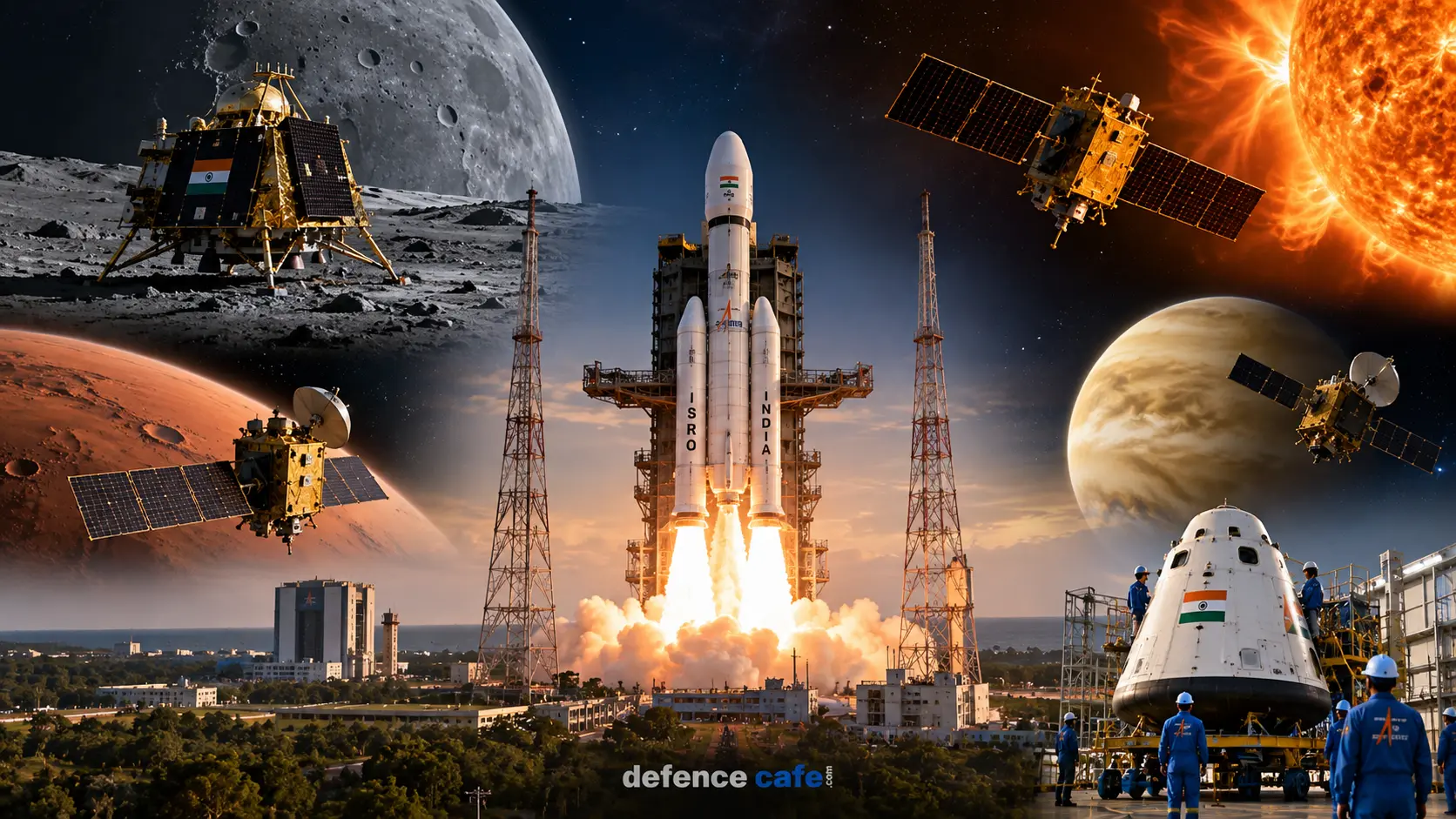
India’s space programme is no longer defined by a single type of rocket or satellite. The Indian Space Research Organisation (ISRO) now operates across launch vehicles, Earth observation, communications, navigation, space science, in-orbit technology demonstrations and human spaceflight. Its current launch fleet includes the PSLV, GSLV and LVM3, while the SSLV is moving through its industrialisation and commercialisation phase.
The scale of that evolution is visible in the mission record. ISRO’s official launch database currently lists 106 launch missions from Sriharikota, with GSLV-F17/EOS-05 on September 4, 2026 as the latest listed launch. EOS-05 was placed into a sub-Geosynchronous Transfer Orbit and is described by ISRO as India’s first imaging satellite from geosynchronous orbit.
But launch vehicles are only one part of the story. Chandrayaan-3 demonstrated a controlled lunar landing, Aditya-L1 created a dedicated Indian solar-observation capability, SpaDeX demonstrated autonomous orbital docking and power transfer, NISAR expanded Earth-observation capability through an ISRO-NASA partnership, and Gaganyaan is taking the programme into human spaceflight.
What Is ISRO?
ISRO stands for the Indian Space Research Organisation. It is the principal space agency working under India’s Department of Space (DoS).
India’s organised space activities began in the 1960s. The Indian National Committee for Space Research, or INCOSPAR, was established in 1962. ISRO was established in August 1969, while the Government of India created the Space Commission and Department of Space in 1972 and brought ISRO under the Department of Space.
ISRO’s stated objectives are broader than launching rockets. They include developing launch vehicles and satellites, operating Earth-observation and communication systems, navigation services, space science and planetary exploration, human spaceflight technologies and space-based applications for national development.
ISRO’s official history describes the development of the Indian programme from INCOSPAR and sounding rockets through the creation of operational launch vehicles and satellite systems.
ISRO, Department of Space, IN-SPACe and NSIL: What Is the Difference?
These organisations are often grouped together, but they do not perform exactly the same job.
| Organisation | Basic role |
|---|---|
| Department of Space | Government department responsible for implementing India’s space programme and overseeing the institutional framework. |
| ISRO | Research, development, engineering and operational organisation responsible for spacecraft, launch vehicles, missions and space technology. |
| IN-SPACe | Independent nodal agency that promotes, authorises and supervises space activities by non-government entities. |
| NSIL | Commercial arm of the Department of Space responsible for commercialising and marketing space products, services and technologies. |
ISRO’s official description of IN-SPACe explains its role as the interface between the government space establishment and private participants. ISRO’s NSIL page describes NSIL as the commercial arm of ISRO and outlines its responsibilities in launch services, satellite services and technology transfer.
How India’s Space Programme Evolved
India’s space programme began with a practical philosophy: space technology should solve real problems on Earth.
The early programme concentrated heavily on applications such as communications and remote sensing. The INSAT system supported communications, broadcasting and meteorology, while the Indian Remote Sensing programme developed satellite capabilities for applications such as resource monitoring.
At the same time, India gradually built independent launch capability.
The first Indian satellite, Aryabhata, was launched in 1975 using a Soviet launch vehicle. India’s first successful indigenous orbital launcher, SLV-3, demonstrated the country’s ability to develop and operate a multi-stage rocket in 1980.
Those foundations eventually led to PSLV, GSLV and LVM3, which now form the core of India’s operational launch capability.
ISRO’s Department of Space overview and its official programme history describe this progression from experimental space applications to operational launch and satellite systems.
ISRO’s Major Launch Vehicles Explained
A launch vehicle’s job is simple to describe but difficult to accomplish: it must accelerate a spacecraft to the precise speed, direction and altitude required for its mission.
Different missions require different rockets. A small Earth-observation satellite does not need the same launcher as a heavy communications satellite or a human spacecraft.
| Launch vehicle | Primary role | Current position |
|---|---|---|
| PSLV | Versatile launcher for Earth observation, navigation, scientific and other satellites across several orbit types. | Operational |
| GSLV | Heavier launcher using an indigenous cryogenic upper stage, particularly suited to geosynchronous missions. | Operational |
| LVM3 | Heavy-lift launcher for large satellites, lunar missions and the human-rated Gaganyaan vehicle architecture. | Operational |
| SSLV | Small-satellite launcher designed for quick turnaround and launch-on-demand missions. | Development completed; industrial technology transfer and further evolution underway |
| HLVM3 | Human-rated version of the LVM3 architecture being developed for Gaganyaan. | Under human-rating and mission qualification |
| NGLV | Next-generation heavy launcher intended to significantly increase India’s payload capability and reduce launch cost through advanced architecture and reusability. | In development |
ISRO’s official launchers overview identifies PSLV, GSLV and LVM3 as the main operational launch vehicles. The Department of Space’s 2025-26 annual report records the completion of SSLV development and the start of its industrialisation and technology-transfer process.
PSLV: India’s Versatile Workhorse
The Polar Satellite Launch Vehicle, or PSLV, is one of the most versatile rockets developed by ISRO.
It uses four propulsion stages and can be configured with different numbers of solid strap-on motors depending on mission requirements. That flexibility has allowed it to launch Earth-observation satellites, navigation spacecraft, science missions and commercial customer payloads.
PSLV played a central role in some of India’s most important early planetary and scientific missions. Chandrayaan-1, the Mars Orbiter Mission, AstroSat and Aditya-L1 were all launched using PSLV.
The ISRO PSLV overview describes the vehicle as India’s third-generation launch vehicle and highlights its flexibility across multiple orbit classes.
GSLV: India’s Cryogenic-Era Launcher
The Geosynchronous Satellite Launch Vehicle, or GSLV, was developed to place heavier satellites into geosynchronous transfer orbits.
Its defining feature is its cryogenic upper stage. Cryogenic engines use liquid hydrogen and liquid oxygen and are technically demanding because of the extremely low temperatures and the precision required to manage the propellants.
India’s indigenous cryogenic upper stage became an important milestone in developing an independent capability to launch heavier communication satellites.
ISRO describes GSLV as capable of launching satellites in the roughly 2-tonne class to GTO.
ISRO’s GSLV technical overview provides the official configuration and role of the launcher.
LVM3: India’s Heavy-Lift Launcher
The Launch Vehicle Mark-3, or LVM3, is India’s heavy-lift operational launcher.
Its architecture combines two large solid S200 boosters, a liquid L110 core stage and the C25 cryogenic upper stage.
ISRO describes LVM3 as capable of carrying approximately 4-tonne-class payloads to GTO and 10-tonne-class payloads to LEO. The rocket was the launcher for Chandrayaan-2 and Chandrayaan-3 and has also flown commercial OneWeb and BlueBird missions.
The vehicle has therefore evolved from a national heavy-lift system into a platform serving scientific, commercial and human-spaceflight requirements.
ISRO’s LVM3 technical page provides its official configuration and payload capability.
SSLV: Smaller Rocket, Different Business Model
The Small Satellite Launch Vehicle is designed around a different market need: smaller payloads that need relatively rapid and flexible access to low Earth orbit.
SSLV can place satellites of up to roughly 500 kg into a 500-km-class low Earth orbit. Its compact architecture and reduced launch infrastructure requirements are intended to support quicker turnaround and launch-on-demand operations.
In August 2026, ISRO successfully tested an improved first-stage solid motor design. ISRO said the improved version is expected to increase SSLV’s payload capability by approximately 100 kg to low Earth orbit once inducted.
At the industrial level, ISRO, NSIL, IN-SPACe and HAL signed an SSLV technology-transfer agreement in September 2025, moving the programme toward production by Indian industry.
ISRO’s August 2026 SSLV test update and its SSLV technology-transfer announcement provide the latest programme information.
ISRO’s Major Missions Explained
India’s missions fall into several broad groups: Earth observation, communications, navigation, science and planetary exploration, technology demonstration and human spaceflight.
| Mission / programme | Period | Why it matters |
|---|---|---|
| Aryabhata | 1975 | India’s first satellite and an early foundation for indigenous spacecraft development. |
| INSAT / GSAT | Operational programme | Communications, broadcasting, meteorology and related services. |
| IRS / EOS | Operational programme | Earth observation for mapping, resources, environment and disaster-related applications. |
| Chandrayaan-1 | 2008 | India’s first lunar mission and a major step into planetary science. |
| Mars Orbiter Mission | 2013 | Demonstrated India’s ability to design and operate an interplanetary mission to Mars. |
| Chandrayaan-2 | 2019 | Expanded India’s lunar science capability; its orbiter continues to be listed by ISRO as operational. |
| Chandrayaan-3 | 2023 | Demonstrated a controlled soft landing and rover operations on the Moon. |
| Aditya-L1 | 2023 | India’s first dedicated space-based solar observatory. |
| SpaDeX | 2024–2025 | Demonstrated autonomous rendezvous, docking, undocking and power transfer between spacecraft. |
| NISAR | 2025 | Joint NASA-ISRO Earth-observation mission using dual-frequency synthetic aperture radar. |
| Gaganyaan | Current programme | Developing India’s indigenous human spaceflight capability. |
Chandrayaan: India’s Lunar Exploration Programme
Chandrayaan is India’s lunar exploration programme.
Chandrayaan-1, launched in 2008, marked India’s first mission to the Moon. It expanded international scientific interest in the lunar surface and helped establish India as a participant in planetary exploration.
Chandrayaan-2 followed in 2019 with an orbiter, lander and rover architecture. Although the landing phase did not achieve its intended outcome, the orbiter successfully entered lunar orbit and continues to be listed by ISRO as operational.
Chandrayaan-3 was designed with a more focused objective: demonstrate a safe and soft lunar landing and rover operations. The Vikram lander successfully landed on August 23, 2023, followed by deployment of the Pragyan rover.
ISRO states that Chandrayaan-3 made India the fourth country to achieve a soft lunar landing and the first to land in the southern polar region of the Moon.
ISRO’s Chandrayaan-3 mission page records the landing and subsequent scientific activities.
Chandrayaan-4: From Landing to Sample Return
The next major lunar step is significantly more complicated.
Chandrayaan-4 has been approved as a lunar sample-return mission. Its purpose is to develop and demonstrate technologies for landing, collecting lunar samples, transferring them between spacecraft and safely returning them to Earth.
That makes docking and rendezvous technology particularly important because a sample-return architecture requires multiple spacecraft operations rather than simply reaching the lunar surface.
The Government of India approved Chandrayaan-4 in September 2024, with the programme roadmap targeting the mission by 2027.
The Government’s Chandrayaan-4 announcement explains the sample-return and technology-demonstration objectives.
Aditya-L1: Studying the Sun
Aditya-L1 is India’s first space-based solar observatory.
Unlike an Earth-orbiting satellite that periodically points toward the Sun, Aditya-L1 operates around the Sun-Earth L1 Lagrange point, approximately 1.5 million kilometres from Earth.
From this location, the spacecraft can maintain a continuous view of the Sun without regular occultation by Earth or the Moon. Its scientific objectives include studying the solar atmosphere, solar flares, coronal mass ejections and other phenomena relevant to space weather.
Aditya-L1 was launched by PSLV-C57 on September 2, 2023 and entered its targeted halo orbit around L1 on January 6, 2024. ISRO currently states that the satellite is healthy and operating nominally.
ISRO’s Aditya-L1 mission page provides the mission status and scientific objectives.
SpaDeX: Why Spacecraft Docking Matters
SpaDeX may look much smaller than a lunar mission or heavy launch vehicle, but the technology it demonstrated is strategically important for future complex missions.
The mission used two small spacecraft to demonstrate rendezvous, autonomous docking and undocking in low Earth orbit. ISRO subsequently demonstrated power transfer between the docked spacecraft.
India successfully completed the initial docking on January 16, 2025, and later completed undocking in March 2025.
Space docking matters because large future missions can require multiple launches followed by assembly or transfer operations in orbit. It is relevant to India’s planned space station, future lunar missions and more sophisticated spacecraft operations.
ISRO’s SpaDeX mission documentation explains the rendezvous, docking and power-transfer objectives. The Government also records that India became the fourth country to demonstrate autonomous satellite docking capability.
NISAR: A Major Earth-Observation Partnership
NISAR stands for NASA-ISRO Synthetic Aperture Radar. It is a joint Earth-observation mission between NASA and ISRO.
NISAR was launched on July 30, 2025, aboard GSLV-F16. It combines NASA’s L-band radar with ISRO’s S-band radar, creating a dual-frequency synthetic aperture radar system.
One of the important advantages of radar-based Earth observation is that the spacecraft can collect useful data in conditions where optical imaging may be limited, including darkness and cloud cover.
ISRO’s 2025 programme review states that NISAR became fully operational and is providing Earth-observation data.
ISRO’s 2025 space situational awareness report and its 2025 achievements report provide the relevant launch and operational information.
NavIC: India’s Regional Navigation System
Not every important Indian space system is an exploration mission.
NavIC, India’s regional navigation satellite system, provides positioning, navigation and timing services over India and the surrounding region.
The second-generation NVS satellite series is designed to strengthen continuity and expand the capabilities of the NavIC constellation. NVS-01, launched in 2023, was the first second-generation NavIC satellite and carried an indigenous atomic clock.
NVS-02, launched by GSLV-F15 in January 2025, was successfully injected into its transfer orbit but could not complete the planned orbit-raising operation. ISRO’s subsequent investigation attributed the problem to the drive signal not reaching the pyro valve of the oxidizer line of the orbit-raising engine.
This is an important distinction in understanding space missions: successful launch and successful mission are not always the same thing.
ISRO’s NVS-02 review explains the anomaly and the corrective measures adopted for future missions.
Gaganyaan: India’s Human Spaceflight Programme
Gaganyaan is designed to demonstrate India’s indigenous human-spaceflight capability.
The programme requires much more than a rocket capable of reaching orbit. A human mission needs a human-rated launch vehicle, crew module, life-support systems, crew escape capability, parachutes, mission-control infrastructure, tracking and communications, astronaut training, recovery systems and extensive qualification testing.
The human-rated launcher is called HLVM3, derived from the LVM3 architecture.
As of August 2026, the Government stated that development and ground testing of the major HLVM3 propulsion stages and structures had been completed. The TV-D1 test mission had successfully demonstrated the Crew Escape System, while Integrated Air Drop Tests had been completed for the crew-module deceleration system.
The latest Government roadmap targets the first uncrewed experimental mission in Q4 2026, followed by two additional uncrewed missions in the configuration of the first crewed flight, before the first crewed Gaganyaan mission targeted by 2027.
These are programme targets rather than guarantees; human-spaceflight schedules depend on the results of qualification and safety testing.
The August 2026 Government update on Gaganyaan provides the current development status and mission roadmap.
From Gaganyaan to Bharatiya Antariksh Station
Gaganyaan is intended to be a foundation for a larger human-spaceflight programme.
India’s Bharatiya Antariksh Station (BAS) is planned as a five-module space station, with the first module, BAS-01, targeted for launch by 2028 and full station operationalisation targeted by 2035.
The station would provide a platform for long-duration human spaceflight, microgravity research and advanced orbital operations.
The connection between Gaganyaan, SpaDeX and BAS is therefore important. A permanent or semi-permanent human presence in low Earth orbit requires reliable rendezvous, docking, life-support, crew transport and cargo logistics — all capabilities that must be developed incrementally.
In January 2026, ISRO also issued an Expression of Interest for Indian industry participation in development and realisation of the BAS-01 structure, illustrating the intended role of industrial partners in the programme.
ISRO’s 2026 BAS-01 industry Expression of Interest provides details on the structural-development requirement.
India’s Space Programme Is Moving Beyond Traditional Rockets
The next generation of India’s space programme is not simply about making an existing rocket larger.
Next Generation Launch Vehicle
The Next Generation Launch Vehicle (NGLV) is being developed as a future heavy launcher with a much larger payload capability than the current operational fleet.
Government documents describe a target capability of up to approximately 30 tonnes to low Earth orbit. The programme is also intended to support lower-cost access to space and incorporate reusable technologies.
The Department of Space’s 2025-26 annual report places development of NGLV within India’s Space Vision 2047 roadmap.
Reusable Launch Technology
ISRO has also been testing reusable-launch technologies through its Reusable Launch Vehicle Technology Demonstrator programme.
The underlying idea is straightforward: instead of discarding the major components of every launch vehicle, some hardware could eventually be recovered and reused, potentially reducing turnaround time and cost.
Reusable launchers require difficult technologies including controlled atmospheric re-entry, thermal protection, guidance and autonomous landing. These are long-term technology-development activities rather than capabilities that should be assumed to be operational today.
Third Launch Pad
India’s launch infrastructure is being expanded alongside its vehicles.
Two launch pads at Satish Dhawan Space Centre are currently operational. The Government has approved a Third Launch Pad for future next-generation launch vehicles, with establishment targeted around the 2029–30 timeframe.
A separate SSLV launch facility is also being established at Kulasekarapattinam in Tamil Nadu, intended to support launches into polar orbits.
The Government’s March 2026 update on India’s launch infrastructure provides the current status and planned timelines.
ISRO’s Future Science Missions
India’s scientific ambitions are expanding beyond the Moon and Sun.
Venus Orbiter Mission
The Venus Orbiter Mission is planned to study Venus’s atmosphere, surface, subsurface, ionosphere and interactions with the solar environment.
ISRO’s approved mission architecture identifies LVM3 as the candidate launcher, with a launch target of March 2028. The mission is also intended to demonstrate technologies such as aerobraking and thermal management in the challenging Venusian environment.
ISRO’s Venus Orbiter Mission overview explains the planned scientific objectives and technology demonstrations.
Chandrayaan-5 / LUPEX
India is also participating in the planned Lunar Polar Exploration Mission (LUPEX) with Japan. The mission is intended to investigate the lunar polar environment and improve understanding of resources and conditions in permanently shadowed areas.
Government documents list Chandrayaan-5/LUPEX among the approved future space projects, alongside Chandrayaan-4 and the Venus Orbiter Mission.
The Growing Role of India’s Private Space Sector
One of the biggest structural changes in India’s space programme has happened on Earth rather than in orbit.
Space-sector reforms have opened more activities to private companies and startups, while ISRO increasingly focuses on research, advanced technology development and national missions.
As of August 2026, the Government said approximately 440 space-technology startups were registered in India. IN-SPACe had granted 113 authorisations to 52 non-government entities for various space activities.
NSIL has also been transferring ISRO-developed technologies to Indian industry. A Government update in August 2026 said NSIL had signed 118 technology-transfer agreements covering 83 technologies.
The significance is larger than the number of companies. A mature space ecosystem needs manufacturers, launch providers, satellite companies, component suppliers, data companies, ground-station operators, propulsion specialists and software firms alongside the national space agency.
The Government’s August 2026 update on India’s space startups provides the latest official figures on authorisations and technology transfers.
India’s Space Programme Is Also a Service Programme
Space exploration tends to attract the most public attention, but many of India’s most important space capabilities operate without dramatic launches or planetary headlines.
Earth-observation satellites support mapping, agriculture, water-resource management, environmental monitoring and disaster assessment. Communication satellites support connectivity and broadcasting. Navigation satellites provide positioning and timing. Meteorological observations contribute to weather forecasting and disaster preparedness.
That application-oriented foundation remains central to ISRO’s mission.
ISRO’s stated mission includes using space technology for Earth observation, communications, navigation, meteorology, societal applications and scientific research. Exploration is expanding, but it sits alongside a large operational infrastructure that serves everyday needs on Earth.
ISRO’s official Vision, Mission and Objectives page outlines these national-development applications.
What Happened in India’s Space Programme in 2025–2026?
The most recent phase has been particularly important because it combines mature operational systems with new technology demonstrations.
| Development | Significance |
|---|---|
| NVS-02 | GSLV mission demonstrated precise initial injection, but the spacecraft could not complete its planned orbit raising. |
| SpaDeX | Demonstrated autonomous docking, undocking and power transfer. |
| NISAR | Expanded joint India-US Earth-observation capability with dual-frequency SAR. |
| LVM3-M6 | Demonstrated India’s ability to launch a very large commercial communications satellite into LEO. |
| SSLV improved-stage test | Advanced the small-launcher architecture and production-oriented design. |
| GSLV-F17 / EOS-05 | Latest listed Sriharikota launch as of September 4, 2026. |
| Gaganyaan preparation | Human-rating, crew escape, parachute and ground-system qualification continued. |
ISRO’s official mission records show both successful and unsuccessful missions during this period. The important point is not to treat every launch as a binary measure of the programme. Modern launch systems are developed through flight experience, investigation of anomalies and incorporation of corrective action.
ISRO’s official launch mission database provides the mission-by-mission record, while the 2025–26 Department of Space annual report documents recent technical and programme developments.
India’s Space Vision 2047
The next phase of India’s programme is organised around a much broader technological vision.
The Government’s Space Vision 2047 roadmap includes:
- Gaganyaan: indigenous human spaceflight capability.
- Bharatiya Antariksh Station: first module targeted by 2028 and full station targeted by 2035.
- Chandrayaan-4: lunar sample-return technology and mission.
- Chandrayaan-5 / LUPEX: deeper lunar polar exploration.
- Venus Orbiter Mission: planned Venus exploration targeted for 2028.
- NGLV: next-generation heavy-lift launch capability.
- Third Launch Pad: new launch infrastructure for future heavy launch vehicles.
- Human lunar exploration: a long-term goal involving the development of technologies needed for an Indian lunar landing.
These dates are government programme targets and approved roadmaps, not completed capabilities. Their eventual schedules will depend on technical development, testing, mission readiness and future programme decisions.
The Department of Space’s 2025–26 Annual Report describes the Space Vision 2047 milestones and approved programmes.
Why ISRO Matters Beyond Space Exploration
India’s space capability increasingly affects sectors that do not look like “space” at first glance.
Communications satellites support connectivity. Earth observation supports decisions about land and resources. Navigation enables positioning and timing services. Scientific missions expand knowledge of the Moon, Sun and planets. Launch vehicles create access to orbit. Human-spaceflight technologies push developments in life support, materials, robotics, propulsion and safety engineering.
There is also an industrial effect. Launch vehicles and spacecraft contain thousands of components, creating opportunities for Indian manufacturers, electronics companies, precision-engineering firms, software developers and specialised research institutions.
The result is a programme that connects science, engineering, national infrastructure, commercial activity and international cooperation.
What to Watch Next
The most important developments over the next several years are likely to come from the convergence of different programmes rather than from one isolated mission.
Gaganyaan will test India’s ability to operate safely with astronauts. SpaDeX has already demonstrated a key orbital-enablement technology. BAS will require repeated rendezvous, docking and logistics operations. Chandrayaan-4 will demand lunar landing, sample collection and return capability. NGLV is intended to expand the country’s launch capacity. At the same time, private companies are expected to take on a larger share of commercial launch and satellite activity.
Together, these programmes mark a shift from demonstrating individual capabilities toward building an integrated space ecosystem.
Frequently Asked Questions
What is ISRO?
ISRO, or the Indian Space Research Organisation, is India’s principal space research and development organisation under the Department of Space. It develops launch vehicles, satellites and spacecraft and conducts space science, Earth-observation, navigation and human-spaceflight programmes.
How many launch vehicles does ISRO currently operate?
ISRO’s core operational launch fleet consists of the PSLV, GSLV and LVM3. SSLV development has been completed and the vehicle is moving toward industrial production and commercialisation, while HLVM3 and NGLV represent further development paths.
What is the difference between PSLV, GSLV and LVM3?
PSLV is the most versatile of the three and is widely used for Earth observation, navigation and science missions. GSLV is designed for heavier payloads to geosynchronous transfer orbits and uses a cryogenic upper stage. LVM3 is India’s heavy-lift launcher and is also the basis for the human-rated launcher being developed for Gaganyaan.
What was India’s most important lunar mission?
Chandrayaan missions have built progressively greater lunar capability. Chandrayaan-1 began India’s lunar exploration programme, Chandrayaan-2 expanded orbital and landing capability, and Chandrayaan-3 successfully demonstrated a controlled lunar soft landing and rover operations.
What is Aditya-L1?
Aditya-L1 is India’s first space-based solar observatory. It operates around the Sun-Earth L1 point and studies the Sun’s atmosphere and phenomena such as solar flares and coronal mass ejections.
What is SpaDeX?
SpaDeX is a technology-demonstration mission designed to develop autonomous rendezvous, docking and undocking capabilities between spacecraft. ISRO also demonstrated power transfer between the docked satellites.
When will India send humans into space?
The Gaganyaan programme is targeting India’s first crewed mission by 2027, following uncrewed and qualification missions. The Government’s August 2026 roadmap targeted the first uncrewed experimental mission for Q4 2026.
What is India’s planned space station?
The Bharatiya Antariksh Station is a planned five-module Indian space station. The first module is targeted for launch by 2028, with full station operationalisation targeted by 2035.
What is NGLV?
NGLV, or Next Generation Launch Vehicle, is a future Indian heavy launcher intended to substantially increase payload capability and support lower-cost access to space through advanced and reusable technologies.
Conclusion
ISRO’s story is no longer just the story of building a rocket and putting a satellite into orbit.
India now has operational launch vehicles covering different mission classes, established Earth-observation and communications systems, a regional navigation system, planetary missions, a dedicated solar observatory, orbital docking technology and a growing private space ecosystem.
The next stage is more ambitious: human spaceflight, a national space station, lunar sample return, Venus exploration, reusable technologies and a much larger industrial role.
The important thread connecting all of these programmes is capability building. Each successful mission adds another piece — propulsion, navigation, landing, docking, re-entry, life support, Earth observation or launch infrastructure — to a progressively more capable Indian space system.
That is what makes the current phase of India’s space programme particularly significant: the objective is increasingly not just to reach space, but to build the technologies and institutions needed to operate there with greater independence and complexity.
Sources & Further Reading
- ISRO — Genesis and History of the Indian Space Programme
- ISRO — Launch Vehicles: PSLV, GSLV and LVM3
- ISRO — Official Launch Missions Database
- ISRO — Chandrayaan-3 Mission
- ISRO — Aditya-L1 Solar Mission
- ISRO — SpaDeX Mission and Space Docking Technology
- ISRO — Indian Space Situational Awareness Report 2025
- Department of Space / ISRO — Annual Report 2025–26
- PIB / Department of Space — Gaganyaan and Bharatiya Antariksh Station Update, August 2026
- PIB / Department of Space — India’s Launch Infrastructure and Third Launch Pad
- PIB / Department of Space — Indian Space Startups and Technology Transfer, August 2026
- ISRO — IN-SPACe
- ISRO — NewSpace India Limited (NSIL)
- ISRO — Venus Orbiter Mission and Chandrayaan-4
