


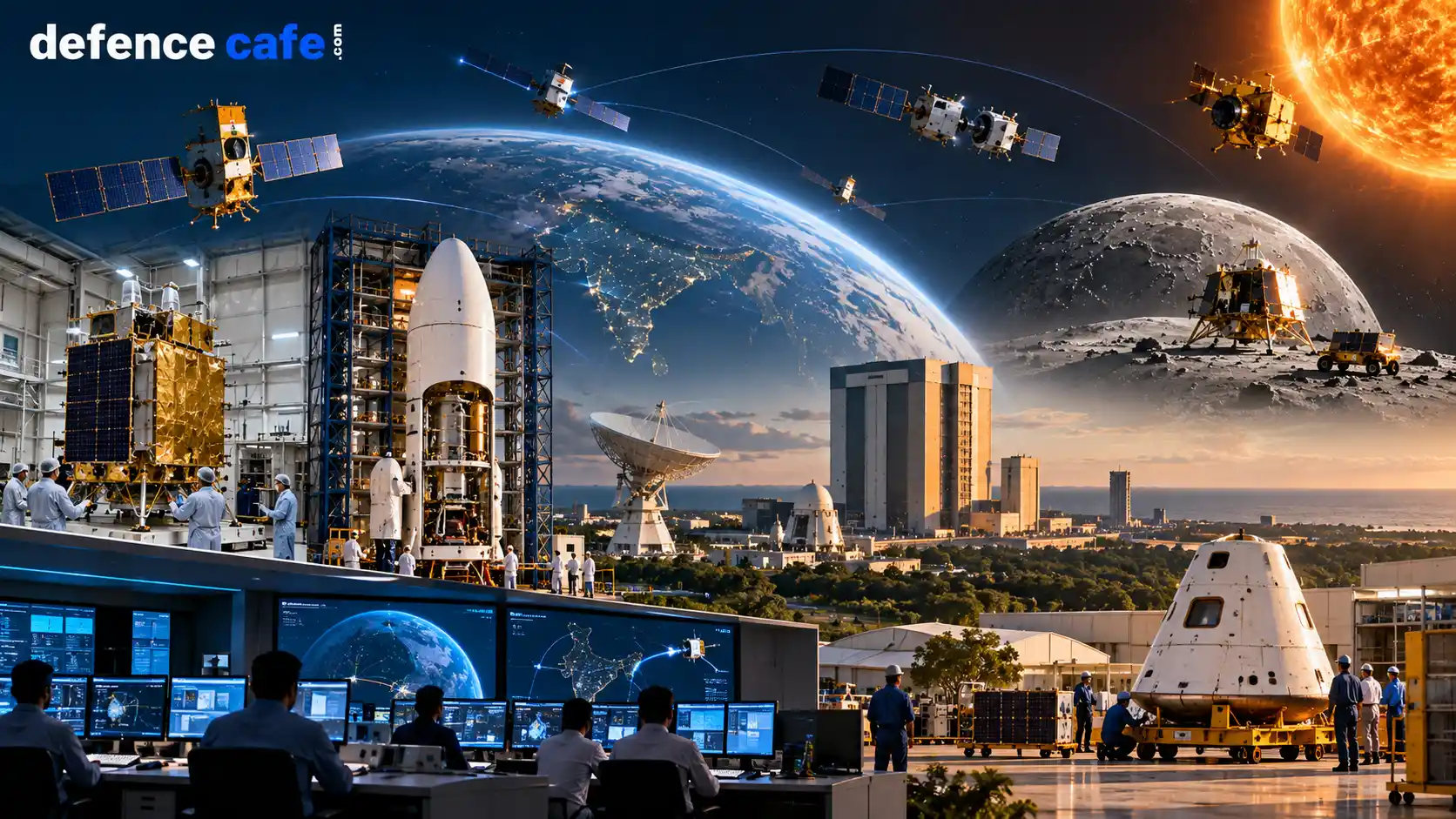
India’s space programme has moved well beyond demonstrating that it can place a satellite in orbit. Over the last two decades, Indian missions have progressively tackled lunar exploration, Mars, solar science, X-ray astronomy, Earth observation, autonomous space docking and human-spaceflight technologies.
The most visible milestones are the Chandrayaan missions and Aditya-L1. But the programme’s next phase is broader: Chandrayaan-4 is being developed as a lunar sample-return mission, LUPEX will investigate the Moon’s polar environment with Japan, Gaganyaan is moving toward human spaceflight, and the Bharatiya Antariksh Station is planned as a long-term orbital platform.
As of October 2026, several of India’s important missions are still producing scientific or technological value, while others have completed their planned mission phases. The key is to understand what each mission was designed to prove or study — and how one mission creates capabilities for the next.
How India’s Space Missions Have Evolved
India’s space exploration story did not begin with Chandrayaan-3. The programme developed through increasingly demanding scientific and technological missions.
Chandrayaan-1 demonstrated that India could operate a spacecraft around the Moon and contributed important evidence of lunar water. The Mars Orbiter Mission then pushed India’s deep-space navigation, communications and autonomous mission-management capabilities beyond Earth and lunar orbit.
Chandrayaan-2 attempted a considerably more complex mission involving an orbiter, lander and rover. Although the Vikram lander did not complete its planned soft landing, the orbiter continued operating and produced useful lunar observations.
Chandrayaan-3 then focused much more sharply on the technology India needed to demonstrate: safe lunar landing and surface mobility.
That progression is important. Space programmes rarely move from one successful mission directly to a dramatically harder mission. Instead, each mission reduces a different technical risk.
Major Indian Space Missions at a Glance
| Mission | Launch | Primary objective | Status / significance |
|---|---|---|---|
| Chandrayaan-1 | 2008 | Lunar mapping and scientific exploration | Completed; major early lunar science milestone |
| Mars Orbiter Mission | 2013 | Mars exploration and interplanetary technology demonstration | Completed; first Indian interplanetary mission |
| Chandrayaan-2 | 2019 | Lunar orbiter, lander and rover mission | Orbiter continued operating after the lander loss |
| Chandrayaan-3 | 2023 | Demonstrate safe lunar landing and roving | Mission objectives completed |
| Aditya-L1 | 2023 | Continuous observation of the Sun | Operational and producing scientific observations |
| XPoSat | 2024 | X-ray polarimetry and high-energy astrophysics | Operational |
| SpaDeX | 2024 | Autonomous rendezvous, docking and undocking | Docking, undocking and power-transfer demonstrations completed |
| NISAR | 2025 | Advanced Earth observation using dual-frequency radar | Operational and in science operations |
| Gaganyaan | In development | Human spaceflight to Low Earth Orbit | Uncrewed precursor programme progressing |
ISRO’s spacecraft and launch-mission records provide the mission dates and current status of many of these spacecraft. Recent government updates also identify Gaganyaan, Chandrayaan-4, Chandrayaan-5/LUPEX and the Venus Orbiter Mission among India’s major upcoming programmes.
Chandrayaan-1: The Mission That Opened India’s Lunar Science Programme
Launched on 22 October 2008 aboard PSLV-C11, Chandrayaan-1 was India’s first dedicated lunar mission.
The spacecraft carried 11 scientific instruments from India and international partners and was designed to map the Moon’s surface and study its mineralogical and chemical characteristics.
One of its most important results was evidence associated with water on the Moon. ISRO’s own mission material records the detection of water molecules and water-related signatures, helping establish lunar water as an important scientific subject for later exploration.
The mission also helped India develop deep-space communications, spacecraft operations and scientific-data handling capabilities that became useful for later planetary missions.
ISRO’s Chandrayaan-1 mission archive provides the mission history and scientific findings.
Mars Orbiter Mission: India’s First Interplanetary Mission
The Mars Orbiter Mission (MOM), widely known as Mangalyaan, launched on 5 November 2013 aboard PSLV-C25.
Its objectives were both technological and scientific. India had to demonstrate Earth-bound manoeuvres, a long cruise to Mars, Mars orbit insertion, deep-space communication and autonomous spacecraft operations.
The spacecraft carried five scientific payloads to study Martian surface features, morphology, mineralogy and atmosphere.
The mission was designed for six months but operated for more than seven years. ISRO describes MOM as India’s first interplanetary mission and notes that India became the fourth space agency to successfully place a spacecraft into Mars orbit.
ISRO’s Mars Orbiter Mission page explains the technological and scientific objectives.
Chandrayaan-2: A Difficult Mission That Still Produced Valuable Science
Chandrayaan-2 launched on 22 July 2019 using the GSLV Mk III-M1.
Unlike Chandrayaan-1, the mission combined three major elements: an orbiter, the Vikram lander and the Pragyan rover. Its central aim was to explore the lunar south-polar region through orbital observations and surface measurements.
The Vikram lander did not complete its planned soft landing. However, the mission was not a total failure: the orbiter remained functional and continued making observations of the Moon.
This distinction matters because planetary missions contain multiple independent objectives. A mission can lose one component while still returning significant scientific or engineering value through another.
ISRO’s mission documentation records that the Chandrayaan-2 orbiter substantially exceeded its originally planned one-year mission life.
ISRO’s Chandrayaan-2 spacecraft documentation details the orbiter, Vikram lander and Pragyan rover.
Chandrayaan-3: India’s Lunar Landing Demonstration
Chandrayaan-3 launched on 14 July 2023 aboard LVM3-M4 and successfully soft-landed the Vikram lander on the Moon on 23 August 2023.
The mission was intentionally more focused than Chandrayaan-2. Its principal objective was to demonstrate safe landing, rover movement and in-situ scientific experimentation.
The Pragyan rover conducted measurements using instruments including LIBS and APXS, while the lander carried instruments for measuring lunar surface temperature, seismic activity and the near-surface plasma environment.
Why the Landing Was Technically Important
A controlled lunar landing requires far more than simply reaching the Moon. The spacecraft has to perform precise navigation, braking and hazard-aware descent while dealing with communication delays and a very different gravitational environment from Earth.
The successful landing therefore demonstrated a group of capabilities rather than one isolated event.
Chandrayaan-3 Continued Producing Scientific Results
The mission’s scientific contribution has continued even after the lander and rover’s designed surface mission ended.
In September 2023, Vikram performed a hop experiment using residual propellant. ISRO later reported that this experiment demonstrated a capability relevant to future sample-return missions.
In 2026, new scientific analyses from Chandrayaan-3 continued to be published. ISRO reported findings from APXS measurements concerning the composition of material around the Shiv Shakti landing site, including comparisons with lunar meteorite material. Another 2026 study discussed the unusual properties of lunar regolith at the landing site based on the hop experiment.
These results show why a short-lived surface mission can continue generating scientific value after the spacecraft itself is no longer operational.
ISRO’s Chandrayaan-3 mission page records the mission timeline and surface experiments.
ISRO’s 2026 Chandrayaan-3 hop-experiment study covers the later analysis of the mission’s lunar-surface data.
Aditya-L1: Studying the Sun From Space
Aditya-L1 is India’s first dedicated space-based solar observatory.
Launched on 2 September 2023 aboard PSLV-C57, the spacecraft was placed into a halo orbit around the Sun-Earth L1 point on 6 January 2024.
L1 is a gravitationally useful region roughly 1.5 million kilometres from Earth in the Sun-Earth direction. From this location, Aditya-L1 can maintain a nearly continuous view of the Sun without regular occultation by Earth.
What Does Aditya-L1 Study?
The mission is designed to study different layers and processes of the Sun, including the photosphere and chromosphere, the corona, solar particles and the magnetic environment between the Sun and Earth.
Its seven scientific payloads allow researchers to observe the Sun using multiple wavelengths and measurement techniques.
In 2026, ISRO said more than 30 TB of Aditya-L1 scientific data had been placed in the public domain, with multiple scientific results published in peer-reviewed journals.
This is one reason Aditya-L1 matters beyond the mission itself: solar observations can improve scientific understanding of solar eruptions and the space environment that affects satellites and other technologies.
ISRO’s Aditya-L1 mission page provides the mission objectives and instrument information.
ISRO’s July 2026 Aditya-L1 update describes the continuing science programme and public-data availability.
XPoSat: India’s X-Ray Astronomy Capability
Space exploration is not limited to planets.
India launched XPoSat on 1 January 2024 to study the polarisation of X-rays emitted by cosmic sources. The mission carries POLIX and XSPECT payloads for studying X-ray polarisation, spectra and timing behaviour.
Its targets include extreme astronomical objects where matter and radiation behave under conditions that cannot be reproduced on Earth.
XPoSat therefore represents a different side of India’s space programme: using space platforms as scientific observatories rather than as Earth or planetary probes.
ISRO’s XPoSat mission page describes its scientific objectives and payloads.
SpaDeX: Why Docking Technology Matters
One of the most technically significant recent Indian demonstrations did not involve another planet at all.
The Space Docking Experiment (SpaDeX) used two small spacecraft to demonstrate autonomous rendezvous, docking and undocking in orbit.
The satellites first docked successfully on 16 January 2025. ISRO subsequently achieved undocking on 13 March 2025 and demonstrated a second autonomous docking in April 2025, followed by bidirectional power-transfer experiments.
Docking technology is important because future complex missions may require several spacecraft to operate as one system.
For example, sample-return architecture can involve separate launch and orbital elements. Human spaceflight and a future space station also require reliable rendezvous and docking technologies.
ISRO explicitly identifies docking as an enabling technology for ambitions including lunar sample return and the Bharatiya Antariksh Station.
ISRO’s SpaDeX mission page explains the original mission objectives.
ISRO’s April 2025 SpaDeX update records the second docking and power-transfer demonstration.
NISAR: A New Generation of Earth Observation
Launched on 30 July 2025 aboard GSLV-F16, NISAR is a joint NASA-ISRO Earth-observation mission using synthetic aperture radar.
Its significance lies in the combination of two radar frequency bands, L-band and S-band, allowing the spacecraft to study changes in Earth’s surface under a range of environmental conditions.
Unlike optical imaging missions that depend heavily on daylight and cloud-free views, radar can observe through clouds and in darkness. That makes NISAR particularly useful for monitoring changes in ecosystems, glaciers, forests, ground deformation and other dynamic processes.
As of 2026, ISRO states that NISAR is in its science operations phase, with S-band data being acquired and processed through the Indian ground-segment infrastructure.
ISRO’s July 2026 NISAR data-release update provides the current science-operations status.
Gaganyaan: India’s Human Spaceflight Programme
Gaganyaan represents a completely different level of systems engineering because a human-rated spacecraft must protect a crew throughout launch, orbit, re-entry and recovery.
The programme is designed around a Human Rated Launch Vehicle Mark-3 (HLVM3), crew module, service module, crew escape system, ground infrastructure, communications and recovery systems.
What Gaganyaan Is Intended to Do
The programme aims to demonstrate India’s capability to send a crew of three Indian astronauts into Low Earth Orbit and safely return them to Earth after a short-duration mission.
Government updates in 2026 state that the first uncrewed experimental mission carrying the Vyommitra half-humanoid is targeted for the fourth quarter of 2026. Two further uncrewed missions in the configuration of the crewed flight are planned before the first human orbital mission, which is targeted for 2027.
These dates are programme targets and should not be treated as completed launches.
Why the Uncrewed Missions Matter
Before astronauts fly, ISRO needs to validate the systems under realistic flight conditions.
That includes the launch vehicle, crew escape system, environmental control and life support, thermal protection, parachutes, communications, guidance and recovery procedures.
By August 2026, the government reported that development and ground testing of the HLVM3 propulsion stages and structures had been completed, while precursor tests and preparations for the first uncrewed flight were continuing.
Government of India / PIB — Gaganyaan programme update, July 2026 details the development status.
Government of India / PIB — Gaganyaan roadmap, August 2026 gives the latest publicly stated target sequence.
The Axiom-4 Mission and India’s Human-Spaceflight Preparation
Although Axiom-4 was not an Indian national mission, it was an important milestone for India’s human-spaceflight programme.
ISRO Gaganyatri Group Captain Shubhanshu Shukla travelled to the International Space Station as the Indian pilot on Axiom-4 in 2025. The mission launched on 25 June 2025 and concluded with the crew’s return in July.
During his 18-day stay aboard the ISS, Shukla participated in seven microgravity experiments coordinated with Indian institutions.
For India, the value of the mission extends beyond the astronaut’s time in orbit. It provided practical exposure to crew operations, microgravity experimentation, mission procedures and the operational environment of an international space station.
ISRO’s Axiom-4 mission conclusion records the 18-day ISS mission and its scientific activities.
Chandrayaan-4: From Landing to Bringing Moon Samples Home
The next major lunar step is not simply another landing.
Chandrayaan-4 has been approved as India’s lunar sample-return mission. Its purpose is to demonstrate the ability to land on the Moon, collect lunar material, launch a sample container from the lunar surface and return the collected samples to Earth.
That requires a much more complicated architecture than Chandrayaan-3.
According to government information released in 2026, the mission is targeted for 2027. Its architecture requires technologies including precise rendezvous and docking, lunar surface sampling, autonomous ascent, re-entry and thermal-protection systems.
In practical terms, Chandrayaan-4 is an attempt to close the loop that begins with lunar exploration: go there, collect material and bring it back for laboratories on Earth to study.
ISRO’s Chandrayaan-4 and future lunar exploration overview explains the mission architecture and its role in India’s long-term lunar strategy.
Government of India / PIB — Future lunar missions provides the latest public roadmap and target information.
Chandrayaan-5 / LUPEX: Exploring the Lunar South Polar Environment
LUPEX, or the Lunar Polar Exploration mission, is a joint India-Japan effort involving ISRO and JAXA. It is also referred to as Chandrayaan-5.
The mission is intended to conduct in-situ studies of the lunar polar region, including lunar volatiles and the properties of the surface and subsurface environment.
The polar regions are scientifically valuable because some areas receive extremely little sunlight and can preserve volatile materials for long periods.
As of the latest ISRO annual report available in 2026, LUPEX had received financial sanction, its implementation arrangement had been signed, a science working group had been constituted and the mission’s Preliminary Design Review had been completed.
Unlike Chandrayaan-4, LUPEX is better understood as a science and technology exploration mission rather than an immediate sample-return mission.
ISRO Annual Report 2025-26 contains the latest publicly reported development status for Chandrayaan-5/LUPEX.
Venus Orbiter Mission: India’s Next Planetary Target
India’s planetary programme is also expanding beyond the Moon.
The Venus Orbiter Mission has been approved to study Venus’s atmosphere, ionosphere, surface and subsurface environment and the interaction between the planet and the Sun.
ISRO’s current mission configuration calls for a launch in March 2028, using LVM3 as the identified candidate launch vehicle. The mission is planned to use aerobraking during its orbital insertion process before entering its intended science orbit.
The mission would add a completely different planetary environment to India’s exploration experience. Venus has a dense atmosphere and extreme surface conditions, making atmospheric science, thermal management and spacecraft operations fundamentally different from lunar missions.
ISRO’s official Venus Orbiter Mission overview describes the approved mission architecture and objectives.
Bharatiya Antariksh Station: India’s Longer-Term Human Spaceflight Goal
Gaganyaan is intended to demonstrate short-duration human spaceflight. The longer-term goal is to create a sustained Indian human presence in Low Earth Orbit.
The Bharatiya Antariksh Station (BAS) is planned as a five-module Indian space station. Government information says the first module, BAS-01, is planned for launch by 2028, with the station targeted for operationalisation by 2035.
A space station changes the nature of human spaceflight. Instead of proving that astronauts can survive a single mission, the challenge becomes long-duration life support, repeated crew transport, docking, resupply, microgravity research, station maintenance and orbital operations.
The development of docking technology through SpaDeX therefore has a direct strategic connection to this ambition.
Government of India / PIB — Bharatiya Antariksh Station update, July 2026 describes BAS-01 development and the five-module station plan.
What Comes After These Missions?
India’s future space programme is increasingly about capability building rather than isolated missions.
A lunar sample-return mission needs docking technology. A human space programme needs docking, crew escape, re-entry and life-support systems. A space station needs repeated rendezvous and cargo operations. Future lunar missions require increasingly capable landers and surface mobility. More ambitious planetary missions require stronger deep-space communications and navigation.
The technology therefore overlaps.
India’s Space Vision 2047 includes a Bharatiya Antariksh Station, an Indian crewed lunar mission and the development of advanced and reusable launch systems. The government has also approved work on a Next Generation Launch Vehicle (NGLV) and a third launch pad as part of the larger expansion of launch infrastructure.
India’s Next Major Space Milestones
| Programme | What it is intended to demonstrate | Latest publicly stated timeline |
|---|---|---|
| Gaganyaan | Indian human spaceflight to Low Earth Orbit | First uncrewed experimental mission targeted Q4 2026; crewed mission targeted 2027 |
| Chandrayaan-4 | Lunar sample collection and return to Earth | Targeted 2027 |
| BAS-01 | First module of Bharatiya Antariksh Station | Planned by 2028 |
| Venus Orbiter Mission | Venus atmospheric, surface and planetary-science studies | Targeted March 2028 |
| Chandrayaan-5 / LUPEX | Lunar polar volatile and surface/subsurface studies | Under development; no firm public launch date stated in the latest ISRO annual-report material |
| NGLV | Next-generation, more capable launch architecture | Under development |
These are officially stated targets and development milestones, not guaranteed launch dates. Space missions regularly change schedules because hardware testing, qualification, weather, safety and mission readiness can affect the timeline.
Frequently Asked Questions
What is India’s most successful Moon mission?
Chandrayaan-3 achieved India’s planned lunar soft-landing and rover objectives, while Chandrayaan-1 and Chandrayaan-2 made major contributions to lunar science and orbital exploration. Each mission had a different purpose, so “most successful” depends on the capability being measured.
Is Aditya-L1 still operational?
Yes. ISRO lists Aditya-L1 as operational, and 2026 updates show that the spacecraft continues scientific observations and public-data releases.
What is Chandrayaan-4?
Chandrayaan-4 is India’s planned lunar sample-return mission. It is intended to collect lunar material, return it from the Moon and bring the samples back to Earth for laboratory analysis.
What is LUPEX or Chandrayaan-5?
LUPEX is a joint ISRO-JAXA lunar polar exploration mission intended to study lunar volatiles and the Moon’s polar surface and subsurface environment in situ.
When will Gaganyaan launch?
The latest government roadmap states that the first uncrewed experimental Gaganyaan mission is targeted for the fourth quarter of 2026. Additional uncrewed missions are planned before the first crewed mission, which is targeted for 2027.
What did SpaDeX achieve?
SpaDeX demonstrated autonomous rendezvous, docking and undocking of two spacecraft. ISRO later demonstrated a second docking and power transfer between the satellites, strengthening technologies needed for more complex future missions.
What is the Bharatiya Antariksh Station?
It is India’s planned five-module space station in Low Earth Orbit. The first module, BAS-01, is planned for launch by 2028, with the station targeted for operationalisation by 2035.
Conclusion
India’s space programme is entering a phase in which individual missions increasingly connect to one another.
Chandrayaan-1 helped open lunar science. Chandrayaan-2 expanded orbital and landing ambitions. Chandrayaan-3 demonstrated a successful soft landing and surface operations. Aditya-L1 established a continuing solar observatory. SpaDeX demonstrated an essential orbital technology. NISAR brought advanced joint Earth-observation capability into science operations. Gaganyaan is now applying this accumulated experience to human spaceflight.
The next step is even more demanding: bringing lunar samples back to Earth, exploring the lunar poles in greater detail, reaching Venus, establishing an Indian space station and eventually pursuing more ambitious human and planetary missions.
That makes the story of India’s space programme less about one spectacular launch and more about a growing chain of capabilities. Each mission adds another piece — navigation, landing, robotics, science, docking, human-rating, re-entry or long-duration orbital operations — to a system designed for increasingly complex missions beyond Earth.
Sources & Further Reading
- ISRO — Spacecraft Missions: official mission status and launch records
- ISRO — Chandrayaan-1 Mission
- ISRO — Mars Orbiter Mission
- ISRO — Chandrayaan-2 Spacecraft
- ISRO — Chandrayaan-3 Mission
- ISRO — Chandrayaan-3 2026 Hop Experiment and Lunar Regolith Findings
- ISRO — Aditya-L1 Solar Mission
- ISRO — Aditya-L1 2026 Science Observation Programme
- ISRO — XPoSat Mission
- ISRO — SpaDeX Mission
- ISRO — Second SpaDeX Docking and Power Transfer
- ISRO — NISAR S-Band Data Products and Science Operations
- Government of India / PIB — Gaganyaan Programme Development Update, July 2026
- Government of India / PIB — Gaganyaan and Human Space Exploration Roadmap, August 2026
- Government of India / PIB — India’s Future Lunar and Human Space Missions
- ISRO — Chandrayaan-4 and Venus Orbiter Mission: Approved Configurations and Objectives
- ISRO — Annual Report 2025-26: Chandrayaan-4, LUPEX, Venus Orbiter Mission and Gaganyaan
- ISRO — Axiom-4 Mission: Return of Gaganyatri Shubhanshu Shukla
