


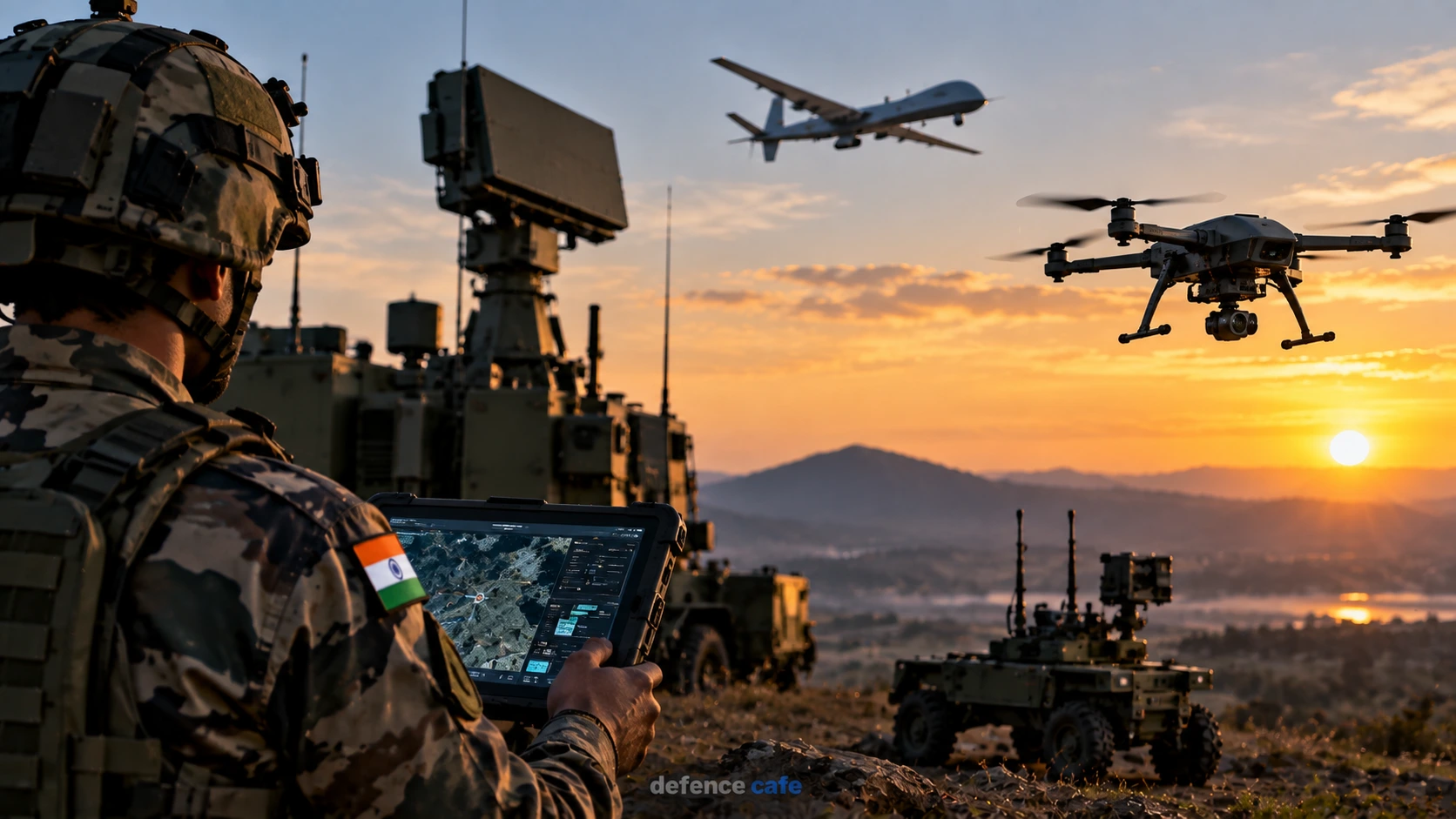
Artificial intelligence is becoming part of the military technology stack alongside radar, communications, satellites, cyber systems and autonomous platforms. Its role is not limited to autonomous weapons. AI can help military organisations process large amounts of information, identify patterns in sensor data, support logistics, improve surveillance and provide decision-support tools to commanders.
India has been developing this capability through a combination of government policy, DRDO research, Defence AI Council initiatives, military projects, public-sector development and private-sector innovation. In 2026, the Ministry of Defence also launched a policy document on Artificial Intelligence in the Military Domain alongside SAMADH, an AI platform developed by DRDO’s Centre for Artificial Intelligence and Robotics (CAIR) for situational awareness involving aerial drones and autonomous/swarm environments. :contentReference[oaicite:0]{index=0}
The important point is that AI does not replace the entire military system. Instead, it is increasingly being integrated into existing sensors, command networks, aircraft, ships, vehicles, unmanned systems and logistics chains.
What Is AI in Defence?
AI in defence refers to the use of artificial intelligence and machine-learning techniques in military systems, support infrastructure and operational decision-making.
In simple terms, traditional software usually follows rules explicitly written by developers. Machine-learning systems can instead learn patterns from data and use those patterns to classify, predict or recognise new inputs.
For a military organisation, this matters because modern forces generate enormous quantities of information. Radar, electro-optical sensors, satellites, aircraft, ships, unmanned systems, communications networks and intelligence sources can all produce data.
The challenge is no longer simply collecting information. It is processing the right information quickly enough to support a decision.
Where AI Can Be Used in Military Operations
AI has applications across almost every stage of the military information cycle, although the degree of autonomy can vary considerably from one system to another.
| Area | Potential AI application | Why it matters |
|---|---|---|
| Surveillance | Object detection, classification and pattern recognition in imagery and sensor feeds. | Helps operators process large volumes of information. |
| Command & control | Data fusion, decision-support tools and automated information processing. | Can reduce the time required to understand complex situations. |
| Autonomous systems | Navigation, perception, route planning and coordination for unmanned platforms. | Allows machines to perform selected tasks with reduced human intervention. |
| Logistics | Demand forecasting, maintenance prediction, inventory optimisation and routing. | Can improve the availability and movement of equipment and supplies. |
| Cyber defence | Anomaly detection, network monitoring and automated analysis. | Helps identify unusual behaviour across large digital environments. |
| Electronic warfare | Signal classification, threat identification and spectrum analysis. | Can help process complex electromagnetic environments. |
| Training & simulation | Adaptive simulations, synthetic environments and AI-assisted analysis. | Can create more varied training and wargaming scenarios. |
1. AI for Battlefield Surveillance
One of the most straightforward military applications of AI is computer vision.
Military sensors can produce enormous quantities of photographs, video and electro-optical or infrared imagery. Human analysts remain essential, but manually examining every frame or image is time-consuming.
Machine-learning systems can be trained to identify objects, classify imagery and highlight patterns that deserve human attention.
DRDO’s published AI/ML technology portfolio includes AI-based image and video analytics for intelligence, object detection and classification, AI/ML-based satellite sensor-data processing and other intelligence-related applications. :contentReference[oaicite:1]{index=1}
The practical concept is relatively simple:
- A sensor collects information.
- An AI system processes the data.
- The system identifies or classifies patterns.
- Relevant information is presented to a human operator.
- The operator or command system decides what action is appropriate.
This can be especially useful when the volume of information is too large for people to process manually in the available time.
2. AI and Situational Awareness
Military operations increasingly depend on having a common picture of what is happening across multiple domains.
A commander may need to combine information from aircraft, ground sensors, ships, satellites, unmanned systems, communications networks and intelligence sources. These feeds can differ in format, reliability, timing and resolution.
AI can assist with data fusion — combining information from different sources to identify patterns or relationships.
DRDO’s technology portfolio specifically lists AI/ML-based command-and-control applications, AI-powered C4I systems and maritime-domain-awareness applications using data analytics and machine learning. :contentReference[oaicite:2]{index=2}
This does not mean an AI system automatically becomes the commander. In many applications, its role is closer to that of an advanced analytical assistant that helps humans make sense of a complicated information environment.
3. AI in Command and Control
Command and control, often abbreviated as C2, refers to the systems and processes through which military organisations understand situations, communicate decisions and coordinate forces.
AI can support this process by:
- organising incoming information;
- identifying patterns across multiple data sources;
- highlighting anomalies;
- prioritising information for human review;
- supporting planning and simulation; and
- helping generate or summarise large volumes of information.
India’s defence establishment has been working on AI-enabled command-and-control capabilities for several years. DRDO’s current technology portfolio includes AI/ML-based C2 applications, AI-powered C4I systems and AI-based battlefield-management command-and-control research. :contentReference[oaicite:3]{index=3}
Why Decision Support Is Important
The value of AI in command systems is not necessarily that it makes decisions independently.
Its value can be the reduction of the information-processing burden on people.
If a command centre receives thousands of data points, an AI system may help identify which information deserves immediate attention. The human decision-maker can then assess the relevant information rather than manually searching through every available data stream.
4. AI and Autonomous Systems
Autonomous systems are among the most visible applications of AI in defence.
An autonomous platform needs some combination of perception, navigation, decision-making and control. AI can contribute to several of these functions.
For example, an unmanned vehicle may need to recognise obstacles, estimate its position, select a route and respond to changes in its environment.
DRDO’s published autonomous-systems portfolio includes research into autonomous environment perception, event detection, navigation and mission planning, autonomous target identification and classification, unmanned ground and underwater systems, human-robot teaming and autonomous aerial navigation. :contentReference[oaicite:4]{index=4}
This is broader than the popular idea of a completely autonomous combat machine. Many autonomous military applications can instead involve navigation, surveillance, logistics, reconnaissance or support tasks.
5. AI and Drone Operations
The rapid growth of drones has created another major application area for AI.
A drone can collect video, imagery and other sensor information continuously. AI can help analyse this information, identify objects and provide situational awareness.
In March 2026, India launched SAMADH — Situational Awareness for Aerial Drones. Developed by DRDO’s CAIR, the platform was described by the Ministry of Defence as a scalable and extensible sovereign AI platform intended to provide real-time situational awareness across warfare environments, including autonomous and swarm-drone environments. :contentReference[oaicite:5]{index=5}
The significance of such systems is not simply automation. It is the ability to process information generated by increasingly numerous unmanned platforms.
6. AI in Electronic Warfare
The electromagnetic spectrum has become a major operational environment.
Military forces use radar, communications, navigation systems, datalinks and other electromagnetic technologies. Electronic warfare systems therefore have to deal with a large number of signals that can change rapidly.
AI and machine learning can assist with tasks such as signal classification, pattern recognition and threat identification.
DRDO’s published electronic-warfare technology portfolio includes AI/ML frameworks and algorithms for electronic-warfare applications, signal-classification systems, radar-threat fingerprinting and smart-jamming research. :contentReference[oaicite:6]{index=6}
The objective is not simply to automate electronic warfare. AI can help systems recognise patterns in an environment where the number and complexity of signals may exceed what a human operator can efficiently evaluate in real time.
7. AI in Logistics and Predictive Maintenance
Not all military AI applications are directly connected to combat.
Large armed forces operate fleets of aircraft, ships, armoured vehicles, trucks, generators and other equipment. Maintaining those assets requires enormous amounts of information about operating hours, components, inspections, failures and spare parts.
AI can be used to identify patterns associated with equipment degradation and help predict when maintenance may be required.
Similarly, machine-learning systems can support inventory forecasting and logistics planning by analysing historical consumption, demand patterns and transportation requirements.
This is one reason AI can have an impact far away from the battlefield. A military platform that is unavailable because a critical component is not ready cannot contribute to an operation, regardless of how advanced its onboard technology may be.
8. AI for Intelligence and Information Processing
Military intelligence involves much more than collecting information. Analysts have to organise, compare, interpret and communicate it.
Natural-language processing can assist with large volumes of text, while computer vision can process imagery. AI systems can also support translation, document summarisation and information retrieval.
DRDO’s current AI/ML portfolio includes autonomous document summarisation, machine translation, text analytics, speech processing, explainable AI and large-document summarisation and cross-lingual question-answering technologies. :contentReference[oaicite:7]{index=7}
These capabilities can be particularly useful when analysts need to process information from multiple languages and sources.
9. AI and Multi-Domain Operations
Modern military operations increasingly connect land, sea, air, space, cyber and information environments.
India’s 2026 Ran Samwad discussions described multi-domain operations as requiring interaction across physical, synthetic and cognitive realms, while the Tri-Services Future Warfare Course held in 2026 covered AI, autonomous systems, cyber and cognitive warfare, information warfare and future operations across land, maritime, air and space domains. :contentReference[oaicite:8]{index=8}
AI becomes particularly relevant in such an environment because each additional domain produces more information.
The challenge is therefore not simply developing a smarter individual platform. It is developing systems that can connect information across platforms and domains while keeping the resulting information reliable and understandable to humans.
India’s Defence AI Architecture
India’s formal effort to integrate AI into defence predates the current wave of generative AI.
In 2018, the Ministry of Defence established a multi-stakeholder task force to examine the strategic implications of AI for national security and defence. The work involved government, the armed forces, academia, industry, DRDO, defence public-sector organisations and other stakeholders. :contentReference[oaicite:9]{index=9}
This was followed by institutional initiatives including the Defence AI Council (DAIC) and Defence AI Project Agency (DAIPA), intended to provide policy guidance and institutional support for AI adoption in the armed forces.
The ecosystem now includes several layers:
| Layer | Role |
|---|---|
| Ministry of Defence | Policy, institutional direction and defence capability priorities. |
| Defence AI Council / related institutions | Policy and coordination for defence-AI adoption. |
| DRDO | Research and development of AI, robotics, command-and-control, cyber and mission-critical technologies. |
| Armed Forces | Operational requirements, evaluation, integration and employment of AI-enabled capabilities. |
| DPSUs and industry | Development, engineering, production and integration of AI-enabled defence systems. |
| Start-ups and academia | New algorithms, software, autonomous systems, sensors and specialised technologies. |
DRDO’s Role in Defence AI
DRDO has dedicated capabilities in artificial intelligence, robotics, computational systems and cyber security.
The organisation’s Micro Electronic Devices, Computational Systems & Cyber Security cluster includes work on artificial intelligence, robotics, command and control, networking, secure computing, cryptology and cyber security for mission-critical applications. :contentReference[oaicite:10]{index=10}
Its Centre for Artificial Intelligence & Robotics, or CAIR, is one of the key laboratories involved in this area.
DRDO’s published technology portfolio illustrates how broad the research agenda has become. It includes AI-based imagery, satellite-data processing, autonomous systems, natural-language processing, AI-enabled command systems, electronic warfare and human-machine teaming. :contentReference[oaicite:11]{index=11}
AI in India’s Defence Industry
AI development is not restricted to government laboratories.
India’s defence innovation ecosystem includes defence public-sector companies, private companies, technology firms, start-ups and academic institutions. The iDEX programme is one of the mechanisms through which innovators and entrepreneurs can develop defence technologies.
The Department of Defence Production’s iDEX programme specifically identifies AI/ML, computer vision, RF countermeasures and anti-drone technologies among the technologies being developed through its innovation ecosystem. :contentReference[oaicite:12]{index=12}
This matters because defence AI requires more than algorithms. Operational systems need sensors, processors, communications, cybersecurity, software integration, testing and long-term support.
What Are the Biggest Challenges of Military AI?
AI can process information quickly, but speed does not automatically mean correctness.
Military environments are particularly difficult because the data may be incomplete, deceptive, noisy or deliberately manipulated.
1. Reliability
An AI model trained under one set of conditions may perform differently when the environment changes. A system that works well during testing may encounter unfamiliar situations in actual operations.
2. Adversarial Manipulation
Adversaries can deliberately attempt to deceive AI systems through manipulated data, camouflage, electronic interference or other methods designed to exploit weaknesses in automated recognition.
3. Cybersecurity
AI systems themselves become potential targets. Their models, training data, sensors, communications links and computing infrastructure all require protection.
4. Explainability
In high-consequence environments, operators may need to understand why an AI system produced a particular recommendation or classification.
5. Data
AI depends heavily on high-quality data. Defence datasets can be limited, classified, unevenly distributed or difficult to label. Building reliable datasets can therefore be as important as developing the algorithm itself.
6. Human Oversight
Some military decisions carry consequences that make human responsibility especially important. The appropriate degree of human involvement can differ depending on the system, mission and level of risk.
India’s Approach to Trustworthy AI
India’s defence establishment has explicitly addressed the reliability and trustworthiness problem.
In October 2024, the Ministry of Defence unveiled the Evaluating Trustworthy Artificial Intelligence (ETAI) Framework and Guidelines for the Armed Forces. The framework identifies five broad principles: reliability and robustness, safety and security, transparency, fairness and privacy. :contentReference[oaicite:13]{index=13}
The framework is important because defence AI cannot be evaluated solely on whether an algorithm produces an accurate result under normal conditions. It must also be assessed for resilience, safety, security and behaviour under adverse conditions.
AI Does Not Automatically Mean Autonomous Weapons
This distinction is important.
Artificial intelligence is a technology for processing information or performing tasks that can involve learning, perception, prediction or decision support.
Autonomy refers to the ability of a system to perform functions with varying degrees of human intervention.
A military AI system can therefore be completely non-autonomous. For example, an AI tool that analyses satellite imagery and highlights objects for an analyst is using AI without independently controlling a weapon.
Similarly, an autonomous navigation system can control the movement of an unmanned vehicle without independently deciding whether to use force.
Keeping these concepts separate is essential when discussing the future of military technology.
What AI Could Change in Future Military Operations
The long-term change may come from the combination of several technologies rather than AI acting alone.
Consider a future network in which sensors on aircraft, ships, ground systems, satellites and unmanned platforms continuously generate information. AI systems could help process these feeds, identify patterns, prioritise information and provide decision-support outputs to human operators.
That would shift some military advantage away from individual platforms and toward how effectively an entire force can collect, process, share and act on information.
India’s 2026 defence discussions increasingly reflect this direction. The Ministry of Defence has highlighted AI, autonomous systems, data analytics and secure communications as areas requiring continued capability development, while the Tri-Services Future Warfare Course has treated AI and autonomous systems as part of the broader future-warfare environment. :contentReference[oaicite:14]{index=14}
Why AI in Defence Matters for India
India operates across a large and complex security environment, while its armed forces manage equipment and information across land, sea, air, space and cyber domains.
AI can potentially help address some of the resulting information and resource challenges by improving surveillance, processing, logistics, training and decision support.
At the same time, developing sovereign AI capability matters because critical defence systems cannot always depend on external technology, datasets or cloud infrastructure.
For India, the emerging objective is therefore broader than simply acquiring AI-enabled equipment. It involves building an ecosystem of indigenous algorithms, computing infrastructure, secure data, sensors, autonomous platforms, skilled personnel and trusted software.
What to Watch Next
- AI-enabled command and control: greater integration of sensor data and decision-support tools across services.
- Autonomous and uncrewed systems: wider use of AI for perception, navigation, coordination and surveillance.
- AI-enabled electronic warfare: faster classification and interpretation of increasingly complex electromagnetic environments.
- Defence robotics: greater experimentation with unmanned ground, aerial and underwater systems.
- Trustworthy AI: stronger emphasis on testing, reliability, cybersecurity, explainability and human oversight.
- Indigenous computing and data: greater attention to the infrastructure required to train and operate military AI systems securely.
The direction is not simply toward machines making more decisions. It is toward military organisations becoming increasingly data-driven and networked, with AI acting as one of the tools used to turn information into operationally useful insight.
Frequently Asked Questions
What is AI in defence?
AI in defence refers to the use of artificial intelligence and machine learning in military systems and support functions such as surveillance, intelligence analysis, command and control, logistics, autonomous systems and electronic warfare.
How is AI used by the Indian military?
India is developing and evaluating AI applications across surveillance, command and control, autonomous systems, intelligence processing, logistics and electronic warfare. DRDO’s published technology portfolio includes AI-enabled imagery analysis, satellite-data processing, autonomous systems, C2 applications and electronic-warfare research.
What is SAMADH in Indian defence AI?
SAMADH stands for Situational Awareness for Aerial Drones. Developed by DRDO’s Centre for Artificial Intelligence and Robotics, it was launched in 2026 as a sovereign AI platform for real-time situational awareness, including autonomous and swarm-drone environments.
Does AI mean autonomous weapons?
No. AI can be used for many non-autonomous functions, including imagery analysis, logistics, document processing, surveillance and decision support. Autonomy refers to the degree to which a system can perform functions without direct human intervention.
What is the role of DRDO in defence AI?
DRDO conducts research and develops technologies involving AI, machine learning, robotics, command and control, electronic warfare, autonomous systems, cyber security and related mission-critical applications.
What are the biggest risks of AI in defence?
Key concerns include reliability, cybersecurity, adversarial manipulation, data quality, explainability, privacy and determining appropriate levels of human oversight for high-consequence applications.
Conclusion
AI is becoming an increasingly important layer of military technology, but its role is broader than autonomous weapons or futuristic battlefield robots.
Its immediate value can be seen in much more practical areas: processing sensor data, analysing imagery, supporting commanders, improving logistics, detecting patterns, assisting autonomous navigation and helping military organisations understand increasingly complex information environments.
India’s defence AI ecosystem is developing across the Ministry of Defence, armed forces, DRDO, defence companies, start-ups and academia. Programmes such as SAMADH and the ETAI framework illustrate two sides of that effort: building useful AI capabilities while also addressing reliability and trustworthiness.
The larger transformation is likely to be gradual. AI will increasingly become part of the infrastructure connecting sensors, platforms, people and decisions. The military systems that benefit from it will not necessarily be the ones with the most autonomy, but those that can use AI effectively while maintaining security, reliability and appropriate human control.
Sources & Further Reading
- Ministry of Defence / PIB — Artificial Intelligence in the Military Domain and launch of SAMADH
- Ministry of Defence / PIB — Evaluating Trustworthy Artificial Intelligence Framework and Guidelines for the Armed Forces
- DRDO — AI/ML Technology: Research and Development Portfolio
- DRDO — C4ISR: AI/ML-Based Command, Control and Situational-Awareness Technologies
- DRDO — Autonomous Systems and Robotics
- DRDO — Artificial Intelligence and Electronic-Warfare Technologies
- Department of Defence Production — iDEX Products and Defence Innovation
- Ministry of Defence / PIB — Government initiative on Artificial Intelligence for National Security and Defence
- Ministry of Defence / PIB — Fourth Tri-Services Future Warfare Course, 2026
