


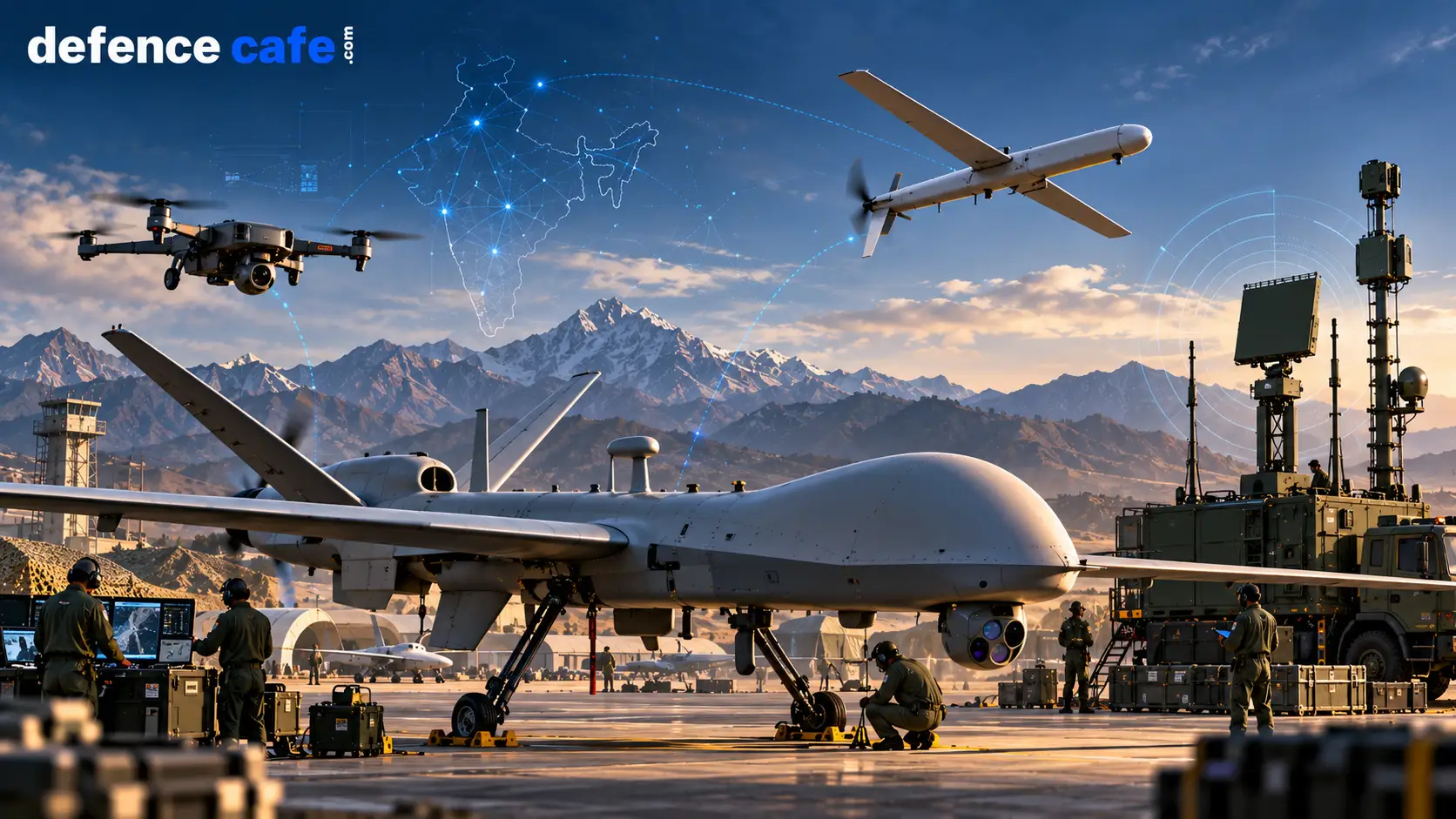
A military drone is no longer simply a remotely controlled aircraft with a camera. Modern unmanned systems can perform intelligence, surveillance and reconnaissance, carry specialised sensors, support communications, transport supplies, operate as part of a coordinated swarm, or function as an expendable weapon such as a loitering munition.
At the same time, the spread of small and inexpensive drones has created a second technological race: how to detect, identify, track and defeat them.
India is developing this capability on both sides of that equation. The armed forces are expanding their use and evaluation of unmanned systems, while DRDO, industry and the Services are building counter-UAS technologies ranging from radar and electro-optical sensors to electronic warfare and directed-energy systems.
That makes the modern drone battlefield less about a single aircraft and more about a connected ecosystem of sensors, communications, software, autonomy, weapons and countermeasures.
What Is a Military Drone?
The word “drone” is widely used, but it is not a particularly precise technical term.
In defence terminology, you will often encounter UAV, UAS and RPAS.
| Term | Meaning | Simple explanation |
|---|---|---|
| UAV | Unmanned Aerial Vehicle | The aircraft itself, operating without an onboard pilot. |
| UAS | Unmanned Aircraft System | The aircraft plus the control station, communications links and associated equipment. |
| RPAS | Remotely Piloted Aircraft System | A system in which the aircraft is remotely piloted from another location. |
| UCAV | Unmanned Combat Aerial Vehicle | An unmanned aircraft designed specifically for combat missions. |
DRDO’s published work on unmanned aircraft systems treats UAVs as a broad engineering field covering aircraft design, control, payloads, operations and system integration.
The important distinction is that not every military drone is armed. A surveillance UAV can be completely unarmed and still be an important military asset because the information it collects can support targeting, movement, maritime awareness or battlefield decision-making.
What Are Military Drones Used For?
Military UAVs can perform very different jobs depending on their size, endurance, sensors and communications architecture.
| Mission | What the drone does | Typical capability |
|---|---|---|
| ISR | Collects intelligence, surveillance and reconnaissance information. | Electro-optical, infrared, radar or other sensors. |
| Targeting | Helps locate and monitor objects of military interest. | Long-endurance sensors and secure data links. |
| Strike | Delivers weapons or functions as an expendable attack system. | Weapon payloads or integrated warhead. |
| Electronic warfare | Supports electronic sensing, interference or spectrum operations. | Electronic-support and electronic-attack payloads. |
| Communications | Acts as an airborne relay to extend connectivity. | Communications payloads and data links. |
| Logistics | Moves supplies, equipment or other small payloads. | Rotary-wing or specialised cargo UAVs. |
| Swarm operations | Multiple unmanned systems work together toward a shared mission. | Coordination, autonomy and distributed sensing. |
The practical value of a drone depends less on the aircraft’s appearance than on its payload, endurance, communications architecture and ability to generate useful information.
MALE and HALE Drones Explained
One common way of describing larger military UAVs is by altitude and endurance.
MALE: Medium Altitude Long Endurance
MALE systems are designed to remain airborne for long periods while operating at medium altitudes. Their mission emphasis is often persistent surveillance and reconnaissance, although some systems can carry weapons.
India’s armed forces have continued to pursue this class of capability. In August 2025, the Defence Acquisition Council granted an Acceptance of Necessity for MALE Remotely Piloted Aircraft for the three Services, with the Ministry of Defence describing the proposed systems as capable of carrying multiple payloads and weapons for long-endurance missions.
HALE: High Altitude Long Endurance
HALE systems operate at higher altitudes and are designed for very long-duration missions. Their major value is persistence: one aircraft can remain over a large area for an extended period and continuously contribute to the maritime or land surveillance picture.
The Indian Navy added another layer to this capability in August 2026 when the Ministry of Defence signed a contract to lease two MQ-9B Sea Guardian HALE RPAS for 30 months. The government said the systems would strengthen maritime domain awareness and provide persistent intelligence, surveillance and reconnaissance coverage over the Indian Ocean Region.
This illustrates an important point: an unmanned aircraft can be valuable even when it is not intended to enter heavily defended airspace. Its ability to stay airborne and collect information over time can itself be the capability.
What Is a Loitering Munition?
A loitering munition sits between conventional UAVs and guided weapons.
Unlike a conventional reconnaissance UAV, it is designed as an expendable weapon. It can travel toward an operational area, remain airborne while searching for a suitable target and then conduct a terminal attack.
NATO’s Munitions Safety Information Analysis Center describes loitering munitions as hybrid systems combining characteristics associated with missiles and unmanned aircraft. The exact degree of autonomy differs among systems.
This distinction matters because the phrase “kamikaze drone” is often used loosely for several different systems. A commercially derived drone modified to carry an explosive payload is not necessarily the same thing as a purpose-designed loitering munition.
Why Loitering Munitions Are Different
A conventional missile generally follows a planned engagement sequence toward a target. A loitering munition adds a period in which the system can remain airborne in the target area before the terminal phase.
That can provide a degree of timing flexibility and target-search capability that conventional point-to-point weapons do not inherently provide.
India’s recent procurement activity shows that this category is becoming more prominent. On 14 August 2026, the Ministry of Defence announced contracts worth approximately ₹1,577 crore with Tata Advanced Systems Limited and NIBE Private Limited for Loiter Munition Systems, associated munitions and accessories for the Indian Army.
The acquisition followed a December 2025 Acceptance of Necessity for Loiter Munition Systems for Army artillery regiments.
An Acceptance of Necessity is an important acquisition milestone, but it should not be confused with a completed contract, delivery or operational induction.
What Is a Drone Swarm?
A drone swarm is not simply “many drones flying together.”
The idea is that multiple unmanned systems can coordinate their behaviour or exchange information so that the group performs tasks more effectively than isolated aircraft.
Depending on the system, coordination can involve:
- shared information from multiple sensors
- distributed surveillance
- coordinated movement
- automatic task allocation
- networked tracking
- human supervision over a larger group of aircraft
Not every swarm is fully autonomous. A system can have automated coordination while still keeping people responsible for important decisions.
India’s Swarm-Technology Push
The Indian Air Force has been developing swarm-related technologies through the Mehar Baba Competition.
In April 2026, the IAF launched Mehar Baba Competition-3, themed “Collaborative Drone-Based Surveillance Radars”. The stated objective is to develop a proof of concept in which a collaborative swarm of unmanned systems can function as an airborne radar network capable of detecting, tracking and reporting aerial targets to a central monitoring station.
The initiative shows how India’s drone strategy is moving beyond individual aircraft toward distributed sensing.
Why Small Drones Are Such a Difficult Defence Problem
A small quadcopter is not necessarily a sophisticated military aircraft, but its size can make it surprisingly difficult for conventional air-defence systems to deal with.
DRDO has explicitly highlighted several reasons for this challenge: small drones can be slow-moving, fly at low altitude, have small physical signatures and can sometimes resemble birds or other objects in a cluttered environment.
This creates a detection problem before it even becomes an interception problem.
A large, fast aircraft can generate a strong and relatively predictable radar picture. A small low-flying drone can be mixed into buildings, terrain, vegetation, birds and other sources of clutter.
The result is a need for multiple types of sensors working together.
How Counter-Drone Technology Works
Counter-UAS, or CUAS, is best understood as a layered process rather than a single weapon.
A typical architecture has four broad stages:
- Detect the object.
- Identify and track it with enough confidence to determine what it is doing.
- Decide whether it is a threat and what response is appropriate.
- Defeat the drone through an electronic or physical effect.
DRDO’s counter-drone documentation describes this multi-sensor approach because no single sensor is guaranteed to provide reliable detection, tracking and identification against every small UAV.
1. Radar
Radar provides detection and tracking information using reflected radio-frequency energy. It is particularly useful for establishing the location and movement of airborne objects.
Counter-drone radars are designed around the difficult characteristics of small, low-flying targets rather than assuming that the target behaves like a conventional fighter or large aircraft.
2. Radio-Frequency Detection
Many remotely operated drones communicate through radio-frequency links. A counter-UAS system can therefore use spectrum sensing to look for relevant emissions and help identify a drone or its control activity.
This is one reason electronic warfare is increasingly connected to counter-drone defence.
3. Electro-Optical and Infrared Sensors
Once a suspicious object is detected, optical and infrared sensors can help determine what it actually is.
Visible-light cameras can provide identification during daylight, while infrared sensors can support detection and tracking under low-light conditions and provide another source of information for the command system.
4. Command and Control
Information from several sensors needs to reach a system that can correlate the tracks, reduce false alarms and assign an appropriate response.
This is why a counter-drone solution is better thought of as a system of systems rather than a single jammer or gun.
Soft Kill vs Hard Kill
Counter-UAS systems generally use two broad categories of defeat mechanisms.
| Method | Basic idea | Typical examples |
|---|---|---|
| Soft kill | Disrupt or interfere with the drone without physically destroying it. | RF jamming and anti-GNSS measures. |
| Hard kill | Physically disable or destroy the drone. | Directed-energy or other kinetic interception mechanisms. |
The balance between the two depends on the situation. Electronic defeat may be effective in one scenario but less useful against a system designed to operate without a conventional external control link. A hard-kill approach may solve the immediate threat but introduces its own requirements involving engagement accuracy, safety and collateral effects.
For that reason, modern counter-drone architectures increasingly combine several mechanisms instead of relying on one answer.
India’s D4 Counter-Drone System
India has already developed a publicly documented indigenous counter-drone architecture known as the D4 Counter Drone System.
The Government’s Department of Defence Production describes the D4, jointly developed by DRDO and produced by Bharat Electronics Limited, as a system capable of real-time search, detection, tracking and neutralisation of micro and small UAVs.
Its publicly described architecture includes:
- drone-detection and tracking radar
- electro-optical and infrared sensing
- radio-frequency detection and jamming
- anti-GNSS measures
- laser-directed-energy capability
- integrated command and control
The significance of the system is not that one technology solves every drone problem. It is that several sensing and defeat mechanisms are integrated into one architecture.
That same principle is increasingly visible across international counter-UAS development.
India’s 2025–2026 Counter-Drone Push
Recent Indian procurement activity shows how quickly unmanned systems and their countermeasures have moved from experimentation toward broader capability development.
Indian Army
In June 2025, the Ministry of Defence announced emergency procurement contracts for the Indian Army that included Integrated Drone Detection and Interdiction Systems, Low Level Lightweight Radars, Remotely Piloted Aerial Vehicles, loitering munitions and other drone categories.
In December 2025, the Defence Acquisition Council also granted Acceptance of Necessity for Loiter Munition Systems, Low Level Lightweight Radars and Integrated Drone Detection and Interdiction System Mk-II for the Army.
In July 2026, the DAC additionally approved an Acceptance of Necessity for AKASH TARANG, an anti-UAV electronic-warfare system intended to provide anti-UAV protection to Army formations. The same approval package also included a jet-based kamikaze drone system.
These are different acquisition stages, so they should not be treated as proof that every system was already fully deployed across the force.
Indian Air Force
The IAF has been using competitions and demonstrations to move emerging unmanned technologies toward military applications.
Its Mehar Baba Competition-3, launched in 2026, focuses on collaborative drone-based surveillance radars and swarm technology.
The IAF also organised Dronathon-2026 in September 2026 to showcase and evaluate UAS and counter-UAS technologies. The officially stated areas of interest included surveillance and reconnaissance, autonomous operations, swarm technologies and electronic warfare.
This is notable because the IAF’s unmanned focus is not limited to strike drones. It includes sensing, networking and counter-drone technologies as well.
Indian Navy
The maritime environment creates a particularly large surveillance challenge because huge areas of sea need to be monitored continuously.
The Indian Navy has therefore used unmanned systems for maritime surveillance, and in August 2026 the Ministry of Defence signed a contract to lease two MQ-9B Sea Guardian HALE RPAS for 30 months.
Government statements said the systems were intended to strengthen Maritime Domain Awareness and provide persistent intelligence, surveillance and reconnaissance coverage over the Indian Ocean Region.
Indian Examples of Military UAV Development
India’s unmanned-aircraft story includes a mixture of operational systems, imported platforms, indigenous development programmes and industry-led experimentation.
Heron and Heron Mk II
The Heron family has been an important part of India’s long-endurance unmanned surveillance capability. A Ministry of Defence review published in 2023 stated that the Heron Mk II had been inducted and operationalised in the Indian Air Force, with advanced sensors and SATCOM-based operations.
That statement is a historical government record from 2023 and is not being used here as a present-day inventory count.
TAPAS BH-201
DRDO’s TAPAS BH-201, formerly associated with the Rustom-2 programme, represents India’s indigenous effort to develop a medium-altitude long-endurance unmanned aircraft for intelligence, surveillance and reconnaissance.
DRDO publications describe TAPAS as a multi-disciplinary programme involving multiple laboratories, industry partners and the armed services.
The programme is important as an example of India’s effort to build not just the aircraft itself, but the underlying ecosystem of flight-control, sensors, communications and ground-control technologies.
Drishti-10 and Naval Unmanned Systems
The Navy has also expanded its unmanned surveillance capabilities. A Ministry of Defence review documented the induction of Drishti-10 MALE RPAs and the induction of shipborne unmanned aerial systems in early 2024.
For a navy, these systems are particularly useful because unmanned aircraft can extend the area over which a ship or naval formation can gather information without requiring a manned aircraft to remain airborne continuously.
What Is Electronic Warfare in the Drone Context?
Electronic warfare is often presented as though it means simply “jamming the enemy.”
In practice, it is broader.
It includes the ability to detect, analyse, exploit, protect and interfere with electromagnetic emissions.
For drones, this matters because the aircraft may depend on communications, navigation signals, datalinks or other electronic systems.
A counter-UAS architecture can therefore include electronic surveillance and electronic attack as part of the overall defence layer.
DRDO’s publicly described D4 architecture is a direct example of this approach, combining radio-frequency detection with electronic disruption and other defeat mechanisms.
Autonomy Does Not Automatically Mean AI-Controlled Weapons
One of the biggest misconceptions about military drones is that any autonomous feature means the aircraft can independently make every battlefield decision.
Autonomy exists on a spectrum.
A drone might automatically maintain a route, manage flight stability, avoid obstacles or return to a designated location while humans still control the mission.
A more sophisticated system might coordinate with other drones, process sensor data or dynamically assign tasks.
Those capabilities are different from a system that autonomously selects and engages a target.
This distinction becomes especially important as military organisations discuss AI and swarm technology. The existence of automation does not, by itself, establish that lethal decisions have been delegated entirely to a machine.
The International Committee of the Red Cross notes that autonomous weapon systems raise additional legal and humanitarian questions, particularly where systems can select and engage targets without further human intervention.
The Limitations of Military Drones
Drones have changed military operations, but they have not made conventional air power or air defence obsolete.
Unmanned systems still face practical constraints involving:
- communications: links can be disrupted, degraded or unavailable
- navigation: satellite-navigation dependence can create vulnerabilities
- weather: wind, rain, temperature and visibility affect different systems differently
- survivability: an unmanned aircraft can still be detected and engaged
- payload: small platforms cannot carry the same sensors or weapons as larger aircraft
- identification: detecting a flying object is not the same as correctly identifying it
The implication is important: drones add new capabilities, but they work best when integrated with other military systems rather than treated as standalone replacements for aircraft, helicopters, artillery or air-defence networks.
Why the Future Is Becoming Unmanned — and Counter-Unmanned
The most important change is not simply that militaries are acquiring more drones.
It is that unmanned systems are becoming embedded inside larger operational networks.
A future military formation may use one group of drones to scout an area, another to extend communications, another to provide electronic sensing, and another to create a persistent surveillance layer. Counter-UAS systems then work to detect, classify and defeat hostile unmanned aircraft trying to do the same thing.
This creates a cycle:
This is why the competition is becoming increasingly technological. The aircraft itself is only one part of the problem.
What to Watch Next in India
Several developments are likely to shape India’s unmanned-systems ecosystem over the next few years.
- Collaborative drone sensing: the IAF’s Mehar Baba Competition-3 points toward networked UAVs functioning as distributed surveillance systems.
- Counter-UAS integration: systems such as D4, IDDIS and AKASH TARANG show the growing emphasis on layered drone defence.
- Loitering munition production: the August 2026 Army contracts indicate increasing procurement activity in this category.
- Long-endurance surveillance: MALE and HALE systems continue to expand the persistence of military intelligence and maritime-domain awareness.
- Electronic warfare: drone operations and counter-drone defence are increasingly tied to control of the electromagnetic spectrum.
- Indigenous ecosystem: competitions, trials and industry participation are pushing more drone design, sensors, software and counter-UAS technology toward domestic development.
Frequently Asked Questions
What is the difference between a UAV and a UAS?
A UAV is the unmanned aircraft itself. A UAS is the broader system that includes the aircraft, control station, communications links and supporting equipment.
Are all military drones armed?
No. Many military UAVs are designed primarily for surveillance, reconnaissance, communications, logistics or other non-strike missions.
What is a loitering munition?
A loitering munition is an expendable unmanned weapon designed to travel to an operational area, remain airborne while searching or waiting for a target and then conduct a terminal attack.
What is counter-UAS technology?
Counter-UAS technology is the collection of sensors, command systems and defeat mechanisms used to detect, identify, track and neutralise hostile unmanned aircraft.
What is the D4 Counter Drone System?
D4 is an indigenous Indian counter-drone system developed by DRDO and produced by BEL. Government and BEL documentation describes it as integrating radar, electro-optical and infrared sensing, RF detection and jamming, anti-GNSS measures, laser-directed-energy capability and command-and-control.
What are MALE and HALE drones?
MALE stands for Medium Altitude Long Endurance, while HALE stands for High Altitude Long Endurance. The categories broadly describe larger unmanned aircraft designed to remain airborne for extended periods.
Does autonomous mean a drone makes every decision by itself?
No. Autonomy can range from automated flight and navigation functions to much more advanced forms of machine decision-making. The level of human supervision can vary substantially between systems.
Conclusion
Military drones are changing how armed forces see, communicate and operate.
The modern unmanned ecosystem includes small tactical UAVs, long-endurance surveillance aircraft, maritime RPAS, swarm systems, electronic-warfare platforms and loitering munitions. Alongside them is an equally important counter-drone layer built from radar, RF sensing, electro-optical systems, command networks, electronic warfare and hard-kill technologies.
India’s recent defence activity shows that both sides of this equation are moving forward. The armed forces are evaluating and procuring more unmanned capabilities, while DRDO, the Services, start-ups and established defence companies are developing indigenous systems and countermeasures.
The key lesson is simple: the future of military drones is not just about building a better aircraft. It is about creating a network in which sensors, communications, autonomy, human decision-making and countermeasures work together.
Sources & Further Reading
- DRDO — Unmanned Aircraft Systems: Technical Monograph
- DRDO — UAV Technology Foresight
- Department of Defence Production — Anti-Drone System / D4 Counter Drone System
- Bharat Electronics Limited — Anti-Drone System / D4 System
- Ministry of Defence / PIB — Emergency Procurement Contracts, including UAVs, Loitering Munitions and Counter-UAS Systems, June 2025
- Ministry of Defence / PIB — Defence Acquisition Council approvals including Loiter Munition, Low Level Lightweight Radars and IDDIS Mk-II, December 2025
- Ministry of Defence / PIB — Defence Acquisition Council approvals, March 2026
- Ministry of Defence / PIB — IAF Mehar Baba Competition-3, Collaborative Drone-Based Surveillance Radars, April 2026
- Ministry of Defence / PIB — July 2026 DAC approval including AKASH TARANG anti-UAV electronic warfare system and Jet Based Kamikaze Drone System
- Ministry of Defence / PIB — ₹1,577 Crore Loiter Munition Contracts for the Indian Army, August 2026
- Ministry of Defence / PIB — MQ-9B Sea Guardian HALE RPAS Lease for the Indian Navy, August 2026
- Ministry of Defence / PIB — IAF Dronathon-2026 and Emerging UAS/CUAS Technologies, September 2026
- Ministry of Defence / PIB — Year End Review 2023: Heron Mk II and Indian Air Force Unmanned Systems
- Ministry of Defence / PIB — Indian Navy Naval Aviation and Unmanned Systems Review
- International Committee of the Red Cross — Drones and Autonomous Weapon Systems: Legal and Humanitarian Considerations
