


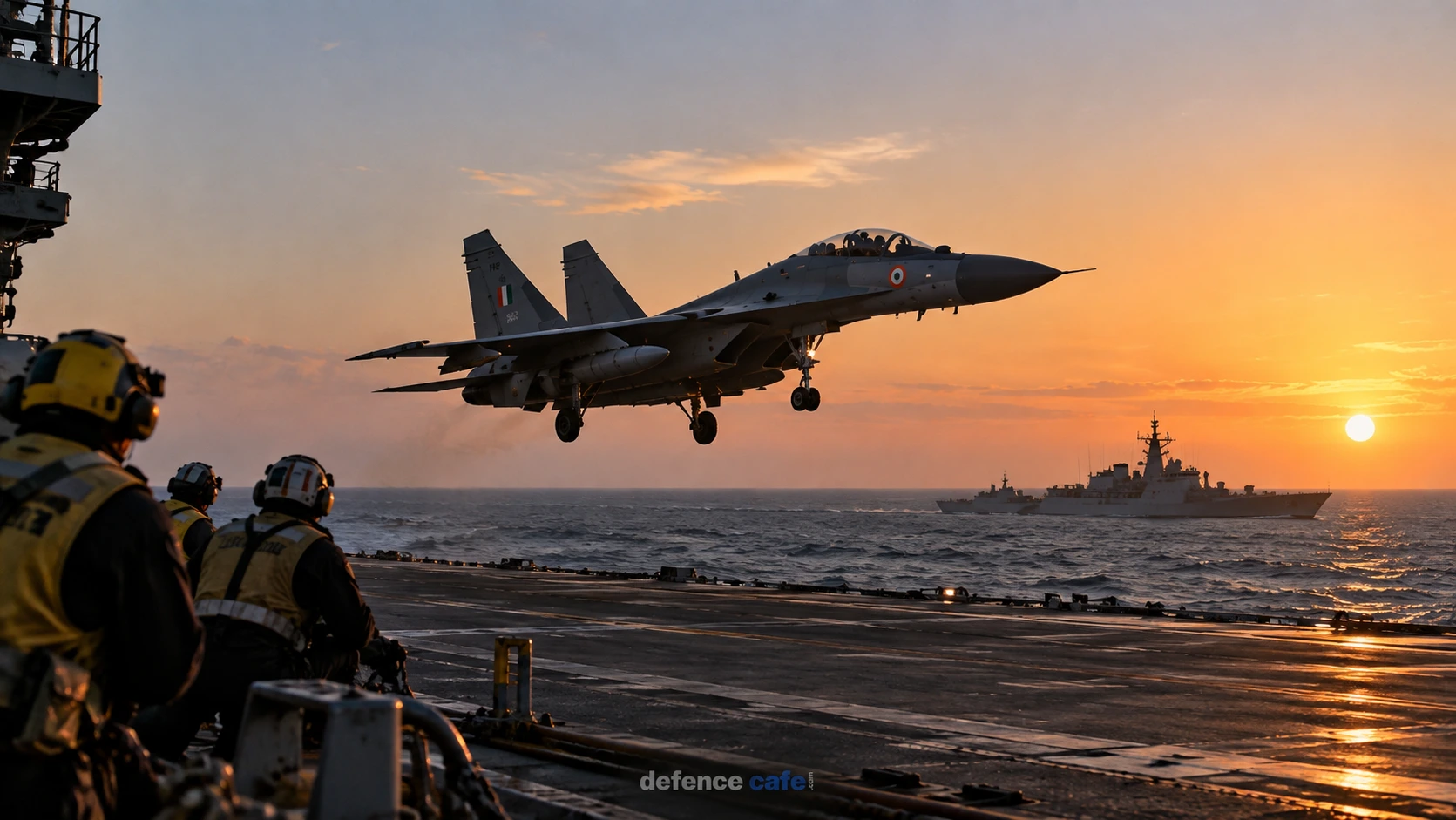
Global defence in 2026 is being shaped by a broad shift in how militaries think about power. The focus is no longer only on buying a larger number of traditional platforms. Governments are increasingly trying to combine drones, artificial intelligence, long-range weapons, air and missile defence, electronic warfare, space systems, cyber capabilities and industrial capacity into connected military networks.
The latest complete global military-spending data available in 2026 underline the scale of the change. SIPRI estimates that world military expenditure reached $2.887 trillion in 2025, up 2.9% in real terms and the 11th consecutive year of growth. Europe and Asia-Pacific were among the major sources of the increase, while the United States, China, Russia, Germany and India together accounted for 58% of global military expenditure. These are 2025 figures published in 2026, rather than a final global spending total for 2026. SIPRI’s 2026 military expenditure assessment provides the underlying data.
The more important story, however, is what governments are spending that money on.
2026 Defence Trends at a Glance
| Trend | What is changing | 2026 evidence |
|---|---|---|
| Higher defence spending | More governments are increasing defence budgets and investment. | SIPRI recorded a 2025 global spending record, while Europe continued a major buildup in 2026. |
| Drones and counter-drones | Uncrewed systems are moving deeper into routine military operations. | NATO, the EU, Ukraine, Japan and other militaries are expanding both drones and counter-UAS capabilities. |
| AI and autonomy | AI is increasingly being integrated into sensing, decision support and autonomous platforms. | The U.S. FY2026 budget request included a dedicated autonomy investment, while NATO is adopting AI models and autonomous technologies. |
| Air and missile defence | Defence against missiles, drones and complex aerial threats is becoming a central requirement. | NATO and the EU are prioritising integrated air and missile defence, while several national programmes are expanding. |
| Long-range precision strike | More militaries are seeking the ability to strike from greater distance. | NATO, Japan and European defence plans all place greater emphasis on long-range precision capabilities. |
| Space, cyber and electronic warfare | Competition is spreading beyond conventional air, land and sea domains. | NATO, Japan and European programmes increasingly treat space, cyber and electromagnetic capabilities as core defence functions. |
| Industrial resilience | Production capacity is becoming a strategic capability in its own right. | NATO and the EU are expanding manufacturing, procurement cooperation and defence-industrial investment. |
1. Defence Spending Is Rising — But the Mix Matters
The world entered 2026 with defence spending already at a historically high level.
SIPRI’s April 2026 assessment put global military expenditure in 2025 at $2.887 trillion. Europe increased military spending by 14% in real terms to $864 billion, while Asia and Oceania increased spending by 8.1% to $681 billion. The global military burden rose to 2.5% of GDP.
The important point is not simply that budgets are growing. Governments are increasingly directing additional resources toward capabilities that can alter how forces operate: precision weapons, drones, air defence, space systems, sensors, communications, autonomy and industrial capacity.
In the European Union, the Council of the EU estimates that member states’ defence expenditure could reach €454 billion in 2026, equivalent to around 2.4% of EU member-state GDP. Defence investment is projected at nearly €163 billion. These are 2026 estimates, not final audited spending results. The EU’s defence expenditure dashboard provides the underlying figures.
This is a significant change from an era when defence budgets could often be read mainly as a list of platforms. The budget is increasingly becoming a map of technological priorities.
2. Strategic Competition Is Becoming Technological and Industrial
Strategic competition in 2026 is no longer confined to the number of tanks, aircraft or ships a country possesses.
Countries are also competing over semiconductor supply chains, satellite infrastructure, AI capabilities, advanced sensors, rare materials, manufacturing capacity, ammunition production and access to defence technology ecosystems.
China’s Military Modernisation
China’s 2026 national general public budget allocates 1.94 trillion yuan for defence spending, according to China’s Ministry of National Defense, an increase of 6.9% over the previous year’s executed budget. The ministry said the additional spending would support military modernisation, new-domain capabilities, advanced weapons and defence-science innovation.
This should be read alongside SIPRI’s assessment that China’s military expenditure was an estimated $336 billion in 2025. The two figures use different accounting and reporting methodologies and should not be treated as interchangeable.
China’s Ministry of National Defense explains the 2026 budget, while SIPRI provides the internationally comparable estimate.
NATO and European Rearmament
Europe’s response is increasingly tied to both force generation and industrial production.
At the 2026 Ankara Summit, NATO reaffirmed the commitment made at The Hague in 2025 to reach 5% of GDP in defence and defence- and security-related spending by 2035. NATO’s framework divides this into at least 3.5% for core defence requirements and up to 1.5% for areas including resilience, critical infrastructure, innovation and the defence-industrial base.
The Ankara Summit also highlighted new procurement in areas such as deep precision strike, integrated air and missile defence, uncrewed systems and intelligence capabilities. NATO said more than €50 billion in new procurement deals were announced at the summit. The Ankara Summit Declaration sets out those commitments.
This is a useful example of a wider trend: strategic competition is increasingly about the ability to combine money, technology, production and alliances.
3. Drones Have Moved From Niche Capability to Core Capability
Drones are no longer a specialist technology reserved for a handful of elite missions.
They are increasingly being used for reconnaissance, targeting, communications, logistics, maritime surveillance, strike missions and interception. At the same time, militaries are investing heavily in systems designed to detect and defeat hostile drones.
NATO’s current emerging-technology programme explicitly identifies AI, drones and autonomous systems as technologies reshaping the character of conflict. The Alliance is working with governments, industry and academia to test and adopt these systems more quickly. NATO’s 2026 technology and innovation overview describes this shift.
Ukraine as a Major Test Case
Ukraine provides one of the clearest examples of how quickly an operational drone ecosystem can evolve.
In June 2026, Ukraine’s Ministry of Defence reported that 95% of drones procured by the country’s Defence Procurement Agency were manufactured in Ukraine. It also said unmanned-system procurement had surpassed ammunition procurement in the previous year.
In September 2026, the Ukrainian Ministry of Defence reported that 650 new unmanned aerial systems had been codified and authorised for use since the start of the year. Among them were strike drones, fibre-optic-controlled systems and interceptor drones. These figures are Ukrainian government procurement and codification data, not a global measure of drone use.
Ukraine’s June 2026 procurement data and its September 2026 UAS update illustrate how quickly this ecosystem is changing.
The lesson for other militaries is not simply “buy more drones.” It is that drone capability depends on a much larger ecosystem: software, operators, sensors, communications, electronic-warfare protection, batteries, manufacturing, rapid iteration and a procurement system that can adapt quickly.
4. Counter-Drone Systems Are Becoming Just as Important
The rapid spread of small uncrewed systems creates a difficult defence problem. A highly expensive missile interceptor may be unnecessary or economically unattractive against a relatively inexpensive drone.
That is pushing militaries toward layered counter-UAS architectures that can combine detection, electronic warfare, guns, missiles, directed energy and interceptor drones depending on the threat.
The European Union’s 2026 defence-readiness plans place specific emphasis on the European Drone Defence Initiative. The EU’s wider roadmap also prioritises air and missile defence, precision strike, electronic warfare and strategic enablers. The European Commission’s Readiness Roadmap 2030 describes the initiative and its milestones.
In the United States, the FY2026 defence budget request included a dedicated counter-unmanned-systems programme and described the rapid proliferation of small UAVs as a major change in the character of conflict.
The U.S. FY2026 Defence Budget Request overview details those priorities.
5. Artificial Intelligence Is Moving Into the Military Mainstream
Artificial intelligence is becoming less about a futuristic autonomous weapon and more about improving the speed at which humans can understand large quantities of information.
Potential military applications include:
- analysing large volumes of sensor data
- supporting command and decision-making
- detecting anomalies and potential threats
- helping coordinate uncrewed systems
- improving logistics and maintenance
- supporting intelligence analysis
The U.S. FY2026 budget request included $13.4 billion for autonomy and autonomous systems, covering areas such as unmanned aircraft, maritime systems, autonomy software and associated capabilities. The request also included major investments in space, cyber and missile defence.
NATO’s Ankara Summit Declaration said the Alliance was developing an interoperable transatlantic warfighting cloud and adopting powerful AI models. NATO’s technology programme separately describes AI and autonomous systems as key emerging capabilities.
The important distinction is that AI does not automatically mean independent decision-making. Much of the near-term military value comes from faster data processing and human-machine teaming.
6. Human-Machine Teaming Is Becoming a Core Design Principle
One of the most consequential changes is the growing expectation that expensive crewed systems will operate alongside large numbers of less expensive uncrewed systems.
This idea appears in different forms across several countries.
The UK’s Strategic Defence Review 2025, for example, argues that autonomous and uncrewed land and aerial systems are becoming an essential component of land warfare. It proposes a “20-40-40” mix as a planning concept involving crewed platforms, reusable systems and consumable systems.
That ratio is a UK planning recommendation, not a global military standard.
The broader trend is easier to identify: militaries increasingly see the future force as a mixture of high-end crewed platforms and scalable uncrewed systems.
7. Air and Missile Defence Is Becoming a Central Requirement
The proliferation of drones, cruise missiles, ballistic missiles and increasingly sophisticated aerial threats is making layered air defence more important.
The concept is relatively simple. A military does not rely on one interceptor or one radar. Instead, it combines sensors and defensive systems operating at different ranges and against different types of targets.
NATO’s 2026 procurement priorities include integrated air and missile defence. The EU’s Readiness Roadmap proposes a broader European Air Shield intended to cover the air and missile defence spectrum while remaining interoperable with NATO systems.
Japan’s 2026 defence planning also places strong emphasis on integrated air and missile defence, stand-off capabilities and unmanned systems. Its defence ministry’s latest policy documents show how several of these capabilities are now being planned together rather than as isolated procurement categories.
Japan’s FY2026 defence planning document outlines these capability priorities.
The Economics of Defence
There is also an economic dimension. Modern air-defence systems can be expensive, while the target they are defending against may be comparatively inexpensive.
This is one reason counter-drone networks are moving toward a combination of lower-cost interceptors, electronic warfare, guns and other defensive layers rather than relying on a single type of missile.
The goal is not simply interception. It is cost-effective defence at scale.
8. Long-Range Precision Strike Is Expanding
Another major trend is the growing emphasis on the ability to engage targets from greater distances.
NATO’s 2026 Ankara declaration specifically includes deep precision strike among advanced capabilities being developed and procured.
Japan’s defence planning also places stand-off defence among its core priorities and calls for longer-range capabilities. The 2026 Japanese Defence White Paper describes the changing threat environment as involving missiles, drones, cyber operations, information warfare and other cross-domain challenges.
Long-range systems change the geography of military planning because they allow forces to hold targets at greater distance while creating additional demands for intelligence, surveillance, targeting and missile defence.
This means the value of a long-range weapon depends heavily on the system around it. A missile can have substantial range on paper, but the military still needs the sensors, communications, targeting data, command systems and logistics required to use that capability effectively.
9. Electronic Warfare Is Becoming a Constant Contest
The electromagnetic spectrum is now an operational domain in its own right.
Radars, communications links, navigation signals, datalinks, satellite systems and electronic-support systems all depend on it. An adversary that can disrupt or deceive those systems can reduce the effectiveness of otherwise capable weapons and platforms.
That is why electronic warfare is increasingly being integrated into broader military architectures rather than treated as a specialised support function.
The Japanese 2026 defence planning framework explicitly includes the electromagnetic domain alongside space, cyber, unmanned systems and cross-domain operations. The EU’s defence priorities similarly place electronic warfare alongside AI, cyber, drones and precision strike.
Ukraine’s reported expansion of fibre-optic-controlled drones provides another practical example of the adaptation taking place around electronic warfare. Ukraine’s Ministry of Defence said 231 fibre-optic-control UAVs had been authorised for use in 2026, highlighting the effort to create systems less vulnerable to conventional radio-frequency jamming.
10. Space and Cyber Are Becoming More Closely Integrated With Conventional Forces
Modern military forces depend on satellites for communications, navigation, intelligence and timing. They also rely heavily on digital networks connecting sensors, commanders, aircraft, ships and ground units.
As a result, space and cyber capabilities increasingly affect operations in the air, on land and at sea.
NATO’s 2026 Ankara declaration explicitly describes deterrence and defence as combining nuclear, conventional and missile-defence capabilities with space and cyber assets. It also identifies intelligence capabilities, uncrewed systems and advanced technology as major areas of investment.
The European Union’s Readiness Roadmap similarly treats space protection, cyber defence and strategic infrastructure as part of the wider defence picture.
This is one of the clearest signs that military modernisation is becoming increasingly cross-domain.
11. Defence Industrial Capacity Has Become a Strategic Capability
One of the most important lessons of recent conflicts is that advanced technology is useful only when it can be produced, maintained and replaced at sufficient scale.
That has pushed ammunition production, supply-chain resilience, manufacturing capacity and defence-industrial policy much higher on national security agendas.
NATO’s 2026 summit placed strong emphasis on expanding defence-industrial production and removing barriers to defence trade. The EU is doing something similar through joint procurement, industrial programmes and incentives for European defence production.
In April 2026, the European Commission announced €1.07 billion for 57 European Defence Fund projects, including projects in AI, cyber defence, drones and counter-drone systems. The funding supports the wider Readiness 2030 agenda.
The European Commission’s April 2026 announcement provides the project details.
NATO Secretary General Mark Rutte also said in September 2026 that substantial additional investment was being directed toward expanding factories and production lines across the Alliance. That statement is an attributed assessment from NATO leadership rather than an independent global production statistic.
12. The Defence Industry Is Moving Toward Faster Innovation Cycles
Traditional military acquisition can take years from concept to operational deployment. Commercial technology moves much faster.
Governments are therefore trying to shorten the distance between prototype and fielded capability.
Japan’s 2026 defence planning includes a framework intended to accelerate deployment of priority technologies by combining repeated operational testing, industry proposals and civilian technological innovation. The stated objective is to move some technologies into equipment within five years and toward full-scale operation within roughly ten years.
NATO’s technology programme is similarly focused on adopting technologies faster and working with private-sector innovation ecosystems.
Ukraine’s rapidly changing drone ecosystem offers another example. Smaller manufacturers can iterate designs quickly when procurement systems allow operational users to provide direct feedback.
The emerging model is therefore increasingly test, field, learn, modify and produce again rather than assuming that a single design will remain unchanged for decades.
13. Strategic Stockpiles and Munitions Are Back at the Centre
For many years, discussions of advanced militaries focused heavily on expensive platforms: fighters, destroyers, submarines, missiles and armoured vehicles.
Recent conflicts have renewed attention on a more basic question: how long can a force sustain intensive operations?
That makes ammunition production, spare parts, fuel, maintenance, batteries and industrial replenishment strategically important.
The U.S. FY2026 budget request included additional funding for missiles and munitions production expansion as well as defence-industrial supply-chain improvements. NATO and the EU are also prioritising industrial scaling.
Modernisation is therefore increasingly about both quality and quantity.
14. Maritime Forces Are Becoming More Networked and Uncrewed
The maritime domain is also being reshaped by the same technology cycle.
Uncrewed surface and underwater systems can extend surveillance, mine-countermeasure and maritime-domain-awareness missions without requiring a crew on every platform. At the same time, major navies continue to invest in advanced air-defence ships, submarines, long-range weapons and carrier aviation.
The result is not the disappearance of large warships. Instead, larger ships are increasingly becoming command, sensor and weapons nodes inside wider networks.
The U.S. FY2026 defence request illustrates the continuing importance of naval power, with major funding devoted to ship construction alongside investments in autonomous systems, long-range drones, hypersonics and missile defence.
15. India Is Part of the Same Transformation
India is pursuing many of these trends simultaneously while placing strong emphasis on domestic production.
SIPRI’s 2025 data place India as the world’s fifth-largest military spender.
At the policy level, India’s draft Defence Acquisition Procedure 2026 proposed further emphasis on jointness, force modernisation, faster acquisition, increased production and the domestic defence ecosystem, with a continued preference for indigenously designed, developed and manufactured systems.
The Ministry of Defence’s February 2026 release on DAP-2026 explains these proposed directions.
Indian Focus on Drones and Counter-Drones
India is also actively testing how unmanned systems fit into future operations.
In September 2026, the Indian Air Force organised Dronathon-2026 to evaluate domestic unmanned and counter-unmanned systems. The event included a focus on surveillance and reconnaissance, autonomous operations, swarm technologies and electronic warfare.
The official PIB release on Dronathon-2026 describes the exercise and its technology focus.
Air Power and Stand-Off Capability
In February 2026, India’s Defence Acquisition Council granted Acceptance of Necessity for a series of major acquisitions, including Multi Role Fighter Aircraft, combat missiles and a high-altitude pseudo-satellite capability for the Indian Air Force.
An Acceptance of Necessity is an acquisition milestone and should not be confused with a completed contract, delivery or operational induction.
The Ministry of Defence’s February 2026 DAC announcement provides the official details.
What These Trends Mean for the Future Force
Looking across the major military powers, a common pattern emerges.
First, militaries are becoming more networked. Sensors, weapons and command systems increasingly need to exchange information in real time.
Second, uncrewed systems are expanding the number of platforms that can be fielded. The future force is unlikely to consist only of small numbers of extremely expensive systems.
Third, air defence is becoming an ecosystem rather than a single weapon. Drones, missiles and other aerial threats are pushing governments toward layered defence.
Fourth, technology and industry are converging. A military cannot adopt AI, drones or precision weapons at scale without software, electronics, manufacturing and supply-chain depth.
Fifth, traditional platforms remain important. Fighters, submarines, aircraft carriers, destroyers, tanks and long-range missile systems have not disappeared. Instead, their value increasingly depends on the digital and uncrewed systems around them.
What to Watch Next
Several areas deserve particular attention as governments translate their 2026 plans into procurement and operational capability.
- Drone and counter-drone scaling: whether governments can move from experimentation to affordable systems that can be produced in large numbers.
- AI adoption: how quickly military organisations can turn AI from demonstrations into trusted decision-support and operational tools.
- Air and missile defence: whether layered systems can remain affordable as the number and variety of aerial threats expand.
- Defence manufacturing: whether increased budgets translate into sustained production capacity rather than only larger procurement plans.
- Space and cyber resilience: how militaries protect critical networks and satellite-enabled capabilities from disruption.
- Human-machine teaming: how armed forces balance expensive crewed platforms with larger numbers of autonomous and uncrewed systems.
Conclusion
Global defence in 2026 is being reshaped by a combination of higher spending, technological change and strategic competition.
Drones are becoming standard military tools. Counter-drone systems are becoming essential. AI is moving into command, intelligence and autonomous platforms. Air and missile defence is receiving renewed attention. Long-range precision weapons are expanding. Space, cyber and electronic warfare are becoming increasingly integrated with conventional operations.
At the same time, defence ministries are rediscovering an older but equally important lesson: industrial capacity is military capability.
A country may possess advanced aircraft or missiles, but sustained military power depends on whether it can maintain those systems, replace losses, secure its supply chains, produce ammunition and continuously improve its technology.
That is why the defining defence story of 2026 is not one particular weapon. It is the transformation of the entire military system — from research and industry to sensors, networks, autonomous platforms and the people operating them.
Sources & Further Reading
- SIPRI — Trends in World Military Expenditure, 2025
- SIPRI — Trends in International Arms Transfers, 2025
- NATO — The Ankara Summit Declaration, 2026
- NATO — Innovation and Technology Adoption
- Council of the European Union — EU Defence in Numbers
- European Commission — Readiness Roadmap 2030
- European Commission — €1.07 Billion for 57 Defence Projects, April 2026
- U.S. Department of Defense — FY2026 Defense Budget Request Overview
- Japan Ministry of Defense — Defense of Japan 2026
- UK Government — Strategic Defence Review 2025
- Ministry of Defence of Ukraine — Drone Procurement and Domestic Production, June 2026
- Ministry of Defence of Ukraine — 650 New UAS Codified in 2026, September 2026
- China’s Ministry of National Defense — 2026 Defence Spending Arrangement
- Ministry of Defence / PIB — Draft Defence Acquisition Procedure 2026
- Ministry of Defence / PIB — IAF Dronathon-2026
