


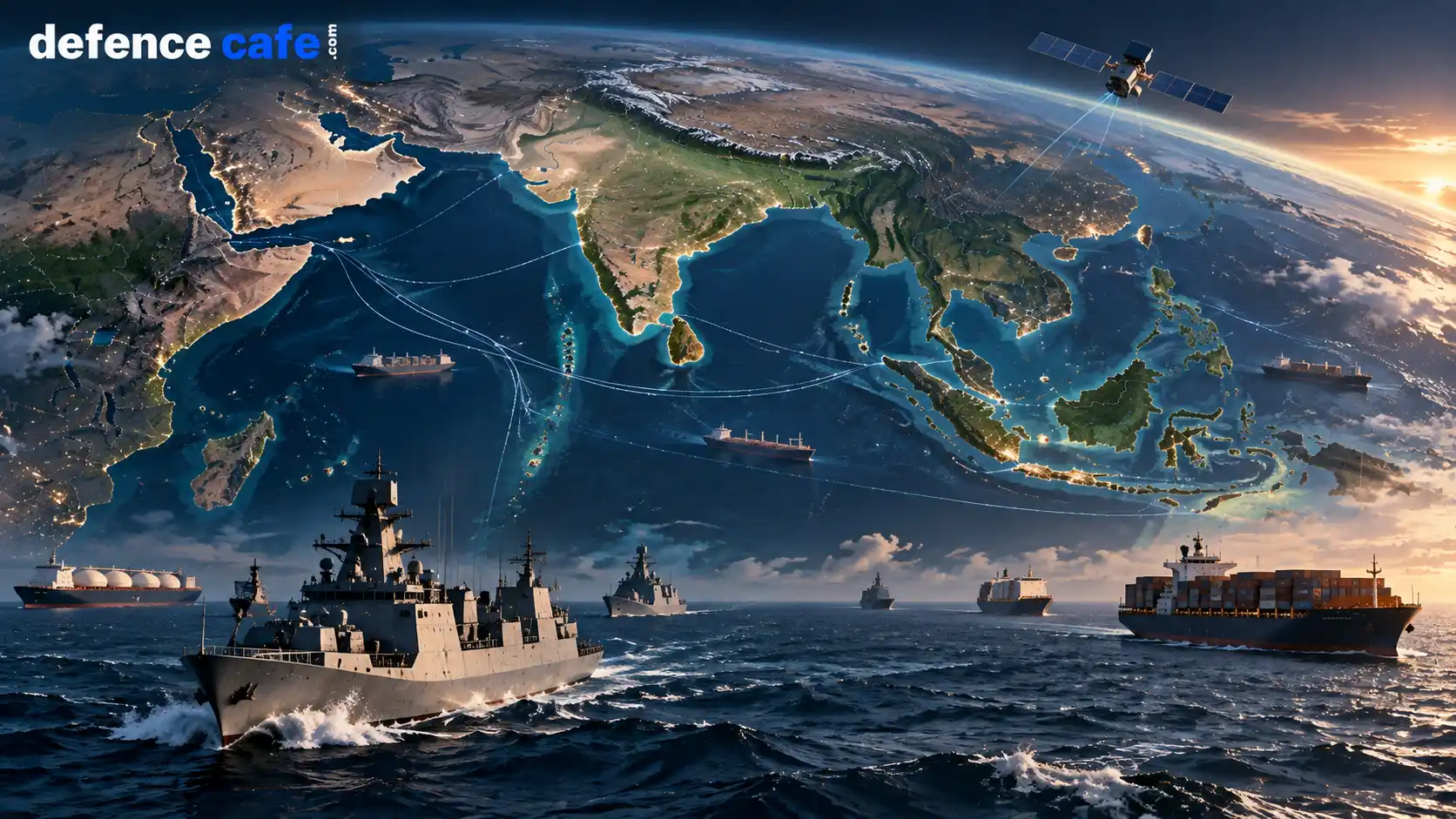
The Indian Ocean matters to India for a simple geographic reason: India sits near its centre, with the Arabian Sea to the west, the Bay of Bengal to the east and the wider Indo-Pacific opening beyond the Strait of Malacca. But geography alone does not explain its importance.
The ocean carries commercial shipping, connects India to energy-producing regions and Asian markets, hosts vital maritime infrastructure and links several of the world’s most important sea lanes. For India, protecting maritime interests is therefore connected not only to naval security but also to trade, energy, island territories, coastal development and relations with countries across the Indo-Pacific.
India’s own policy framework reflects this broader understanding. The government describes its Indo-Pacific approach in terms of a free, open, inclusive and rules-based region, while the SAGAR concept places security and growth at the centre of India’s engagement with the Indian Ocean and neighbouring regions.
What Is the Indo-Pacific?
The Indo-Pacific is a strategic and geographic concept rather than a single treaty organisation or universally fixed map.
Different governments and institutions can draw its boundaries differently, but the central idea is to view the Indian and Pacific Oceans as an interconnected maritime space. That connection matters because trade routes, energy flows, military activity, supply chains and diplomatic relationships do not stop neatly at the boundary between two oceans.
India’s Ministry of External Affairs describes its Indo-Pacific vision as free, open, inclusive and rules-based, with emphasis on sovereignty, territorial integrity, peaceful resolution of disputes and respect for international law.
The Indian approach also places considerable importance on ASEAN centrality and engagement across multiple political, economic, security and connectivity platforms rather than defining the Indo-Pacific exclusively as a military grouping.
India’s Ministry of External Affairs overview of the Indo-Pacific explains the broad principles behind India’s approach.
Indian Ocean Region vs Indo-Pacific
These two terms are related but not interchangeable.
| Term | What it generally refers to | Why it matters to India |
|---|---|---|
| Indian Ocean Region (IOR) | The maritime region surrounding the Indian Ocean and its littoral states. | India’s immediate maritime neighbourhood and a major area for security, trade and diplomacy. |
| Indo-Pacific | A broader interconnected strategic space linking the Indian and Pacific Oceans. | Connects India’s western maritime interests with Southeast Asia, East Asia and the wider Pacific. |
Put simply, the Indian Ocean is a central part of India’s Indo-Pacific outlook, but the Indo-Pacific extends beyond the Indian Ocean itself.
Why Geography Makes the Indian Ocean Important
Look at a map and one feature becomes obvious: the Indian Ocean sits between several economically and strategically important regions.
To the west are the Gulf and Arabian Peninsula. To the north lies South Asia. To the east are Southeast Asian maritime routes and the approaches to the Pacific. Farther south, the ocean connects to major routes around Africa and toward the southern approaches to Asia.
That position creates a network of maritime connections rather than a single strategic corridor.
The Indian Ocean Links Major Economic Regions
Ships moving between the Middle East, South Asia, Southeast Asia, East Asia, Africa and Europe use routes connected to the Indian Ocean. The exact route varies according to cargo, destination and global conditions, but the underlying geography gives the ocean lasting importance.
For India, this means maritime security cannot be viewed purely through the lens of coastal defence. Developments far from India’s shoreline can affect shipping, insurance costs, energy supplies and the movement of goods.
Chokepoints: Why Narrow Straits Matter
Large oceans provide room for movement, but important maritime traffic often passes through much narrower passages.
These chokepoints can become strategically important because disruption, congestion or insecurity at a relatively narrow location can affect much larger trade networks.
| Chokepoint | Connects | Strategic relevance to the Indian Ocean |
|---|---|---|
| Strait of Hormuz | Persian Gulf and Gulf of Oman | Critical route for energy shipments leaving the Gulf region. |
| Bab el-Mandeb | Red Sea and Gulf of Aden | Links Indian Ocean approaches with the Red Sea and Suez route. |
| Strait of Malacca | Indian Ocean and Pacific Ocean | One of the principal maritime connections between the two oceans and an important Asian energy route. |
Recent U.S. Energy Information Administration data illustrates just how significant these passages remain for global energy movement. Its March 2026 analysis identified the Strait of Hormuz and Strait of Malacca as two of the world’s most important strategic oil chokepoints by volume, based on 2020–2025 data.
The U.S. Energy Information Administration’s 2026 chokepoint analysis provides the underlying data.
The Strait of Malacca Is Especially Important to the Indo-Pacific
The Strait of Malacca is particularly significant because it sits directly at the transition between the Indian and Pacific Oceans.
The International Maritime Organization describes it as the main shipping channel between the Indian and Pacific Oceans. The narrow geography means that disruptions can have consequences well beyond the immediate area.
That is one reason India’s relationship with Southeast Asian maritime states is relevant to its wider Indo-Pacific outlook.
The International Maritime Organization’s guidance on major navigational straits explains the importance of the Malacca and Singapore Straits to international shipping.
Energy Security: The Ocean Connection
Energy security is another reason the Indian Ocean matters.
India is connected by sea to major energy-producing regions in the Gulf and beyond. Oil and gas therefore travel through maritime routes before reaching Indian ports and refineries.
This creates a direct relationship between maritime stability and the wider economy.
A disruption at sea does not have to involve a naval battle to become economically significant. Shipping delays, rerouting, increased insurance costs, port congestion or insecurity around a major route can affect the cost and timing of cargo movement.
The issue has become especially visible during periods of instability around the Red Sea, Gulf of Aden and Gulf region, where ships have at times altered routes to reduce exposure to security risks.
The International Maritime Organization’s 2026 statement on vital shipping lanes underlines the wider importance of navigational rights and the safety of commercial shipping.
Why the Indian Ocean Matters to India’s Trade
India’s economy is deeply connected to maritime transport.
In July 2026, the Ministry of Defence stated that more than 90 per cent of India’s trade by volume passes through maritime routes. The same official statement linked maritime security with India’s energy security, Exclusive Economic Zone and island territories.
This is an official government figure for 2026 and should not be confused with the percentage of India’s trade measured by value.
The implication is straightforward: a secure maritime environment is an economic issue as much as a military issue.
The Ministry of Defence statement from July 2026 provides the government’s current trade-by-volume figure and its connection to maritime security.
India’s SAGAR Doctrine
India’s maritime approach is often discussed through the acronym SAGAR — Security and Growth for All in the Region.
The concept was first articulated by Prime Minister Narendra Modi in 2015. India’s Ministry of External Affairs describes SAGAR as a framework for a free, open, inclusive, peaceful and prosperous Indo-Pacific, with emphasis on security cooperation, connectivity, disaster management, capacity building, maritime safety and sustainable development.
This is important because SAGAR is broader than naval power alone.
Its practical expression can include:
- maritime security cooperation
- capacity building for partner countries
- humanitarian assistance and disaster relief
- maritime safety
- information sharing and maritime domain awareness
- action against illegal, unreported and unregulated fishing
- connectivity and sustainable development
The Ministry of External Affairs note on SAGAR explains these elements and the evolution of the concept.
From SAGAR to MAHASAGAR
In 2025, India introduced MAHASAGAR — Mutual and Holistic Advancement for Security Across the Regions as a broader expression of its maritime and Global South engagement.
The Navy subsequently connected several regional initiatives to this framework, including the Indian Ocean Ship (IOS) SAGAR programme.
In March 2026, the second edition of IOS SAGAR began with Indian and foreign naval personnel sailing together aboard an Indian naval ship. The programme included participation from 16 Indian Ocean Region partner countries and was designed around professional interaction, training and maritime cooperation.
The Ministry of Defence’s March 2026 release on IOS SAGAR describes the initiative and its connection to MAHASAGAR.
India’s Indo-Pacific Oceans Initiative
Another important pillar of India’s approach is the Indo-Pacific Oceans Initiative (IPOI), announced by Prime Minister Modi at the East Asia Summit in 2019.
Unlike a military alliance, IPOI is an open, non-treaty-based initiative focused on practical cooperation.
India’s Ministry of External Affairs describes seven broad pillars:
| Pillar | Focus |
|---|---|
| Maritime Security | Improving cooperation and security at sea. |
| Maritime Ecology | Protecting the marine environment. |
| Maritime Resources | Sustainable use of ocean resources. |
| Capacity Building and Resource Sharing | Building capabilities and sharing expertise. |
| Disaster Risk Reduction and Management | Improving cooperation during disasters and emergencies. |
| Science, Technology and Academic Cooperation | Research, innovation and knowledge exchange. |
| Trade, Connectivity and Maritime Transport | Strengthening maritime economic connectivity. |
The Ministry of External Affairs annual report provides the official description of the IPOI’s seven pillars.
Maritime Security Is Bigger Than Naval Warfare
One of the most important changes in modern maritime strategy is the expansion of what counts as a security problem.
Piracy remains relevant in parts of the western Indian Ocean. Human trafficking, narcotics smuggling, illegal fishing and maritime terrorism create additional challenges. Offshore energy infrastructure and shipping can also be exposed to disruptions.
In September 2026, a Colombo Security Conclave tabletop exercise in Visakhapatnam examined coordinated responses to illicit maritime activities including maritime terrorism, narcotics smuggling, human trafficking and illegal, unreported and unregulated fishing.
The September 2026 PIB release on the exercise records the focus on these non-traditional maritime security challenges and information sharing.
Maritime Domain Awareness: Knowing What Is Happening at Sea
A navy cannot effectively protect maritime interests if it does not have a reliable picture of what is happening across a huge ocean area.
This is the purpose of Maritime Domain Awareness (MDA).
MDA combines information from multiple sources so that authorities can identify, monitor and assess ships and other maritime activity.
For India, one important institution is the Information Fusion Centre — Indian Ocean Region (IFC-IOR) in Gurugram.
The Ministry of External Affairs describes the IFC-IOR as an important platform for maritime security partnerships and collective maritime domain awareness. Partner countries have also positioned liaison officers there to improve information sharing.
This makes maritime security less about a single radar screen and more about combining information across countries, agencies and sensor networks.
The MEA overview of Maritime Security Affairs explains India’s role through the IFC-IOR and other regional mechanisms.
Why Island Nations Matter
The Indian Ocean is dotted with island states and strategically located island territories. Their importance comes not simply from military geography but from their location along maritime routes.
Countries such as Sri Lanka, Maldives, Mauritius, Seychelles and others occupy maritime positions that connect different parts of the oceanic network. Cooperation with these countries can therefore involve shipping, fisheries, disaster response, environmental issues, port infrastructure, maritime safety and defence.
For India, the Andaman and Nicobar Islands also have particular geographic significance because they sit close to the approaches connecting the Indian and Pacific Oceans.
This is one reason India’s eastern maritime outlook increasingly connects the Bay of Bengal with Southeast Asia.
The Bay of Bengal and India’s Eastward Outlook
The Bay of Bengal is where India’s immediate Indian Ocean neighbourhood increasingly overlaps with the Indo-Pacific.
From India’s eastern coast, maritime routes connect toward Myanmar, Thailand, Malaysia, Indonesia and the Strait of Malacca.
That geography reinforces India’s Act East engagement. Maritime cooperation in the Bay of Bengal can simultaneously support trade connectivity, disaster relief, coastal security and wider strategic relationships.
The importance of this space is reflected in India’s increasing cooperation with Southeast Asian maritime partners and its efforts to strengthen information-sharing mechanisms across the region.
What About the Western Indian Ocean?
The western Indian Ocean is equally important, but for somewhat different reasons.
The region links India with the Gulf, Arabian Peninsula and East Africa and connects to the approaches of the Red Sea and Suez Canal.
It is also a zone where maritime security challenges such as piracy and attacks on commercial shipping can directly affect vessels moving between Europe, the Middle East, Africa and Asia.
India has increased naval engagement in this area through deployments, anti-piracy operations, information sharing and regional partnerships.
In July 2026, for example, an Indian naval ship operating in the Gulf of Aden responded to a reported piracy attempt against a merchant vessel after the incident was coordinated with the IFC-IOR.
The Ministry of Defence release on the July 2026 Gulf of Aden incident illustrates how maritime surveillance, information sharing and naval response can work together.
India’s Role in Regional Maritime Cooperation
India’s regional maritime role is not limited to bilateral naval relationships.
In February 2026, India assumed the chairmanship of the Indian Ocean Naval Symposium (IONS). The 9th Conclave of Chiefs brought together representatives from 33 countries, reflecting the wide geographic span of the forum.
IONS is a professional maritime cooperation mechanism rather than a military alliance. Its value lies in dialogue, interoperability, information exchange and practical cooperation among Indian Ocean maritime states.
The Ministry of Defence’s February 2026 release records India’s assumption of the chairmanship and the participation at the Conclave of Chiefs.
Goa Maritime Conclave
The Goa Maritime Conclave provides another forum for regional maritime dialogue.
The fifth edition in February 2026 brought together chiefs of navies and senior maritime representatives from Indian Ocean countries to discuss common maritime security challenges and mechanisms for cooperation.
The official PIB account of the 2026 Goa Maritime Conclave describes its focus on cooperative responses to evolving regional maritime risks.
India Is Not the Only Country With Interests in the Indian Ocean
The Indian Ocean is shared by numerous coastal states and affects countries far beyond its littoral.
India’s interests therefore exist alongside those of Southeast Asian states, Gulf countries, African countries, European maritime powers and larger Indo-Pacific actors such as the United States, Japan and Australia.
France also has enduring interests in the Indian Ocean through its territories and maritime presence. Countries outside the region have commercial, diplomatic and security interests because the ocean connects them to major trade and energy routes.
This makes the Indian Ocean a space of overlapping interests rather than a region that can be understood through a single country’s strategic lens.
The Chinese Factor
China is an important part of the contemporary strategic discussion because its economic and maritime presence extends across the broader Indo-Pacific.
Chinese commercial relationships, port investments, naval deployments and engagement with Indian Ocean countries have all contributed to growing attention to the region.
At the same time, it is important to separate different activities. A commercial port relationship is not automatically a naval base, and a naval port call is not automatically evidence of a permanent military presence.
For India and other regional states, the relevant question is therefore not simply whether China is present, but how different forms of Chinese economic, diplomatic and maritime activity affect regional connectivity and security over time.
That distinction is important for understanding the Indian Ocean without turning every port, exercise or deployment into evidence of strategic confrontation.
Trade Routes, Ports and Connectivity
Maritime strategy is closely linked to infrastructure.
Ports are where ocean routes connect to national economies. Shipping requires terminals, logistics, refuelling, maintenance, communications and inland transport networks.
India’s maritime policy therefore includes both security and economic dimensions. The government’s Sagarmala programme, for example, focuses on port modernisation, port connectivity, port-led industrialisation, coastal community development and coastal shipping and inland water transport.
The Ministry of Ports, Shipping and Waterways’ 2026 overview of the maritime sector describes the relationship between maritime development, connectivity and the MAHASAGAR vision.
Undersea Infrastructure Is Becoming More Important
Modern maritime competition is not limited to ships and aircraft.
Undersea cables, offshore energy infrastructure, pipelines and other seabed-connected systems form part of the wider maritime environment.
Damage to such infrastructure can have effects far beyond the immediate geographic location of the incident, which is why awareness of the underwater domain is becoming increasingly important.
For India, this adds another layer to maritime domain awareness. The objective is not simply to know where ships are, but to understand the condition and activity of critical infrastructure in the surrounding maritime space.
Humanitarian Assistance and Disaster Relief
The Indian Ocean is also a region where natural disasters regularly create humanitarian demands.
Cyclones, floods, earthquakes, tsunamis and other emergencies can affect coastal and island countries with limited resources for rapid response.
Naval vessels are useful in these situations because they can carry supplies, medical teams, helicopters, engineering equipment and desalination or support capabilities without requiring damaged local infrastructure to be fully operational.
This is one reason disaster response appears alongside maritime security in India’s SAGAR and IPOI frameworks.
Strategic influence in the Indian Ocean can therefore be expressed through disaster response and capacity building as well as military capability.
Why the Indian Ocean Matters to the Indo-Pacific
The strategic logic can now be brought together.
The Indian Ocean matters because it connects several systems at once:
| Dimension | Why it matters |
|---|---|
| Trade | Connects major markets through international shipping routes. |
| Energy | Links Gulf producers with major importing economies in Asia. |
| Geography | Provides the maritime link between the Middle East, South Asia, Southeast Asia and the wider Indo-Pacific. |
| Security | Includes piracy, terrorism, trafficking, illegal fishing and threats to commercial shipping. |
| Infrastructure | Contains ports, shipping routes, offshore assets and undersea infrastructure. |
| Diplomacy | Creates space for naval cooperation, capacity building, HADR and multilateral institutions. |
| Technology | Requires increasingly sophisticated surveillance, data sharing and maritime-domain awareness. |
That is why the Indian Ocean cannot be separated neatly from the wider Indo-Pacific. A maritime event in one part of this network can have economic, diplomatic or security consequences elsewhere.
What to Watch Next
Several developments will shape India’s position in the Indian Ocean and wider Indo-Pacific over the coming years.
- Maritime domain awareness: greater use of data fusion, surveillance systems, unmanned platforms and information-sharing networks.
- Regional partnerships: continued cooperation with Indian Ocean and Southeast Asian countries through naval exercises, port calls, capacity building and maritime institutions.
- Shipping security: developments around the Gulf of Aden, Red Sea, Arabian Sea and other major commercial routes will continue to affect maritime security planning.
- Underwater infrastructure: protection and monitoring of cables and other critical maritime infrastructure will become a larger part of maritime security discussions.
- Indian naval capability: new surface combatants, submarines, aircraft, unmanned systems and support infrastructure will influence India’s ability to maintain sustained maritime presence.
In September 2026, the Ministry of Defence also highlighted the growing complexity of the maritime environment, including concerns around congestion, deception and grey-zone activities. That reflects a wider shift from a simple distinction between “peace” and “war” toward a maritime environment in which information, presence, infrastructure and coercive pressure can all matter.
The Ministry of Defence account of the September 2026 Naval Commanders’ Conference provides the government’s latest description of this evolving maritime environment.
Frequently Asked Questions
Why is the Indian Ocean strategically important to India?
India’s geographic position, maritime trade, energy connections, island territories and extensive maritime interests make the Indian Ocean central to its economic and security planning.
What is India’s Indo-Pacific strategy?
India describes its Indo-Pacific approach as free, open, inclusive and rules-based, with emphasis on sovereignty, international law, connectivity, regional partnerships and security and growth.
What is SAGAR?
SAGAR stands for Security and Growth for All in the Region. It is India’s maritime policy framework, first articulated in 2015, covering security cooperation as well as connectivity, capacity building, disaster response and maritime development.
What is the Indo-Pacific Oceans Initiative?
The Indo-Pacific Oceans Initiative, or IPOI, is an open, non-treaty-based Indian initiative launched in 2019 covering seven broad areas of maritime cooperation.
Why is the Strait of Malacca important?
The Strait of Malacca is the main maritime connection between the Indian and Pacific Oceans and is an important route for Asian trade and energy shipments.
What is maritime domain awareness?
Maritime domain awareness is the ability to build a useful picture of activity at sea by combining information from ships, aircraft, satellites, coastal systems, partner countries and other sources.
What is MAHASAGAR?
MAHASAGAR stands for Mutual and Holistic Advancement for Security Across the Regions. India introduced the concept in 2025 as a broader framework for maritime and Global South engagement.
Conclusion
The Indian Ocean is strategically important because it is where geography, commerce, energy, infrastructure and security intersect.
For India, the ocean is simultaneously a maritime neighbourhood, an economic lifeline and a bridge toward the wider Indo-Pacific. The Strait of Malacca connects it to Southeast Asia and the Pacific; the western approaches connect it to the Gulf, Africa and the Red Sea; and the maritime routes linking these regions support a large part of India’s external trade.
India’s response has consequently developed beyond traditional naval power. SAGAR, IPOI, MAHASAGAR, IONS, IOS SAGAR, maritime-domain-awareness mechanisms and bilateral partnerships all form different parts of a larger approach.
The central challenge is not simply to control the ocean. It is to help maintain a maritime environment in which shipping can move, commerce can function, infrastructure can remain secure, countries can cooperate and maritime disputes can be managed under international law.
That is ultimately why the Indian Ocean sits so close to the centre of India’s Indo-Pacific strategy.
Sources & Further Reading
- Ministry of External Affairs — India’s Indo-Pacific Vision and Policy Framework
- Ministry of External Affairs — SAGAR: Security and Growth for All in the Region
- Ministry of External Affairs — Annual Report: Indo-Pacific and Maritime Security Affairs
- Ministry of Defence / PIB — Indian Ocean Region, Maritime Security and India’s Maritime Interests, July 2026
- Ministry of Defence / PIB — India Assumes Chairmanship of the Indian Ocean Naval Symposium, February 2026
- Ministry of Defence / PIB — Indian Ocean Ship SAGAR, March 2026
- Ministry of Defence / PIB — Colombo Security Conclave Maritime Security Exercise, September 2026
- U.S. Energy Information Administration — World Oil Transit Chokepoints, March 2026
- International Maritime Organization — Safety of Straits Used for International Navigation
- Ministry of External Affairs — Maritime Security Affairs and Information Fusion Centre-Indian Ocean Region
