


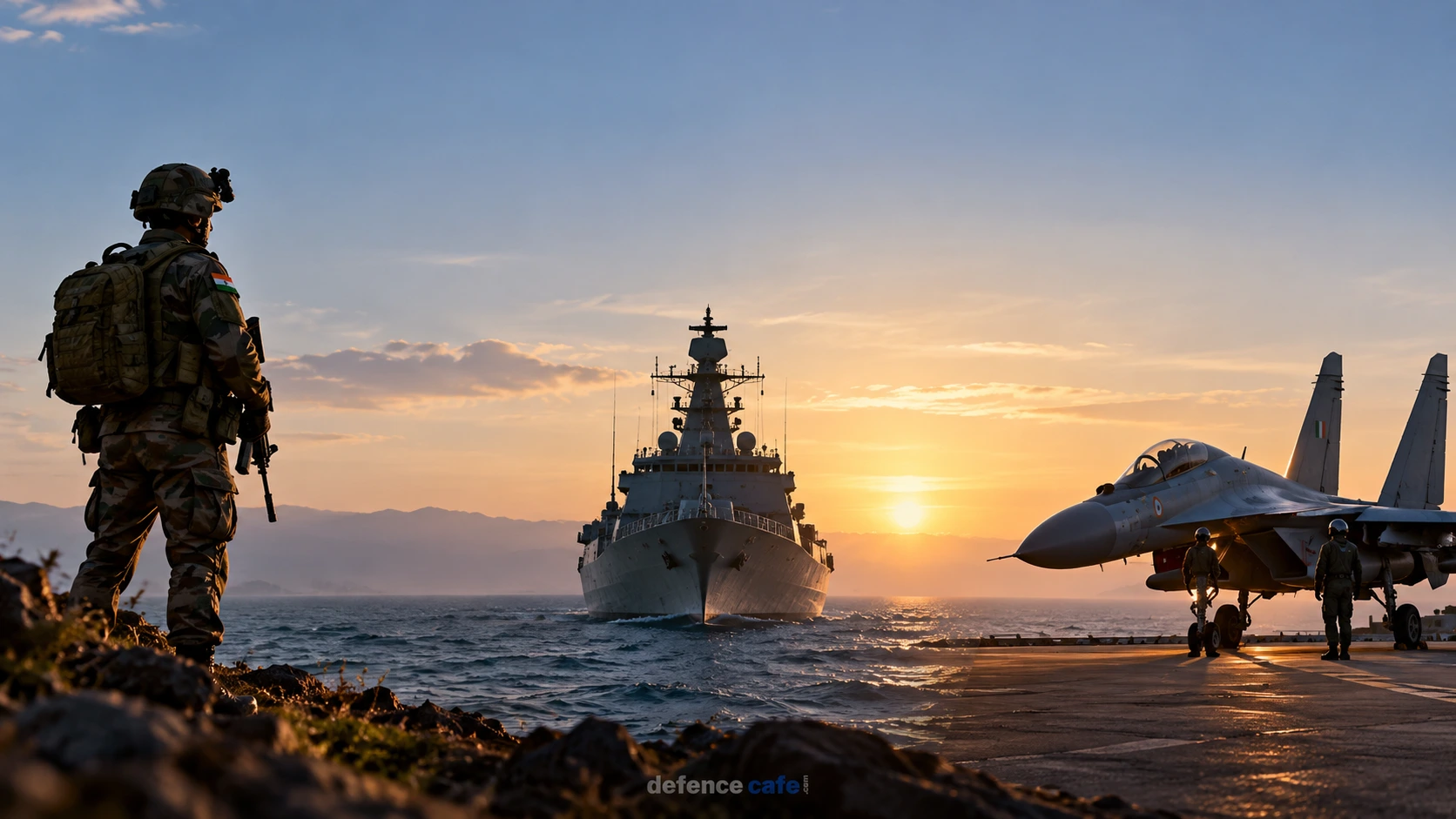
A modern military is not organised as one giant formation. It is built as a layered system in which different services, headquarters, formations and specialist units perform different jobs and then connect through a common command structure.
The Army concentrates on land warfare, the Navy on maritime operations, and the Air Force on the use of air power. But modern operations rarely stay inside one domain. Air defence can depend on naval and land sensors, ground forces can depend on airlift and close air support, and naval forces can depend on aircraft, satellites and shore-based intelligence.
That is why the modern military is increasingly organised around two ideas at the same time: specialisation within each Service and joint employment across Services.
Why Militaries Need an Organisational Structure
Military equipment only becomes useful when people can organise, command, maintain and employ it.
A fighter squadron needs pilots, maintainers, weapons support, intelligence, communications and logistics. A warship needs a crew, sensors, weapons, engineers and replenishment support. A land formation needs combat units alongside medical, engineering, communications, intelligence and supply elements.
A military organisation therefore has to answer several basic questions:
- Who commands the force?
- Who is responsible for a particular geographic area or mission?
- Which units are available for an operation?
- How are logistics, intelligence and communications provided?
- How do different Services work together?
The organisational structure is the framework that provides those answers.
The Three Levels of Military Command
One useful way to understand modern military organisation is to divide command into strategic, operational and tactical levels. NATO’s current command structure explicitly describes these three overlapping levels.
1. Strategic Level
The strategic level connects military power to national objectives.
This is where governments and senior defence authorities establish national policy, military priorities, resource decisions and broad strategic objectives. Military headquarters then translate those directions into defence plans and capability requirements.
The strategic level normally deals with questions such as:
- What national objective is the military supporting?
- What capabilities need to be maintained or developed?
- Which regions or threats require priority?
- How should limited resources be allocated?
Strategic command is therefore less about telling an individual platoon where to move and more about defining the overall military purpose and framework.
2. Operational Level
The operational level turns strategic objectives into campaigns, major operations and coordinated military activity.
An operational headquarters may control forces from multiple Services and organise them around a geographic area, mission or specific objective.
This is where the question changes from “What does the country want to achieve?” to “How will military forces combine their capabilities to achieve it?”
3. Tactical Level
The tactical level is where units execute specific missions.
A battalion conducting a ground operation, a fighter squadron flying an assigned mission, or a naval task group conducting a maritime patrol may all be operating at the tactical level.
The boundaries are not always rigid. A headquarters can perform different functions depending on the size and nature of an operation. NATO’s current command architecture, for example, uses strategic, operational and tactical structures that can interact across the same mission.
NATO — Allied Command Operations
How the Army Is Organised
The Army is fundamentally a land warfare organisation. Its formations are designed to put soldiers, vehicles, artillery, engineers, air defence, communications, intelligence and logistics together in a structure capable of controlling large areas of ground.
A typical Army hierarchy can be simplified as:
| Level | Typical purpose | Common examples |
|---|---|---|
| Command / Theatre | Large geographic or operational responsibility. | Army command, field army or joint theatre. |
| Corps | Controls multiple major land formations and conducts large-scale operations. | Corps headquarters. |
| Division | Large combined-arms formation capable of conducting sustained operations. | Infantry, mountain, armoured or other divisions. |
| Brigade | Flexible formation used to conduct specific missions and combine combat and support elements. | Infantry brigade, armoured brigade, artillery brigade. |
| Battalion | Major tactical unit built around companies or equivalent sub-units. | Infantry battalion, mechanised battalion, engineer battalion. |
| Company / Squadron / Battery | Smaller tactical formation tailored to a particular arm or service. | Infantry company, cavalry squadron, artillery battery. |
| Platoon / Troop / Section | Small tactical units responsible for direct execution of missions. | Platoons, troops and sections. |
The exact hierarchy varies by country and by type of formation. US Army doctrine, for example, describes armies, corps, divisions and brigades as major Army organisational levels and notes that forces are often task-organised according to the mission.
U.S. Army — National Security Structure & Joint Operations
The Important Difference Between a Formation and a Unit
Military terminology can become confusing because terms such as brigade, battalion, regiment, group, squadron and wing are not used identically across all countries.
A formation generally describes a larger organisation built to command and coordinate multiple subordinate units. A unit is a more defined organisation with its own personnel and equipment structure.
But even this distinction is not universal. Military traditions inherited from different countries use the same words in different ways.
The safe rule is simple: never assume that the same organisational term means exactly the same thing in every military.
How the Navy Is Organised
The Navy is different because the sea does not behave like land.
Naval organisations have to combine ships, submarines, aircraft, bases, logistics and command systems over enormous geographic areas.
A navy therefore tends to organise around a mixture of geographic commands, fleets, task groups, squadrons and specialised forces.
| Naval level | Typical function |
|---|---|
| Naval command | Major geographic or functional responsibility. |
| Fleet | Operational grouping of ships and supporting forces. |
| Task force / Task group | Mission-oriented grouping assembled for a particular operation. |
| Flotilla / Squadron | Grouping of similar ships or specialised maritime forces. |
| Individual ship or submarine | Self-contained operational platform with its own crew and mission systems. |
India’s Naval Structure
India provides a useful example of geographic naval organisation.
The Indian Navy has three major commands:
| Command | Headquarters | Broad role |
|---|---|---|
| Western Naval Command | Mumbai | Operational command associated with India’s western maritime area and the Arabian Sea. |
| Eastern Naval Command | Visakhapatnam | Operational command associated with India’s eastern maritime area and the Bay of Bengal. |
| Southern Naval Command | Kochi | Primarily the Navy’s training command. |
Government educational material describes the Western and Eastern Commands as operational commands with the Western and Eastern Fleets, while Southern Naval Command is responsible for training.
Government of India — Career Opportunities in Defence Services
The Navy’s current command culture remains focused on operational preparedness, maritime security, force development and technology absorption. At the September 2026 Naval Commanders’ Conference, the Chief of the Defence Staff also stressed greater jointness, integration and seamless data sharing between the Services.
Ministry of Defence / PIB — Naval Commanders’ Conference 2026
How the Air Force Is Organised
The Air Force is organised around the problem of generating and controlling air power over large distances.
That means its structure has to connect aircraft, pilots, maintenance, weapons, air bases, radar, command-and-control, intelligence, air defence and logistics.
A common air-force structure can be represented as:
| Level | Typical role |
|---|---|
| Air command | Major geographic or functional responsibility. |
| Wing / large flying formation | Controls multiple subordinate aviation or support elements depending on the country’s organisational model. |
| Group | Administrative or operational grouping of squadrons in some air forces. |
| Squadron | Core flying or specialist unit in many air forces. |
| Flight / smaller element | Sub-unit used for aircraft, personnel or mission organisation. |
These labels are not universal. For example, official US Air Force material describes a structure in which wings contain groups, groups contain squadrons, and squadrons are the basic unit.
U.S. Air Force — Organisational Structure
India’s Air Force Command Model
Government and defence reference material describes the Indian Air Force as having seven commands: five operational commands and two functional commands, with Training and Maintenance being the major functional groupings.
The operational structure and geographic responsibilities are different from those of the Army because air power is inherently mobile. Aircraft can be moved between sectors much more rapidly than large land formations, so command structures must balance geographic responsibility with the need to concentrate and redeploy air power.
A DRDO-hosted defence publication summarising India’s existing command structure describes the Army and Air Force as having seven commands each and the Navy as having three, forming the established single-Service command architecture.
DRDO — Defence command-structure reference
Why the Army, Navy and Air Force Cannot Operate Completely Separately
Modern military problems often cross traditional Service boundaries.
Consider a simplified maritime-security scenario. A navy might detect a contact at sea. A maritime patrol aircraft can investigate it. Satellites may contribute additional information. Fighter aircraft can provide air cover. Land-based radar may track related air activity. A joint command system can combine this information and coordinate the response.
No single Service owns the entire problem.
This is the basic reason modern armed forces increasingly emphasise jointness.
What Is a Joint Operation?
A joint operation involves military forces from two or more Services working together under a coordinated command framework.
NATO defines joint forces as forces from two or more military services operating under a single command. Its command architecture uses joint headquarters to bring land, maritime and air capabilities together for specific missions.
NATO — Allied Command Operations and Joint Forces
The US Joint Chiefs of Staff similarly maintains a dedicated joint doctrine framework for planning and conducting operations that combine military capabilities into an integrated force.
U.S. Joint Chiefs of Staff — Joint Operations Doctrine
Joint Does Not Mean Identical
Joint operations do not erase the identity of the individual Services.
An Army unit still specialises in land warfare. A naval force still has to understand maritime operations. An air force still needs specialised aviation and air-command expertise.
Jointness means that these specialised capabilities are planned and employed together when the mission requires it.
Tri-Service Organisations
Some missions require standing organisations that include personnel from all three Services.
India has already created such structures. The Andaman and Nicobar Command is a tri-service command, while the Strategic Forces Command is responsible for India’s strategic nuclear forces. India has also established tri-service organisations and agencies dealing with areas such as special operations, space, cyber and defence communications.
The purpose of these organisations is to create a shared framework where a single mission cannot be effectively handled by one Service acting independently.
Ministry of Defence / PIB — Tri-Service integration and joint structures
From Jointness to Integrated Theatre Commands
There is an important difference between joint operations and a permanent integrated theatre command.
A joint operation can bring together forces from different Services for a particular mission. A theatre command goes further by creating a standing operational command responsible for a defined geographic or functional area.
The idea is to reduce the need for three separate Service chains to coordinate every major operation and instead place relevant capabilities under a unified operational headquarters.
Why India Is Pursuing the Reform
India’s Department of Military Affairs was created in 2020 with responsibilities that include promoting jointness in procurement, training and staffing and facilitating restructuring of military commands, including joint and theatre commands.
Ministry of Defence / PIB — Creation of the Department of Military Affairs
The Ministry of Defence has subsequently described theatre commands as part of a wider reform intended to improve jointness and integrate capabilities according to geography and function.
The reform also seeks to distinguish operational employment from the traditional administrative Raise-Train-Sustain responsibilities of the individual Services.
Ministry of Defence / PIB — Jointness, CDS and Integrated Theatre Commands
What Is the Status in 2026?
India’s theatre-command reform is still evolving rather than being a simple completed replacement of all existing Service commands.
In an official India-Japan defence statement of 20 August 2026, the two governments referred to cooperation with India’s integrated theatre commands following their establishment. In September 2026, Defence Secretary Rajesh Kumar Singh also publicly described the defence architecture as moving toward greater jointness and ultimately integrated theatre commands.
These dated statements show that the reform remained an active transition during 2026, with the existing Service structures continuing to matter while the future integrated model was being developed.
Government of India — India-Japan Joint Press Statement, 20 August 2026
The Inter-Services Organisations Act and Why It Matters
Organisational change requires more than drawing a new box on a command chart. Commanders also need clear legal authority over personnel from different Services.
The Inter-Services Organisations (Command, Control and Discipline) Act, 2023 was designed to address this problem. The rules notified in 2025 give commanders of notified inter-services organisations powers over personnel from the Services serving within those organisations.
The stated objective is to strengthen command efficiency, reduce duplication and support greater jointness while retaining the distinct service conditions applicable to personnel.
Ministry of Defence / PIB — Inter-Services Organisations Rules, 2025
Beyond Three Services: The Multi-Domain Military
A modern military organisation is becoming more complicated because warfare increasingly extends beyond traditional land, sea and air categories.
NATO describes contemporary multi-domain operations across maritime, land, air, space and cyberspace. The underlying concept is that activities in one domain can influence operations in another.
For example, an aircraft can depend on satellite navigation and secure communications. A naval force can depend on space-based surveillance. A land formation may depend on air defence sensors, cyber networks and airborne intelligence.
That creates a new organisational requirement: military headquarters need specialists who can connect these domains without losing the expertise of the individual Services.
NATO Allied Command Transformation — Multi-Domain Operations Explained
Command and Control: The Hidden Backbone
People often focus on tanks, fighters, ships and missiles because they are visible. Command-and-control systems are less visible but equally important.
Command is the authority to direct forces.
Control is the process of managing and coordinating the execution of those decisions.
A modern headquarters may need to combine:
- intelligence
- surveillance and reconnaissance
- communications
- operations planning
- logistics
- air and missile defence
- cyber and information capabilities
- space-derived information
The quality of this network determines how quickly information can become a useful decision and, eventually, an action.
Logistics Is Part of the Organisation, Not an Afterthought
A fighting force cannot operate for long without fuel, ammunition, food, spare parts, medical support, maintenance and transportation.
This is why logistics formations and support organisations exist alongside combat units.
An Army division requires supply and maintenance. A naval task group requires replenishment and engineering support. An air force squadron needs ground crews, fuel, weapons support and maintenance infrastructure.
In a joint operation, these support networks also have to connect across Services.
Joint logistics is therefore one of the least visible but most important components of military integration.
How Joint Operations Work in Practice
A useful non-combat example is Humanitarian Assistance and Disaster Relief.
The Indian government describes the Army as providing troops, rescue teams, field hospitals and infrastructure support; the Navy as providing ships, helicopters, evacuation and relief transport; and the Air Force as providing strategic and tactical airlift, evacuation and rescue capability.
None of these tasks requires the Services to become one organisation. Instead, each contributes its specialist capability to a common mission.
Ministry of Defence / PIB — Indian Armed Forces in Humanitarian Assistance and Disaster Relief
The same logic applies to many military missions: the Services retain their specialist roles while command structures determine how those capabilities are combined.
Joint vs Combined: Two Terms That Are Often Confused
Joint normally refers to forces from different military Services within the same country.
Combined normally refers to forces from different countries operating together.
A multinational naval exercise involving Indian, Japanese and other national forces may therefore be both joint and combined: joint because more than one Service may participate, and combined because more than one nation is involved.
NATO uses this distinction explicitly in its military command framework.
What a Future Military Organisation May Look Like
The direction of travel is toward structures that are more connected rather than simply larger.
Future headquarters are likely to rely increasingly on:
- networked command systems that share information rapidly
- joint intelligence rather than isolated Service-level pictures
- uncrewed systems operating across land, maritime and air environments
- space-enabled communications and surveillance
- cyber and electronic warfare capabilities
- common logistics and support mechanisms
- data-driven decision-making
India’s own 2026 defence discussions reflect this direction. The Army designated 2026 as the year of Networking and Data Centricity, while the September 2026 Naval Commanders’ Conference stressed technology transformation, seamless data sharing and greater jointness and integration.
Ministry of Defence / PIB — Army Commanders’ Conference 2026
Frequently Asked Questions
Are all modern militaries organised in the same way?
No. Military structures differ according to geography, history, doctrine, budget, strategic priorities and civil-military institutions. The terms used for formations also vary between countries.
What is the difference between strategic, operational and tactical command?
Strategic command connects military power to national objectives, operational command organises campaigns and major operations, and tactical command directs units during specific missions.
What does joint operations mean?
Joint operations involve forces from two or more military Services working together under a coordinated command structure.
What is an integrated theatre command?
An integrated theatre command is a standing operational command designed to bring capabilities from multiple Services together for a defined geographic or functional mission.
Does jointness mean the Army, Navy and Air Force become one Service?
No. Jointness means greater coordination and integrated employment of specialist capabilities. Individual Services can retain their own professional identities and expertise.
How is a Navy different from an Army organisationally?
An Army normally organises large land formations such as corps, divisions and brigades. A Navy more commonly organises around fleets, task forces, ships, submarines and specialised maritime commands.
Why is military logistics so important?
Combat forces cannot sustain operations without fuel, ammunition, food, maintenance, medical support, spare parts and transport. Logistics therefore forms a core part of military organisation.
Why are space and cyber becoming part of military organisation?
Modern forces depend heavily on satellites, communications, networks, sensors and digital systems. Space and cyber capabilities can therefore directly affect how land, maritime and air forces operate.
Conclusion
The modern military is best understood as a layered network of specialised organisations.
The Army provides land combat power. The Navy generates maritime power and protects access to sea. The Air Force provides air power, air defence and long-range mobility. Behind them sit intelligence, logistics, communications, maintenance, training and increasingly important space and cyber capabilities.
The organisational challenge is not simply to create more units. It is to make those units work together without losing the specialised knowledge that makes each Service effective.
That is the central idea behind modern joint operations and the movement toward integrated military structures: separate capabilities, connected command.
Sources & Further Reading
- Ministry of Defence / PIB — Major Government-Led Coordination Efforts Among the Armed Forces
- Ministry of Defence / PIB — Inter-Services Organisations Rules, 2025
- Ministry of Defence / PIB — Creation of the Department of Military Affairs
- Ministry of Defence / PIB — Indian Army seven-command structure and transformation
- Government of India — Career Opportunities in Defence Services: Indian Navy organisational structure
- DRDO — Reference material on India’s existing military command structure
- Ministry of Defence / PIB — Tri-Service integration and joint structures
- Ministry of Defence / PIB — Naval Commanders’ Conference 2026
- Government of India — India-Japan Joint Press Statement, 20 August 2026
- NATO — Allied Command Operations and Joint Forces
- NATO — Military Organisation and Structures
- NATO Allied Command Transformation — Multi-Domain Operations Explained
- U.S. Joint Chiefs of Staff — Joint Operations Doctrine
