


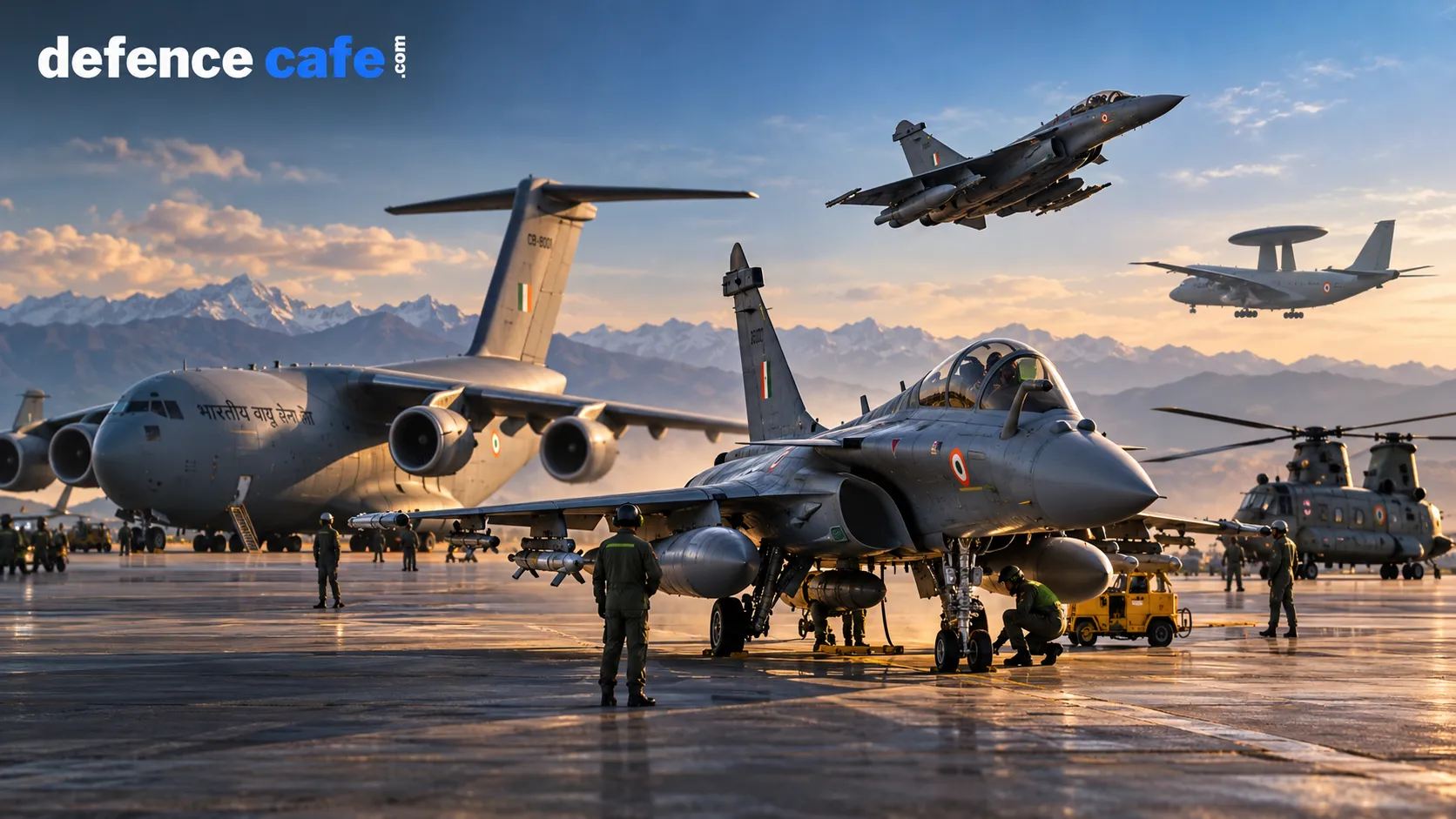
The Indian Air Force is not simply a collection of fighter jets. It is a complete aerospace force built around combat aircraft, airlift, helicopters, airborne surveillance, air defence, command and control, logistics and increasingly uncrewed and networked systems.
Its fighter fleet provides air defence and strike capability. Transport aircraft move troops, equipment and supplies over long distances. Helicopters operate in roles ranging from battlefield support and high-altitude combat to special operations and rescue. Airborne Early Warning and Control systems extend the force’s ability to see and manage the airspace, while ground-based air-defence systems add another layer of protection.
The structure behind these capabilities is equally important. The IAF is organised under Air Headquarters and seven commands: five operational commands and two functional commands responsible for training and maintenance. An official government reference describes this broad organisational model, while the IAF’s modernisation programme is increasingly focused on indigenous platforms, longer-range weapons, surveillance, networking and next-generation aerospace technology.
What Is the Indian Air Force?
The Indian Air Force is the air arm of India’s armed forces. Its responsibilities extend well beyond conventional air combat.
In a major conflict, the IAF may have to protect Indian airspace, achieve air superiority, strike enemy targets, support land and maritime forces, conduct reconnaissance, move troops and equipment, provide airborne command and control, evacuate casualties and sustain operations over long distances.
Its role also extends beyond warfighting. Transport aircraft and helicopters can support humanitarian assistance and disaster relief, search and rescue, emergency evacuation and rapid movement of personnel and supplies.
Exercise Vayu Shakti-2026 demonstrated this broad approach. The official Ministry of Defence release listed fighter, transport, helicopter and remotely piloted aircraft participating in the exercise, alongside air-defence and counter-unmanned-aircraft systems.
Ministry of Defence / PIB — Exercise Vayu Shakti-2026
How the Indian Air Force Is Organised
The IAF’s command structure combines geographical responsibility with functional specialisation.
There are five operational commands and two functional commands. Air Headquarters in New Delhi provides service-level command and administration.
| Command | Type | Headquarters |
|---|---|---|
| Western Air Command (WAC) | Operational | New Delhi |
| Eastern Air Command (EAC) | Operational | Shillong |
| Central Air Command (CAC) | Operational | Prayagraj |
| South Western Air Command (SWAC) | Operational | Gandhinagar |
| Southern Air Command (SAC) | Operational | Thiruvananthapuram |
| Training Command (TC) | Functional | Bengaluru |
| Maintenance Command (MC) | Functional | Nagpur |
The government educational material describing IAF organisation identifies seven commands, comprising five operational commands and the Training and Maintenance Commands. The older document uses the former name Allahabad for Central Air Command’s headquarters; the city is now officially known as Prayagraj.
CBSE / Government educational handbook — Indian Air Force organisation and commands
Controller General of Defence Accounts — Indian Air Force organisational structure
Operational vs Functional Commands
The distinction is useful.
The five operational commands control forces responsible for conducting air operations over their respective areas. The Training Command is responsible for the training system, while the Maintenance Command deals with the repair, overhaul, storage and technical support necessary to keep aircraft and equipment available.
That arrangement reflects an important reality of air power: flying the aircraft is only one part of the mission. Pilot training, engineering, spares, weapons, runway infrastructure, communications and maintenance determine whether an aircraft can actually generate sustained sorties.
The Indian Air Force Fighter Fleet
Fighter aircraft are the most visible part of the IAF, but there is no single fighter that performs every mission.
The current combat fleet combines heavy, medium and light aircraft acquired or developed at different points in India’s aerospace history.
| Aircraft | Broad category | Primary roles |
|---|---|---|
| Sukhoi Su-30MKI | Heavy multirole fighter | Air combat, long-range strike and multirole missions. |
| Rafale | Multirole fighter | Air-to-air, precision strike and other multirole missions. |
| Tejas | Light combat aircraft | Multirole fighter operations and progressive replacement of older light fighters. |
| Mirage 2000 | Multirole fighter | Air defence and strike missions. |
| MiG-29 | Multirole / air-combat fighter | Air defence and strike missions. |
| Jaguar | Strike aircraft | Deep-penetration and ground-attack missions. |
These are not six interchangeable aircraft. Each exists within a particular combination of weapons, sensors, range, maintenance requirements, pilot training and operational doctrine.
Su-30MKI: The Heavy Fighter Backbone
The Su-30MKI is one of the IAF’s most important combat aircraft. Its size, range, payload and multirole design allow it to undertake air-combat and strike missions while carrying advanced Indian and foreign-origin systems integrated into the platform.
One of the most important aspects of the Su-30MKI story is that India’s version has evolved well beyond an off-the-shelf aircraft. The platform has undergone multiple upgrades and has been integrated with Indian weapons and mission systems.
Its importance also explains why the IAF continues to invest in extending the platform’s service life. In April 2026, the Defence Acquisition Council granted an Acceptance of Necessity for the overhaul of Su-30 aero-engine aggregates, intended to increase service life and meet the operational requirements of the Air Force.
Rafale: The Newer Multirole Fighter
India acquired 36 Rafale fighters under the 2016 India-France intergovernmental arrangement. The first aircraft arrived in India in 2020.
The Rafale adds a newer-generation multirole capability to the IAF, including modern sensors, electronic warfare and precision-strike systems.
The aircraft also has a separate naval connection: India later signed a separate agreement for 26 Rafale-Marine aircraft for the Indian Navy. That is a different procurement from the IAF’s 36-aircraft fleet.
Ministry of Defence / PIB — Rafale fighter aircraft deal
Ministry of Defence / PIB — Rafale-Marine and India’s Rafale programme
Tejas: India’s Indigenous Fighter
LCA Tejas is central to India’s long-term effort to build an indigenous fighter-aircraft ecosystem.
The aircraft was designed by India’s Aeronautical Development Agency and manufactured by Hindustan Aeronautics Limited. Its significance therefore goes beyond the individual airframe: the programme has created experience in flight-control systems, avionics, composites, systems integration and aerospace manufacturing.
The current expansion is centred on the LCA Mk1A. On 25 September 2025, the Ministry of Defence signed a contract with HAL for 97 LCA Mk1A aircraft, including 68 single-seat fighters and 29 twin-seat aircraft. The government said deliveries would begin in 2027-28 and continue over six years. The aircraft under this contract are stated to have more than 64% indigenous content.
Ministry of Defence / PIB — 97 LCA Mk1A contract with HAL
A further step in the domestic aerospace ecosystem came in September 2026 when HAL handed over two LCA FOC twin-seater trainers and three HTT-40 basic trainer aircraft to the IAF. This is distinct from the future 97-aircraft Mk1A production contract, but it shows the broader expansion of indigenous aircraft manufacturing.
Ministry of Defence / PIB — HAL hands over LCA FOC twin-seaters and HTT-40 trainers to IAF
Mirage 2000, MiG-29 and Jaguar
Older aircraft do not automatically become irrelevant. Their continuing usefulness depends on upgrades, weapons integration, maintenance and the missions for which they are retained.
The IAF’s Mirage 2000 and MiG-29 fleets have received progressive upgrades, while Jaguar aircraft remain associated with strike missions. This creates a mixed fleet in which different aircraft generations operate at the same time.
The transition is gradual rather than instantaneous. That is one reason why modernisation programmes usually include both new aircraft and life-extension or upgrade programmes for existing fleets.
The MiG-21 Era Has Ended
One important change has already occurred. The IAF’s MiG-21 was retired from operational service in September 2025, ending more than six decades of service with the Indian Air Force.
The retirement marked the end of one of the most recognisable chapters in Indian military aviation and reinforced the shift toward newer platforms such as Tejas.
Ministry of Defence / PIB — Decommissioning of the IAF MiG-21
Transport Aircraft: The Fleet That Moves the Force
Combat aircraft attract most of the attention, but air power cannot be sustained without air mobility.
Transport aircraft move soldiers, ammunition, vehicles, equipment, humanitarian supplies and specialist personnel. They can also support airborne operations, casualty evacuation and rapid reinforcement.
| Aircraft | Role | Why it matters |
|---|---|---|
| C-17 Globemaster III | Heavy strategic airlift | Long-range movement of troops and heavy equipment. |
| C-130J Super Hercules | Tactical transport / special operations support | Supports specialised airlift and operations from austere locations. |
| C-295 | Medium tactical transport | Replacing the ageing Avro fleet and strengthening tactical airlift. |
| An-32 | Tactical transport | Long-serving medium transport platform progressively being replaced. |
| Il-76 | Heavy transport | Part of the older heavy airlift architecture being addressed by fleet modernisation. |
C-17: Strategic Airlift
The C-17 Globemaster III provides the IAF with heavy strategic airlift capability.
Its value is not limited to conventional military logistics. An aircraft with this kind of airlift capacity can rapidly move personnel and equipment between distant locations, which becomes especially important when geography makes road or rail movement slow or difficult.
Strategic airlift is therefore a form of military mobility. It can influence how quickly a country can reinforce a distant theatre, respond to a crisis or sustain forces operating far from their normal bases.
C-130J: Tactical and Special Operations Airlift
The C-130J Super Hercules occupies a different part of the air-mobility spectrum.
It is associated with tactical transport and specialised missions, including the movement of personnel and equipment into locations where a conventional heavy transport aircraft may not be the ideal solution.
During Exercise Vayu Shakti-2026, C-130J aircraft were among the transport platforms participating in the integrated exercise.
Ministry of Defence / PIB — Vayu Shakti-2026 operational display
C-295: India’s New Medium Transport Aircraft
The C-295 is one of India’s most significant recent transport-aircraft programmes.
India contracted for 56 aircraft, with 16 to be delivered in fly-away condition and 40 to be manufactured in India through Tata Advanced Systems Limited and Airbus Defence and Space. The programme is intended to replace the ageing Avro fleet.
The aircraft includes a rear loading ramp and is designed for transport, cargo and para-dropping duties. It can also operate from semi-prepared surfaces, giving it utility beyond large conventional air bases.
The programme became especially significant for Indian aerospace manufacturing because the Vadodara facility is the country’s first private-sector final assembly line for military aircraft. In 2026, the first India-manufactured C-295 completed its maiden flight.
Ministry of Defence / PIB — C-295 manufacturing facility and IAF programme
Helicopters: Air Power Close to the Ground
Helicopters fill a different operational niche from fixed-wing aircraft.
They can hover, operate from confined locations and carry people or equipment into terrain where fixed-wing aircraft cannot easily operate.
For the IAF, this means helicopters support a wide range of missions including battlefield mobility, troop movement, casualty evacuation, search and rescue, air assault support, special operations and high-altitude combat.
| Helicopter | Broad role |
|---|---|
| Mi-17 family | Medium-lift transport, troop movement, logistics and support missions. |
| Chinook | Heavy-lift helicopter for moving personnel and equipment. |
| Apache AH-64E | Attack helicopter for armed battlefield operations. |
| LCH Prachand | Indigenous light combat helicopter designed for armed operations including high-altitude employment. |
| ALH Dhruv / Rudra variants | Multi-role helicopter family with transport and armed variants. |
| Chetak | Light utility and support helicopter. |
Apache
The AH-64E Apache gives the IAF a dedicated modern attack-helicopter capability.
Attack helicopters are not simply smaller fighter aircraft. Their operational environment is much closer to the battlefield, where terrain, low-altitude flight, target identification and coordination with ground forces become critical.
The Apache was among the helicopter platforms demonstrated during Vayu Shakti-2026.
Chinook
The CH-47F Chinook provides a heavy-lift capability.
Heavy-lift helicopters are important because some military equipment is too large or too heavy to move efficiently by road in difficult terrain. They can also move personnel and cargo rapidly in areas where ground access is constrained.
During Vayu Shakti-2026, Chinook helicopters demonstrated transport of equipment to difficult terrain as well as other mission tasks.
LCH Prachand
The Light Combat Helicopter Prachand is one of India’s most important indigenous rotary-wing programmes.
Designed and developed by HAL, it was inducted into the IAF in 2022. Its design emphasises combat capability in demanding terrain, including high-altitude environments.
On 28 March 2025, the Ministry of Defence signed contracts with HAL for 156 LCH Prachand helicopters for the armed forces: 66 for the IAF and 90 for the Indian Army. The ministry said deliveries would begin from the third year and continue over five years.
Ministry of Defence / PIB — Contract for 156 LCH Prachand helicopters
The indigenous LCH also took centre stage during Vayu Shakti-2026, when the President of India undertook a sortie in the helicopter at Air Force Station Jaisalmer.
President’s Secretariat / PIB — Sortie in indigenous LCH Prachand
Airborne Early Warning and Control: The “Eyes in the Sky”
A fighter can see only what its own sensors can detect. An Airborne Early Warning and Control aircraft can look across a much broader area while also helping coordinate other aircraft.
That makes AEW&C a major force multiplier.
The idea is simple: place a powerful surveillance system on an aircraft flying at altitude. From there, the system can help detect and track airborne activity and provide commanders and friendly aircraft with a wider operational picture.
Netra AEW&C
India’s indigenous Netra AEW&C programme is a major step in this direction.
DRDO handed over the Final Operational Clearance certificate for the indigenous Netra AEW&C system to the IAF in June 2026. The government said the system enhances airborne surveillance, situational awareness and battle-management capability.
Ministry of Defence / PIB — IAF receives Final Operational Clearance for indigenous Netra AEW&C
AEW&C Mk II
The next step is AEW&C Mk II.
In July 2026, DRDO’s Centre for Air Borne Systems signed contracts related to the conversion of six A321 aircraft for the programme and the development and production of mission systems. The government says the Mk II system is intended to provide enhanced endurance, advanced airborne surveillance, secure communications and improved command-and-control capability.
Ministry of Defence / PIB — AEW&C Mk II programme contracts
How Modern Air Power Actually Works
The easiest way to understand air power is to stop thinking only about the aircraft.
A modern air operation resembles a chain:
| Stage | What happens |
|---|---|
| Detect | Radar, aircraft, satellites, ground sensors and other systems identify potential contacts. |
| Track | The contact is monitored to establish its movement and behaviour. |
| Identify | Available information is used to determine what the contact represents. |
| Decide | Commanders determine whether and how to respond. |
| Act | The appropriate aircraft, weapon or defensive system is employed. |
| Assess | Information is collected to understand the outcome and guide subsequent decisions. |
This is why an AEW&C aircraft can be valuable even though it may not fire a weapon. Similarly, a tanker may increase the useful reach of fighters without carrying out an attack itself.
Air Defence: Protecting India’s Airspace
Offensive air power and defensive air power are closely connected.
The IAF’s air-defence architecture includes airborne platforms, ground-based radars and surface-to-air missile systems. The objective is not simply to destroy an incoming aircraft; it is to create a layered system capable of detecting and responding to different kinds of threats.
Government releases have identified systems including S-400, MRSAM, Akash and SPYDER within India’s wider air-defence architecture, alongside counter-unmanned-aircraft systems.
In February 2026, the Defence Acquisition Council also accorded Acceptance of Necessity for additional S-400 capability. An AoN is an acquisition approval milestone; it should not be confused with a completed contract or induction.
Air-to-Air Refuelling: Extending Fighter Reach
Another often-overlooked component of air power is air-to-air refuelling.
A fighter normally has a finite amount of fuel. A tanker can transfer fuel in the air, allowing compatible aircraft to remain airborne longer or operate farther from their bases without depending entirely on external landing points.
This becomes especially useful when an air force has to maintain patrols, reposition aircraft or conduct long-range missions.
India has also used contractual and training arrangements to support air-to-air refuelling proficiency. In 2025, the Ministry of Defence signed an agreement for wet leasing of one flight-refuelling aircraft to support training for IAF and Navy pilots.
Ministry of Defence / PIB — Flight-refuelling training arrangement
Uncrewed Aircraft and the Changing Air Battlefield
Uncrewed systems are becoming another part of the IAF’s air-power architecture.
They can perform surveillance, reconnaissance and other specialised missions without putting a pilot inside every aircraft. Their value can become particularly apparent when persistent observation is more important than speed or heavy payload.
Vayu Shakti-2026 included Remotely Piloted Aircraft in the exercise. The exercise also incorporated counter-unmanned-aircraft systems, showing that drones are now relevant on both sides of the air-defence equation.
The broader shift is from a world dominated almost entirely by manned aircraft toward a mixed environment containing manned fighters, helicopters, unmanned systems, ground sensors and digital networks.
India’s Fighter Modernisation: What Comes Next?
The IAF’s future is not built around a single replacement programme.
It is a layered modernisation effort covering today’s fleets, near-term additions and next-generation aircraft.
LCA Mk1A
The 97-aircraft Mk1A contract signed in September 2025 is one of the key near-term programmes. The government has stated that deliveries under this contract are scheduled to begin in 2027-28.
The aircraft is intended to strengthen the indigenous light-fighter segment and expand the production base supporting the Tejas family.
MRFA
In February 2026, the Defence Acquisition Council granted Acceptance of Necessity for the Multi Role Fighter Aircraft (MRFA) programme, with the proposal identifying Rafale aircraft.
The government said the procurement is intended to strengthen air-dominance capability and that the majority of the aircraft would be manufactured in India.
Because this is an AoN, it represents an acquisition milestone rather than a completed delivery programme.
Ministry of Defence / PIB — MRFA Acceptance of Necessity, February 2026
AMCA
The Advanced Medium Combat Aircraft is intended to take India into the next generation of indigenous fighter design.
In May 2025, the government approved an AMCA Programme Execution Model under which the Aeronautical Development Agency would execute the programme through competitive industry partnerships, opening participation to Indian private and public-sector companies.
The government described prototype development as a major milestone in India’s effort to build indigenous aerospace capability.
Ministry of Defence / PIB — AMCA Programme Execution Model
The AMCA story matters because fifth-generation combat aviation requires more than an airframe. It brings together low-observable design, advanced sensors, electronic warfare, high-end flight software, systems integration, manufacturing precision and a sophisticated industrial supply chain.
Indigenous Aerospace Ecosystem
Another important part of the story is the industrial base supporting these programmes.
The Tejas, C-295 and LCH programmes all involve substantial Indian participation, while AMCA is being structured around greater industry integration. In September 2026, HAL’s handover of LCA trainers and HTT-40 aircraft further illustrated the widening range of aircraft being produced in India.
The objective is not simply to produce more airframes. A sustainable aerospace ecosystem must also be capable of producing components, avionics, structures, engines or engine-related systems, maintenance support and future upgrades.
Vayu Shakti-2026: A Snapshot of Modern IAF Operations
One of the clearest public demonstrations of the IAF’s force structure came in Vayu Shakti-2026 at Pokhran in February.
The exercise involved more than 130 aircraft and combined fighters, transport aircraft, helicopters and indigenous airborne systems. Rafale, Su-30MKI, Tejas and Mirage 2000 were among the fighter aircraft involved, while C-17, C-130J and C-295 represented the transport element. Helicopter platforms included Mi-17, Apache, Chinook, ALH and LCH Prachand.
The important point was not the number of aircraft on display. The exercise was structured around integration — offensive air operations, air defence, special operations, logistics and humanitarian missions functioning within a common operational framework.
President’s Secretariat / PIB — Vayu Shakti-2026 exercise
Tarang Shakti 2026 and International Interoperability
Air power is increasingly shaped by interoperability as well as domestic capability.
At the time of publication, Exercise Tarang Shakti 2026 is being conducted in India from 26 September to 12 October 2026, with seven friendly foreign countries participating.
The exercise involves aircraft from countries including Australia, the United States, the United Arab Emirates, France, Germany, Sri Lanka and Bangladesh. The aircraft participating cover combat, airlift and air-to-air refuelling roles.
Such exercises allow air forces to practise large-scale coordination, mission planning, communications and operational procedures with partners.
Ministry of Defence / PIB — Exercise Tarang Shakti 2026
Why the Indian Air Force Needs Different Types of Aircraft
A common mistake is to ask which aircraft is the “best” and assume that the answer should replace the rest of the fleet.
That is not how an air force is designed.
A heavy fighter, a light fighter, a transport aircraft and an attack helicopter solve completely different problems.
| Capability | Typical platform | Purpose |
|---|---|---|
| Air combat | Su-30MKI, Rafale, Tejas, MiG-29 | Protect airspace and conduct air-to-air missions. |
| Precision strike | Rafale, Su-30MKI, Jaguar, Mirage 2000 | Engage surface targets at varying ranges. |
| Tactical airlift | C-130J, C-295, An-32 | Move troops and cargo closer to operational areas. |
| Strategic airlift | C-17 | Move heavy loads over long distances. |
| Battlefield helicopter support | Mi-17, LCH, Apache | Provide mobility and armed support near the battlefield. |
| Heavy lift | Chinook | Move heavy equipment and personnel rapidly. |
| Airborne surveillance | Netra AEW&C | Extend detection and battle-management capability. |
That is why the phrase “air power” is more accurate than simply saying “fighter strength”.
What to Watch Next
The next phase of Indian air-power modernisation will be shaped by several overlapping developments.
- Tejas Mk1A: production and delivery under the 97-aircraft contract will be a major part of the near-term fighter transition.
- MRFA: the 2026 Acceptance of Necessity could progress into later acquisition stages, but an AoN should not be treated as a completed contract.
- AMCA: prototype-development and industry-partnership milestones will determine the pace of India’s next-generation fighter programme.
- AEW&C Mk II: the six-aircraft programme should expand India’s airborne surveillance and command-and-control architecture.
- C-295: the Indian manufacturing ecosystem will continue to mature as more aircraft are produced domestically.
- LCH Prachand: the 66-aircraft IAF procurement will gradually expand indigenous combat-helicopter capability.
- Uncrewed systems: drones, remotely piloted aircraft and counter-UAS technology will become increasingly important parts of air operations.
Frequently Asked Questions
How many commands does the Indian Air Force have?
The Indian Air Force is organised into seven commands: five operational commands and two functional commands — Training Command and Maintenance Command.
What are the main fighter jets of the Indian Air Force?
The IAF’s major combat-aircraft families include the Su-30MKI, Rafale, Tejas, Mirage 2000, MiG-29 and Jaguar. Their exact roles differ according to aircraft design, mission systems, weapons and operational requirements.
Is Tejas replacing the MiG-21?
Tejas is part of the IAF’s transition toward newer indigenous fighter aircraft, while the MiG-21 completed its operational service in September 2025.
What is the role of the C-17 in the Indian Air Force?
The C-17 provides heavy strategic airlift, allowing the IAF to move personnel and substantial equipment over long distances.
What is the difference between the C-17, C-130J and C-295?
They belong to different parts of the air-mobility spectrum. The C-17 provides heavy strategic airlift, the C-130J is oriented toward tactical and specialised transport, while the C-295 is a medium tactical transport aircraft replacing the ageing Avro fleet.
What is the LCH Prachand?
LCH Prachand is India’s indigenous Light Combat Helicopter developed by HAL. It is designed for armed missions and is particularly relevant to demanding terrain, including high-altitude environments.
What is an AEW&C aircraft?
AEW&C stands for Airborne Early Warning and Control. These aircraft carry surveillance systems that provide an expanded view of the airspace and help with situational awareness and battle management.
What is AMCA?
AMCA stands for Advanced Medium Combat Aircraft. It is India’s indigenous next-generation fighter programme, with the programme execution model approved in 2025 to support prototype development through industry partnerships.
Why does the IAF need transport aircraft when it already has fighter jets?
Fighter aircraft provide combat power, but they cannot perform the same logistics role as dedicated transport aircraft. Transport aircraft move personnel, equipment and supplies and help the IAF sustain operations over long distances.
Conclusion
The Indian Air Force is best understood as an integrated aerospace system rather than a list of fighter jets.
Its fighters — from Su-30MKI and Rafale to Tejas and the legacy fleets — provide combat capability. C-17, C-130J and C-295 aircraft provide strategic and tactical mobility. Helicopters such as Apache, Chinook, Mi-17 and indigenous LCH Prachand operate across battlefield and support missions. Netra AEW&C and future AEW&C Mk II aircraft extend the force’s ability to see and manage the airspace.
Underneath all of this sits the less visible machinery of air power: training, maintenance, logistics, communications, radar, weapons, air defence, air-to-air refuelling and data networks.
India’s modernisation is therefore about more than buying new aircraft. The larger transformation is toward a force that can combine indigenous design and manufacturing, networked sensors, advanced weapons, airborne surveillance, mobility and increasingly uncrewed systems.
That combination — rather than any single aircraft — is what gives the Indian Air Force its modern air-power architecture.
Sources & Further Reading
- CBSE / Government educational handbook — Indian Air Force organisation and seven-command structure
- Controller General of Defence Accounts — Indian Air Force organisational structure and command framework
- Ministry of Defence / PIB — Curtain Raiser for Exercise Vayu Shakti-2026
- President’s Secretariat / PIB — Vayu Shakti-2026 operational exercise
- Ministry of Defence / PIB — Contract for 97 LCA Mk1A aircraft for the IAF
- Ministry of Defence / PIB — Defence Acquisition Council approvals for IAF modernisation, February 2026
- Ministry of Defence / PIB — Final Operational Clearance for indigenous Netra AEW&C
- Ministry of Defence / PIB — AEW&C Mk II development and industry contracts
- Ministry of Defence / PIB — C-295 manufacturing programme and Tata Aircraft Complex
- Ministry of Defence / PIB — Contract for 156 LCH Prachand helicopters
- Ministry of Defence / PIB — AMCA Programme Execution Model through industry partnership
- Ministry of Defence / PIB — Decommissioning of the IAF MiG-21 in September 2025
- Ministry of Defence / PIB — Exercise Tarang Shakti 2026
- VAYU by Defence Cafe — Tejas Laser Metal Keychain
