


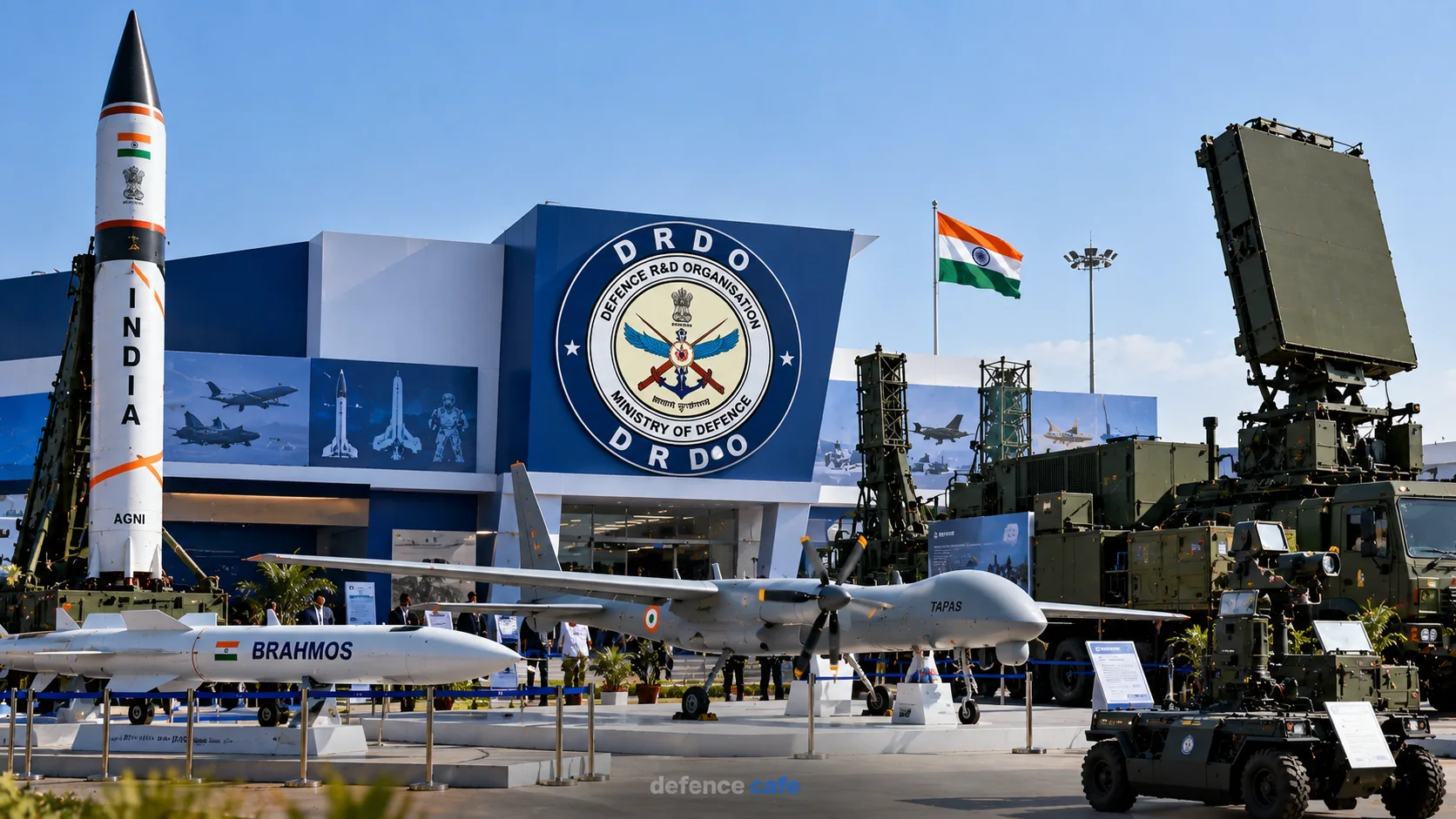
When people hear DRDO, the first image that often comes to mind is a missile test. That is only one part of the story.
The Defence Research and Development Organisation is India’s central defence research network, responsible for developing technologies and systems for the armed forces across land, air, sea, space and cyber domains. Its work ranges from missiles and radars to aircraft systems, combat vehicles, naval sensors, electronic warfare, materials, artificial intelligence, life-support systems and technologies designed to protect soldiers.
As of the organisation’s June 2026 information, DRDO comprises around 41 laboratories and five DRDO Young Scientist Laboratories. These establishments are organised into seven major technology clusters, supported by corporate functions covering technology management, production coordination, resources, human resources and related areas.
Understanding that structure makes DRDO easier to understand. It is not one laboratory, and it is not simply India’s “missile agency”. It is an interconnected research-and-development system intended to turn difficult military requirements into technologies that can eventually be produced and inducted by the armed forces.
What Does DRDO Stand For?
DRDO stands for Defence Research and Development Organisation.
It operates under the Department of Defence Research and Development in the Ministry of Defence, Government of India.
DRDO’s stated mission is to design and develop sensors, weapon systems, platforms and allied equipment for defence and security across land, air, sea, space and cyber domains. It also aims to facilitate production and induction of technologies developed through the defence R&D ecosystem and strengthen research capabilities in industry, science and technology institutions and academia.
DRDO — Organisation, Vision and Mission
When Was DRDO Established?
DRDO was established in 1958 through the merger of existing technical-development and defence-science organisations, including the Technical Development Establishments, the Directorate of Technical Development and Production and the Defence Science Organisation.
It began with only a small number of establishments. Over the following decades, the organisation expanded into a much wider research network covering disciplines that today include aeronautics, armaments, electronics, combat vehicles, engineering systems, computing, materials, naval technology and life sciences.
That history explains something important about DRDO: its identity was never limited to one weapon category. Its purpose was to build a domestic technological base for defence.
DRDO — History and Organisation
What Does DRDO Actually Do?
At the simplest level, DRDO takes a military problem and works on the science and engineering needed to solve it.
That can mean developing a complete system, such as an air-defence missile, or something much less visible, such as a radar processor, a propulsion component, a sonar, a composite material, a communications system or protective equipment for soldiers.
Its stated responsibilities cover five broad activities:
| Area | What DRDO does |
|---|---|
| Research & development | Develops new defence technologies, subsystems, prototypes and complete platforms. |
| Testing & evaluation | Tests technologies and systems against engineering and military requirements. |
| Certification | Provides or supports specialised certification, including military airworthiness through CEMILAC. |
| Technology transfer | Transfers developed technologies to eligible production agencies and industry. |
| Research ecosystem building | Works with industry, startups, MSMEs, universities and research institutions. |
This last point is increasingly important. Modern defence systems are too complex for a single laboratory to build everything alone.
DRDO Is Not the Same as a Defence Manufacturer
This distinction is often missed.
DRDO is primarily a research and development organisation. It develops technologies and systems, but the organisation itself is not the manufacturer of every item eventually used by the armed forces.
Once a technology is sufficiently mature, production can involve public-sector defence companies, private-sector companies, designated production agencies or development-cum-production partners.
DRDO’s own mission describes its role as facilitating the production and induction of systems developed through the R&D ecosystem.
In other words:
How India’s Defence R&D System Works
There is no single identical path for every defence programme, but the broad process can be understood as a chain.
1. The Armed Forces Define the Operational Need
The Army, Navy and Air Force identify military problems and capability gaps. These requirements ultimately shape what technologies need to be developed.
A requirement can be straightforward — for example, the need for a new radar — or extremely difficult, such as developing a propulsion system, high-performance seeker, secure communication technology or a new type of material.
2. DRDO Evaluates the Technology Challenge
Relevant DRDO laboratories assess whether the required capability can be developed using existing technology, modified systems or entirely new research.
This is where the laboratory structure becomes useful. A radar problem may involve electronics and signal processing specialists. A missile programme may bring together propulsion, guidance and testing laboratories. A naval programme may require sonar, underwater weapons, materials and oceanographic expertise.
3. Development and Prototyping
Researchers and engineers then move from concepts to laboratory demonstrations, engineering models and prototypes.
Depending on the programme, that may involve:
- new materials
- electronic hardware and sensors
- software and algorithms
- propulsion systems
- guidance and navigation
- structural and mechanical systems
- complete vehicles or weapon systems
4. Ground Testing and Developmental Trials
A system has to prove that it works outside the laboratory.
Testing may happen in controlled laboratory environments, dedicated test facilities, ground ranges, laboratories, test tracks, flight-test environments or at sea depending on the technology.
For complex systems, testing is not a single event. A prototype may go through many developmental iterations as engineers identify problems, change components and test again.
5. User Evaluation
Once a system reaches the appropriate level of maturity, the armed forces can evaluate it from the user’s perspective.
This is where a technically successful prototype meets the practical realities of military operations: reliability, maintainability, usability, environmental conditions, interoperability and performance under operationally relevant conditions.
6. Certification Where Required
Some defence technologies require specialised certification before production or operational use.
For airborne systems, the Centre for Military Airworthiness and Certification (CEMILAC) performs military airworthiness certification. DRDO describes CEMILAC as supporting indigenous development, upgrades and integration of imported and indigenous systems, with certification extending to aircraft, helicopters, UAVs, aerostats and their relevant systems, components, materials and software.
DRDO — Certification Services and CEMILAC
7. Transfer to Production
A successful development has little military value if it cannot be manufactured reliably at the required scale.
This is where technology transfer and production partnerships become important.
DRDO’s current Transfer of Technology Policy 2025, published in January 2026, provides the framework for transferring developed technologies to industry.
DRDO — Policy for Transfer of Technology 2025
8. Induction and Future Upgrades
Even after induction, a system’s story is not over.
Weapons and platforms may receive software updates, improved electronics, upgraded sensors, new materials, improved maintainability or new operational capabilities over their service life.
That is one reason defence R&D is better understood as a continuing ecosystem rather than a one-time project.
How DRDO Is Organised Today
DRDO currently describes its research network as consisting of around 41 laboratories and five DRDO Young Scientist Laboratories.
The laboratories are grouped into seven technology clusters. Each cluster brings together establishments working in related technical areas.
| Technology cluster | Main focus |
|---|---|
| Aeronautical Systems | Unmanned aircraft, aero-engine technology, airborne surveillance, parachutes and related aerospace systems. |
| Armament & Combat Engineering Systems | Armaments, ammunition, explosives, combat vehicles, launchers and engineering equipment. |
| Electronics & Communication Systems | Radars, electronic warfare, electro-optics, lasers, communications and sensors. |
| Micro Electronic Devices, Computational Systems & Cyber Security | AI, computing, cyber security, quantum technologies and microelectronic systems. |
| Missiles & Strategic Systems | Missiles, propulsion, guidance, control, strategic systems and associated test infrastructure. |
| Naval Systems & Materials | Underwater sensors, naval weapons, sonar, AIP, naval materials and related technologies. |
| Soldier Support System | Human performance, protection, nutrition, medical technologies, life support and CBRN protection. |
Major DRDO Laboratories You Should Know
You do not need to memorise all of DRDO’s establishments to understand the system. A smaller group of laboratories explains a large part of the organisation’s most recognisable work.
Aeronautical Development Establishment — ADE
ADE, based in Bengaluru, is part of DRDO’s Aeronautical Systems cluster and works in areas associated with unmanned aerial vehicles and aerospace systems.
It is also connected to India’s wider effort to develop autonomous and remotely piloted technologies, making it one of the laboratories to watch as uncrewed aviation becomes more important.
Gas Turbine Research Establishment — GTRE
GTRE focuses on gas-turbine engine technology.
Engine development is one of the most difficult areas of aerospace engineering because it combines extreme temperatures, rotating machinery, advanced materials, precision manufacturing and demanding reliability requirements.
DRDO’s current technology catalogue continues to list work on the Kaveri engine core and related hot-end technologies under GTRE.
DRDO — Kaveri Core Engine Technology
Centre for Airborne Systems — CABS
CABS works on airborne surveillance and related systems.
Its work is closely associated with India’s AEW&C capability — the airborne systems that can provide a much wider picture of the airspace and help commanders coordinate operations.
Electronics & Radar Development Establishment — LRDE
LRDE is one of DRDO’s best-known electronics laboratories.
Its work covers radar development, and DRDO’s current product catalogue includes systems such as the Weapon Locating Radar, tactical-control radars and maritime surveillance radars developed under the Electronics and Communication Systems cluster.
Radar development is much broader than the rotating antenna visible from a distance. It involves radio-frequency engineering, signal processing, tracking algorithms, electronic protection and complex software.
Defence Research & Development Laboratory — DRDL
DRDL in Hyderabad is part of the Missiles and Strategic Systems cluster.
It works alongside other specialised establishments dealing with missile design, propulsion, guidance, testing and systems integration. Missile development is therefore not the responsibility of DRDL alone; it is a multi-laboratory effort.
Research Centre Imarat — RCI
RCI is another important establishment within the missile ecosystem, focusing on technologies associated with guidance, navigation, control and related systems.
These functions are easy to overlook, but they are what allow a weapon to determine where it is, where it is going and how it should respond during flight.
Integrated Test Range — ITR
ITR, located at Chandipur in Odisha, is a major test facility associated with missile and strategic-system development.
A sophisticated weapon requires sophisticated testing infrastructure. Range instrumentation, tracking, telemetry and other test systems allow engineers to analyse what happened during a trial rather than simply asking whether a launch succeeded or failed.
Armament Research & Development Establishment — ARDE
ARDE works on armaments and related weapon technologies.
Its work sits in the Armament & Combat Engineering Systems cluster, which covers areas ranging from ammunition and explosives to combat systems and engineering equipment.
Combat Vehicles Research & Development Establishment — CVRDE
CVRDE focuses on combat-vehicle technologies.
That includes engineering challenges such as mobility, transmissions, suspension and other vehicle systems needed to turn an armoured platform into a usable military machine.
Centre for Artificial Intelligence & Robotics — CAIR
CAIR represents one of the newer dimensions of defence research: computing, artificial intelligence, robotics and intelligent systems.
It sits within DRDO’s Micro Electronic Devices, Computational Systems & Cyber Security cluster — a structure that shows how modern defence technology is moving beyond purely mechanical systems.
Naval Physical & Oceanographic Laboratory — NPOL
NPOL is focused on naval technologies, particularly underwater systems and ocean-related research.
Submarine detection, sonar performance and underwater acoustics are challenging because the ocean itself constantly affects how sound travels.
Naval Science & Technological Laboratory — NSTL
NSTL is another major naval laboratory. DRDO’s technology catalogue associates NSTL with systems including the Torpedo Advanced Light, an anti-submarine weapon designed for launch from ships and rotary-wing aircraft.
DRDO — Torpedo Advanced Light (TAL)
Defence Metallurgical Research Laboratory — DMRL
DMRL works on metallurgical technologies and advanced materials.
Materials may not attract the same attention as missiles or fighter aircraft, but they are fundamental to both. High-performance platforms need materials that can withstand heat, stress, corrosion, vibration and repeated loading without compromising weight or reliability.
Soldier-Support Laboratories
DRDO’s Soldier Support System cluster covers an entirely different set of problems.
Laboratories such as DEBEL, DIPAS and DIPR work in areas related to medical support, physiology, psychology and human performance. Other establishments in the cluster address nutrition, protective equipment, life-support systems and protection against chemical, biological, radiological and nuclear hazards.
The point is easy to miss: a defence technology can be technically brilliant and still fail its purpose if the human being using it cannot operate effectively in the environment for which it was designed.
DRDO — Soldier Support System / Life Sciences
Seven Technology Clusters, Not Seven Separate Organisations
The cluster system exists because modern defence programmes overlap.
A missile may involve propulsion, guidance, electronics, materials, testing and command-and-control technology. An aircraft may require sensors from one laboratory, aerospace systems from another, materials from another and certification through CEMILAC.
The same pattern appears in naval and armoured systems.
This is why a single DRDO programme can involve several laboratories rather than one laboratory doing everything from start to finish.
DRDO’s Corporate Side: The Less Visible Part of the System
Research laboratories are only one part of a large organisation.
DRDO also maintains corporate clusters for activities such as:
| Corporate cluster | Broad responsibility |
|---|---|
| Technology Management (TM) | Creates and manages links between DRDO, industry, academia and the broader research ecosystem. |
| Production Coordination & Services Interaction (PC&SI) | Helps facilitate faster induction of DRDO-developed systems by the armed forces. |
| Resource & Management (R&M) | Handles organisational resource management and project planning and execution functions. |
| Human Resources (HR) | Manages recruitment, training, development and other human-capital functions. |
| BrahMos (BM) | Dedicated corporate structure associated with the BrahMos organisation within DRDO’s framework. |
How DRDO and Industry Work Together
One of the biggest changes in Indian defence R&D is the growing role of industry.
Historically, a large share of defence development was centred on government organisations. Today, the model is broader: DRDO laboratories, public-sector companies, private companies, startups, MSMEs and academic institutions increasingly work within the same ecosystem.
DRDO’s Development-cum-Production Partner model is designed to connect development with manufacturing.
According to government information, by March 2026, 134 companies had partnered with DRDO as Development-cum-Production Partners or Production Agencies. The same government material reported more than 2,180 technology-transfer agreements and more than 2,780 intellectual-property rights opened for use by Indian industry.
These are dated figures from March 2026 and should not be treated as a live September 2026 count.
Government of India / PIB — Defence R&D and industry ecosystem, 2026
Technology Transfer: How a Laboratory Invention Reaches Industry
A successful prototype is not the finish line.
Suppose a DRDO laboratory develops a new sensor. The technology has to move from a research environment into a production environment, where another organisation can manufacture it repeatedly, maintain quality and support it through its service life.
That process is called Technology Transfer, or ToT.
DRDO’s ToT framework allows Indian industry to express interest in technologies made available for transfer. Depending on the category and case, the process can involve confidentiality arrangements, technical assessment and a licensing agreement for transfer of technology.
DRDO’s current policy framework for ToT was published in January 2026.
DRDO — Policy for Transfer of Technology 2025
What Is the Technology Development Fund?
The Technology Development Fund (TDF) is one of the mechanisms designed to bring Indian industry — especially startups and MSMEs — into defence technology development.
The scheme is executed by DRDO for the Ministry of Defence and supports development of technologies and products with defence applications.
The idea is important because not every useful defence technology needs to originate inside a government laboratory.
A small Indian company might possess a niche capability in robotics, sensors, advanced materials, artificial intelligence, electronics or manufacturing. TDF can provide a route for that capability to be developed for defence use.
Government information states that TDF can provide funding of up to ₹50 crore per project. An additional ₹500 crore corpus was also approved for deep-tech and cutting-edge work.
As of June 2026, government information said 80 TDF projects worth ₹334 crore were being implemented.
These figures are explicitly tied to the stated dates and can change as projects are added or completed.
DRDO — Technology Development Fund
Government of India / PIB — TDF and defence R&D ecosystem figures for 2026
DRDO Industry-Academia Centres of Excellence
Some of the hardest defence problems begin as research questions rather than product-development contracts.
That is where universities and research institutions become valuable.
DRDO’s Industry Academia Centres of Excellence (DIA-CoEs) are intended to create directed research programmes around critical and future defence technologies.
Government information stated that 15 DIA-CoEs had been established, covering nearly 82 identified research verticals.
The model is designed to bring together DRDO laboratories, academic researchers and industry or startups so that research has a route toward practical defence applications.
DRDO — DIA-CoE and research ecosystem
What Kind of Technology Does DRDO Develop?
The breadth of DRDO’s work is easier to appreciate when the technologies are grouped by function.
| Technology area | Examples of DRDO work |
|---|---|
| Missiles | Ballistic, cruise, air-defence and other missile technologies including propulsion, guidance and control. |
| Radar | Surveillance, weapon-location, tactical-control and maritime radar systems. |
| Electronic warfare | Electronic support, electronic countermeasures and electromagnetic-spectrum technologies. |
| Aircraft systems | Uncrewed aircraft, airborne surveillance, parachute systems and aerospace technologies. |
| Combat vehicles | Armoured platforms, mobility systems, transmissions and engineering components. |
| Naval systems | Sonar, underwater sensors, torpedoes, AIP and naval materials. |
| Materials | Metals, composites, ceramics, protective and high-performance materials. |
| AI and computing | Artificial intelligence, robotics, advanced computing, cyber security and related technologies. |
| Soldier support | Medical equipment, protective gear, nutrition, life-support and human-performance technologies. |
DRDO’s Role in India’s Major Defence Programmes
Some of DRDO’s most visible achievements are complete systems. Others are technologies buried inside much larger programmes.
Tejas
DRDO’s aeronautical work is closely associated with the indigenous Light Combat Aircraft Tejas programme, although Tejas is not a single-laboratory project.
Its development involves the broader Indian aerospace ecosystem, including the Aeronautical Development Agency, Hindustan Aeronautics Limited, DRDO laboratories and other industrial and research partners.
Akash
Akash is another major example of indigenous defence-system development. It illustrates how radar, missile technology, command-and-control, propulsion and systems integration must come together in one operational architecture.
Pinaka
The Pinaka multi-barrel rocket launcher demonstrates another side of DRDO’s work — artillery and ground-combat systems rather than aerospace or missiles alone.
Agni and Strategic Systems
DRDO’s missile ecosystem also includes India’s strategic missile development work. The organisation’s own overview cites the Agni and Prithvi series among its major indigenous achievements.
DRDO — Major Indigenous Systems and Organisational Overview
What Is DRDO’s Current Direction in 2026?
DRDO’s recent public record shows a research portfolio that is becoming broader, more networked and more technology-intensive.
Kusha: Long-Range Air Defence
On 23 July 2026, DRDO conducted the maiden flight-test of the indigenous Kusha Long-Range Surface-to-Air Missile from APJ Abdul Kalam Island off Odisha.
The government said the test was conducted against an electronic target representing a high-speed, high-altitude aerial threat and that the target was successfully intercepted.
Importantly, the government also noted that the weapon system was not the work of one laboratory. Its missiles, radars and command-and-control elements were developed by different DRDO laboratories and industry partners.
That is a useful real-world example of how India’s defence R&D system operates.
Ministry of Defence / PIB — Kusha Long-Range Surface-to-Air Missile test, 23 July 2026
Advanced Weapon System Complex
In June 2026, the Raksha Mantri inaugurated an Advanced Weapon System Complex at DRDL’s APJ Abdul Kalam Missile Complex in Hyderabad.
The facility reflects the continuing investment in infrastructure needed for advanced weapon-system development, integration and testing.
Ministry of Defence / PIB — Advanced Weapon System Complex at DRDL, Hyderabad
Quantum Technology
Another part of the 2026 research picture is quantum technology.
DRDO’s current technology catalogue identifies work in areas including quantum communication, quantum machine learning, atomic clocks, quantum sensing and quantum computing. The organisation’s public material also reported successful military field trials of a scalable fibre-based quantum-key-distribution system in July 2026.
These programmes are different from traditional weapons research, but they matter because secure communications and resilient information systems are increasingly important to military operations.
Cyber Security and Artificial Intelligence
The direction is equally visible in cyber and AI.
DRDO’s public notices in 2026 included calls for projects involving large-language-model vulnerability assessment, an indigenous language model for cyber-security vulnerability discovery and threat intelligence, and zero-day vulnerability discovery frameworks under TDF.
These are examples of defence R&D moving into software-heavy areas where the battlefield is increasingly shaped by data and networks.
DRDO — What’s New and 2026 research-development initiatives
Naval Sonar and Underwater Technology
DRDO’s August 2026 publications highlighted the deployment of indigenous sonar technology on newly commissioned ships.
The development is significant in a technical sense because underwater sensing depends on highly specialised knowledge of acoustics, signal processing, ocean conditions and sensor engineering.
DRDO — Indigenous sonar technology deployed on newly commissioned ships, August 2026
Why DRDO Projects Take So Long
Defence technology is rarely a case of inventing something once and putting it into service the following month.
A military system has to survive demanding conditions while meeting requirements for accuracy, reliability, safety, maintainability and interoperability.
Consider a radar. Getting an image on a laboratory screen is one thing. Making that radar work in rain, dust, heat, vibration and electromagnetic interference — while processing many targets and integrating with other systems — is a completely different engineering problem.
The same applies to engines, missiles, submarines, electronics and combat vehicles.
There is also an important difference between technology demonstration and operational induction.
A successful test does not automatically mean a weapon has entered large-scale service. Developmental testing, user evaluation, certification, productionisation and procurement are separate stages.
DRDO, Industry and the “Aatmanirbhar” Push
One of the clearest strategic themes in India’s defence R&D policy is the attempt to reduce dependence on imported critical technologies by building domestic design and manufacturing capability.
That does not mean every component must be manufactured in India immediately. In practice, modern defence systems involve international supply chains, licensed technologies, imported components and indigenous subsystems.
The longer-term objective is to build domestic capability in areas where technological dependence can become a strategic weakness.
DRDO’s growing engagement with private companies, startups, MSMEs and universities is part of that effort.
What DRDO Does Not Do
It is useful to understand the boundaries as well.
DRDO does not single-handedly control all defence acquisition decisions. The organisation develops and supports technologies, but procurement decisions involve the wider Ministry of Defence acquisition framework and the armed services.
Similarly, an Acceptance of Necessity is an acquisition milestone rather than proof that DRDO has completed a project or that a system has already entered service.
And a successful DRDO trial is not automatically equivalent to operational induction.
Keeping these distinctions clear prevents a lot of confusion in defence reporting.
DRDO as a “System of Systems”
The phrase “system of systems” may sound technical, but it captures DRDO’s role surprisingly well.
A modern air-defence system might combine a missile, radar, command network, data links and software.
A naval weapon may combine sonar, an underwater platform, guidance electronics, communications and specialist materials.
A fighter aircraft may depend on an engine, radar, electronic warfare suite, flight-control computer, weapons, composite structures and certification.
No single laboratory necessarily owns every one of those technologies.
The final capability emerges because multiple pieces work together.
What to Watch Next
For DRDO, the interesting story over the next few years is likely to be less about one headline system and more about whether several strands of research begin to mature at the same time.
- Long-range air defence: continued development and testing of Kusha and related technologies.
- Advanced electronics: growth in radar, electronic warfare, secure communications and sensor technology.
- AI and cyber: greater use of artificial intelligence, autonomous systems, cyber-security tools and intelligent decision support.
- Quantum technologies: progress in secure communications, sensing, timing and computing research.
- Naval technology: continued development of sonar, underwater systems, naval weapons and specialised materials.
- Industry participation: more development and production partnerships involving private companies, MSMEs and startups.
The key question is not simply how many projects DRDO can announce. It is how efficiently those projects move from research and prototypes to reliable, producible systems that can actually be supported throughout their service life.
Frequently Asked Questions
What is DRDO?
DRDO is India’s Defence Research and Development Organisation, a Ministry of Defence organisation responsible for developing defence technologies and systems for the armed forces.
How many DRDO laboratories are there?
DRDO’s current organisational information describes a network of around 41 laboratories and five DRDO Young Scientist Laboratories.
How many technology clusters does DRDO have?
DRDO currently organises its technical research into seven technology clusters: Aeronautical Systems; Armament & Combat Engineering Systems; Electronics & Communication Systems; Micro Electronic Devices, Computational Systems & Cyber Security; Missiles & Strategic Systems; Naval Systems & Materials; and Soldier Support System.
What are some major DRDO laboratories?
Important establishments include ADE, GTRE, CABS, LRDE, DRDL, RCI, ITR, ARDE, CVRDE, CAIR, NPOL and NSTL, along with several laboratories specialising in materials, life sciences and soldier support.
Does DRDO manufacture weapons itself?
DRDO primarily develops technologies and systems and facilitates production and induction. Manufacturing is often undertaken by designated production agencies and public- or private-sector industry through mechanisms such as technology transfer and development-cum-production partnerships.
What is the Technology Development Fund?
TDF is a Ministry of Defence scheme executed by DRDO to support defence technology development by Indian industry, particularly startups and MSMEs. It is intended to encourage indigenous innovation and reduce technology gaps in critical areas.
What is CEMILAC?
CEMILAC is DRDO’s Centre for Military Airworthiness and Certification. It provides military airworthiness certification for airborne platforms and relevant systems, components, materials and software.
What is the difference between DRDO and ISRO?
DRDO focuses on defence and security technologies, while ISRO is India’s national space agency and focuses on space research, launch vehicles, satellites and space applications. Their work can overlap in areas such as propulsion, electronics, materials and certain dual-use technologies, but their primary missions are different.
Is every DRDO test followed by immediate induction?
No. A successful developmental test is one milestone. Further development, user evaluation, certification where applicable, productionisation, procurement and induction may still be required.
Conclusion
DRDO is best understood as the research engine behind a much larger Indian defence ecosystem.
Its laboratories work on technologies that range from missiles and radars to aircraft systems, naval sensors, combat vehicles, advanced materials, artificial intelligence, quantum technologies and soldier support.
But the laboratories are only one piece of the system. The armed forces define operational needs, DRDO develops and tests technologies, certification organisations address specialised requirements, industry takes mature technologies toward production, universities contribute research, and the Ministry of Defence manages the wider acquisition framework.
That is why DRDO’s most important story in 2026 is not a single missile or laboratory.
It is the gradual construction of a broader Indian defence R&D ecosystem in which research, testing, industry, academia and military users are increasingly connected.
The ultimate measure of that ecosystem will be whether difficult technologies can move successfully from laboratory benches and test ranges into dependable systems that Indian forces can operate, maintain and upgrade for years.
Sources & Further Reading
- DRDO — Organisation, Vision, Mission and History
- DRDO — Technology Clusters and research areas
- DRDO — Corporate Clusters and organisational functions
- DRDO — Offerings, Certification Services, DIA-CoEs and technology-development programmes
- DRDO — Policy for Transfer of Technology 2025
- DRDO — Technology Development Fund
- Government of India / PIB — Defence R&D, industry partnerships, TDF and DIA-CoE ecosystem in 2026
- Ministry of Defence / PIB — DRDO’s successful maiden flight-test of Kusha Long-Range Surface-to-Air Missile, 23 July 2026
- Ministry of Defence / PIB — Advanced Weapon System Complex inaugurated at DRDL, Hyderabad
- DRDO — Indigenous sonar technology deployed on newly commissioned ships, August 2026
- DRDO — Quantum Technologies research areas
- DRDO — Weapon Locating Radar
- DRDO — Torpedo Advanced Light
- DRDO — Soldier Support System / Life Sciences cluster
- VAYU by Defence Cafe — Tejas Laser Metal Keychain
