


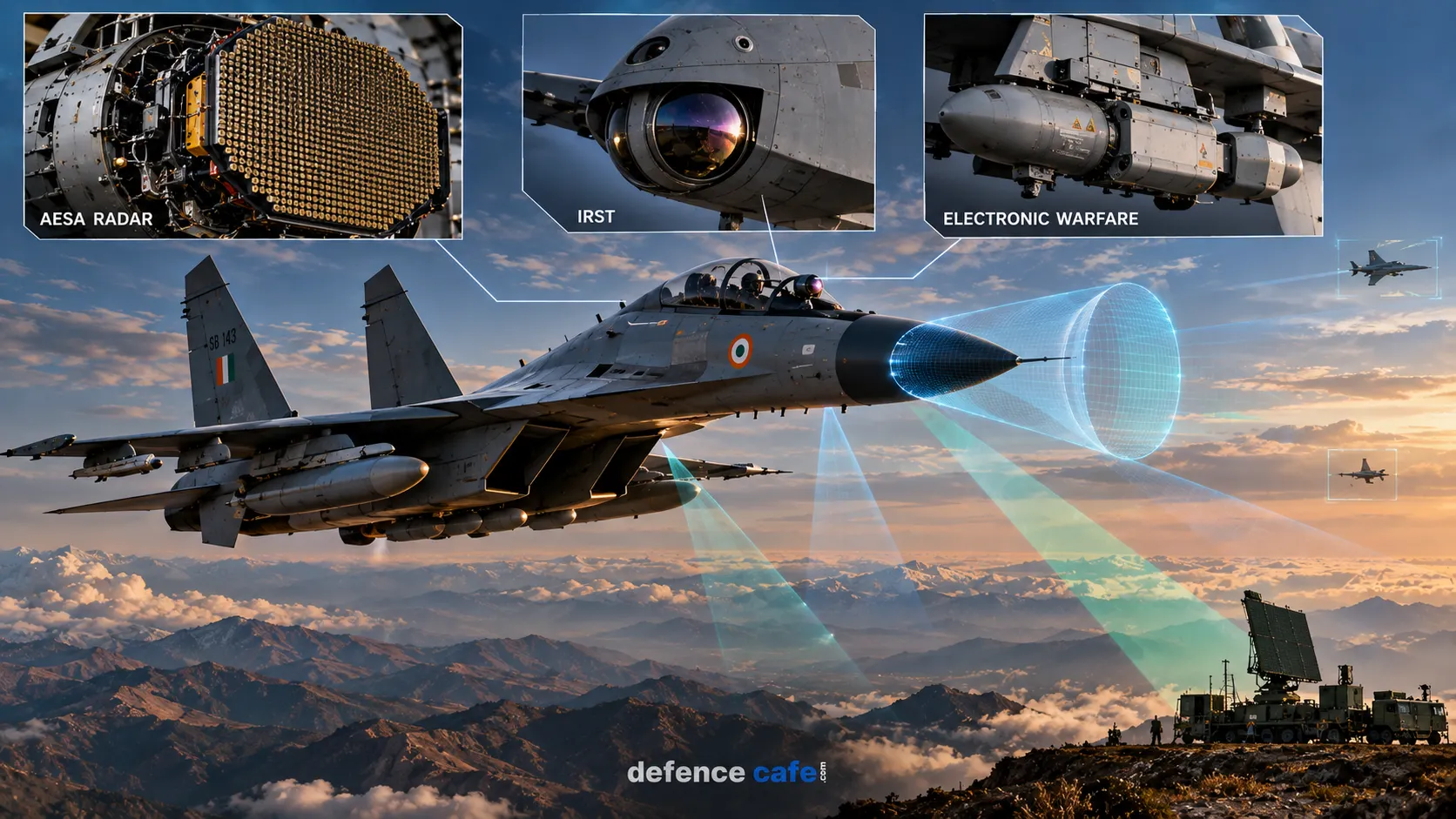
A modern fighter jet is no longer defined by its radar alone.
Its ability to find another aircraft, understand what is happening around it and respond to threats increasingly depends on a combination of Active Electronically Scanned Array (AESA) radar, Infrared Search and Track (IRST), electronic warfare (EW), electronic-support sensors, data links and sensor fusion.
Each system sees the battlespace differently. Radar transmits electromagnetic energy to build tracks. IRST works passively by detecting infrared signatures. Electronic warfare systems listen to the electromagnetic environment, identify threats and can support defensive or electronic-attack functions. The mission computer then combines information from multiple sources into a more useful tactical picture.
That integration is one of the defining features of modern combat aviation.
What Is AESA Radar?
AESA stands for Active Electronically Scanned Array. Instead of relying on a mechanically moving antenna to point a radar beam, an AESA uses many individual transmit/receive elements whose signals are controlled electronically.
That allows the radar beam to be steered extremely quickly without physically moving the entire antenna.
In practical terms, this gives a fighter more flexibility in how it searches and tracks the battlespace. Modern AESA radars can perform different functions across air, surface and ground modes, depending on the design and software of the system.
The US Air Force has described AESA upgrades for the F-16 as improving detection, targeting and tracking while increasing resistance to jamming. DRDO’s own description of its airborne AESA work similarly identifies multi-mode operation, electronic beam steering, multiple-target tracking, low-probability-of-intercept characteristics and air-to-air, air-to-ground and air-to-sea functions among the technology’s capabilities.
How an AESA Radar Works
Think of the radar’s front face as a large collection of small electronic elements rather than one conventional transmitter and receiver.
Each element contributes to the overall electromagnetic wave. By precisely controlling the phase of the signals from the elements, the radar can electronically steer its beam.
The aircraft can therefore change where it is looking without waiting for a large mechanical antenna to rotate.
| Feature | Why it matters |
|---|---|
| Electronic beam steering | Allows very rapid changes in where the radar is looking. |
| Multiple transmit/receive elements | Creates a flexible electronically controlled radar aperture. |
| Multi-mode operation | Allows the radar to support different air, surface or ground functions. |
| Improved reliability | A fixed electronically scanned array has fewer mechanically moving components than a mechanically scanned antenna. |
| Jamming resistance | Modern AESA designs can employ sophisticated frequency, waveform and beam-management techniques in contested electromagnetic environments. |
The DRDO’s airborne AESA radar description identifies the technology as a solid-state active phased-array fire-control radar with a scalable architecture and multiple operating modes.
Why AESA Is Different From Older Mechanical Radar
Older mechanically scanned radars move an antenna or reflector to direct the radar beam. That method worked for generations, but the mechanical architecture puts limits on how quickly the system can change its pointing direction.
AESA replaces much of that physical movement with electronic control.
The result is not simply “a stronger radar”. The important change is flexibility.
A modern fighter may have to maintain tracks while simultaneously searching other sectors, supporting navigation, building a map or operating in an electronically contested environment. Software and electronic beam control allow the radar to divide its attention in ways that would be difficult with a conventional mechanically scanned antenna.
The exact capability depends on the radar’s hardware, cooling system, processing power, software and integration with the aircraft. AESA should therefore be understood as an architecture, not a single universal performance specification.
What Does LPI Mean?
One phrase frequently associated with modern AESA radars is Low Probability of Intercept (LPI).
The basic idea is to make the radar’s emissions harder for another system to detect, recognise and use for locating the emitting fighter.
This can involve sophisticated control of waveform, frequency, timing, power and beam behaviour.
But LPI does not mean invisible.
A radar is still an active transmitter. An opposing electronic-support system may detect emissions under the right conditions, and the effectiveness of any LPI technique depends on the specific systems involved, the environment and the geometry of the engagement.
That distinction matters because modern air combat is not a simple contest in which one side has a radar and the other side cannot see it.
What Is IRST?
IRST stands for Infrared Search and Track.
Unlike conventional radar, IRST is a passive sensor. It does not need to transmit radio energy to search for an aircraft. Instead, it detects infrared radiation associated with objects, particularly the heat signatures produced by engines and airframe surfaces.
That makes IRST valuable in situations where a fighter wants another way to search for and track an aircraft without relying entirely on active radar emissions.
The US Navy’s NAVAIR describes IRST as a passive long-range system capable of searching for, identifying and tracking heat sources. Saab similarly describes IRST on Gripen E as a passive system that can detect heat emissions from aircraft, helicopters and objects on the ground and sea.
Why Passive Detection Matters
Imagine two fighters searching for one another.
A conventional radar actively transmits. A fighter operating only with radar therefore reveals that electromagnetic energy is being emitted.
An IRST sensor, by contrast, can search without transmitting radar energy.
This does not automatically mean that IRST will always detect the opponent first. Infrared sensing depends on factors such as target heat signature, aspect, atmospheric conditions, background temperature and sensor performance.
The real advantage comes from having both active and passive ways of looking.
IRST Is Not the Same as a Thermal Camera
There is an overlap in underlying infrared technology, but an operational IRST is more than a simple thermal imaging camera.
It is designed to search, detect, track and support the broader aircraft mission system. Depending on the architecture, it can also contribute to target identification, cueing and weapons employment.
Some aircraft use additional electro-optical systems for targeting and identification, while others integrate infrared functions into a broader sensor suite.
Radar vs IRST: What Is the Difference?
| Capability | AESA Radar | IRST |
|---|---|---|
| Energy source | Actively transmits electromagnetic energy. | Passively detects infrared radiation. |
| Primary sensing method | Radio-frequency radar energy. | Infrared/thermal radiation. |
| Can it reveal emissions? | Yes. It is an active emitter. | It does not emit radar energy for the search function. |
| Works in poor visibility? | Radar is generally less dependent on visual visibility than optical sensors. | Performance can be affected by atmospheric and thermal conditions. |
| Best use | Active detection, tracking, mapping and fire-control functions. | Passive detection and tracking of heat-emitting targets. |
The most capable fighter does not have to choose between the two. It can use them together.
What Is Electronic Warfare?
Electronic warfare is much broader than simply “jamming radar.”
It involves using the electromagnetic spectrum to sense, understand, protect against or affect hostile systems.
For a fighter aircraft, electronic warfare can include:
- Electronic Support Measures (ESM): detecting and analysing electromagnetic emissions.
- Radar Warning Receiver (RWR): warning the crew when radar energy associated with a threat is detected.
- Electronic Countermeasures (ECM): techniques intended to interfere with or complicate hostile electronic systems.
- Missile warning: detecting indications associated with an incoming missile or launch.
- Decoys and expendables: deploying systems such as chaff or infrared countermeasures where appropriate.
The terminology varies between aircraft and manufacturers, and not every fighter combines these functions in exactly the same way.
DRDO’s electronic-warfare technology roadmap includes work on AI/ML algorithms, wideband digital receivers, communications intelligence, electronic-support functions, electronic countermeasures, signal processing and thermal-management technologies for EW systems.
DRDO’s Electronic Warfare technology page provides an overview of these development areas.
What Does a Radar Warning Receiver Do?
An RWR is effectively an electronic alarm system for the fighter.
Instead of waiting for a physical missile or aircraft to appear visually, the system can detect electromagnetic emissions associated with radar systems and present information to the crew.
Modern RWRs can do more than simply announce that “a radar is nearby”. They can help distinguish different types of emitters and provide information that supports the aircraft’s defensive response.
DRDO’s DARE has developed several generations of radar warning and electronic-warfare systems for Indian military aircraft. Its publicly available material describes systems including TARANG and later-generation digital RWR developments, as well as airborne jamming and electronic-support technologies.
A useful way to think about the difference is:
Jamming: More Than Making Noise
Electronic jamming is commonly described as “flooding an enemy radar with noise”, but that is an oversimplification.
Modern electronic attack can involve carefully designed interference intended to complicate detection or tracking. Different systems can use different techniques, and the details are often classified.
Modern EW suites also increasingly depend on software and databases. A system may need to recognise emitters, compare them with a threat library, prioritise risks and choose an appropriate response.
That is why computing power and software updates have become so important to fighter survivability.
How the Three Technologies Work Together
The real story is not AESA versus IRST versus EW.
It is the combination.
Consider a simplified example.
- The AESA radar searches a sector and establishes a track.
- The IRST independently observes an infrared signature associated with an aircraft.
- The electronic-support system detects and analyses electromagnetic emissions.
- The mission computer compares the information from the different sensors.
- The aircraft produces a more coherent tactical picture for the pilot.
Importantly, this is an illustrative concept rather than a description of a particular aircraft’s classified processing sequence.
Sensor Fusion: The Hidden Technology Behind the Sensors
Having several sensors is useful only if the aircraft can make practical use of their information.
This is where sensor fusion comes in.
Sensor fusion means combining data from different sources to create a more useful representation of the environment than any single sensor could provide on its own.
A modern fighter may receive information from:
- radar
- IRST and electro-optical sensors
- radar warning and electronic-support systems
- missile-warning sensors
- identification systems
- data links
- other aircraft
- airborne early-warning and control platforms
- ground or surface command systems
When these sources are combined correctly, the pilot does not need to interpret every individual sensor separately.
That is an enormous human-factors advantage.
Rafale: A Useful Public Example
The Dassault Rafale provides a good publicly documented example of how these technologies are integrated.
Its sensor architecture combines the RBE2 AESA radar, the Front Sector Optronics (FSO) passive sensor system and the SPECTRA electronic-warfare suite.
Dassault states that the RBE2 AESA provides air-target detection and tracking as well as ground and naval functions. The company describes FSO as a passive visible/infrared system capable of detection and tracking, while SPECTRA provides multi-spectral warning against radar, missile and laser threats.
Dassault Aviation’s Rafale sensor overview documents the relationship between these systems.
Dassault also describes the Rafale’s mission-data processing and sensor-fusion architecture as combining information from the RBE2 radar, FSO, SPECTRA, IFF, weapon seekers and tactical data links.
Its mission-system overview explains how this data is processed into a coherent tactical picture.
SPECTRA and Defensive Electronic Warfare
SPECTRA is especially relevant because it demonstrates that EW is not a separate box simply switched on when a radar threat appears.
MBDA describes SPECTRA as an integrated electronic-warfare suite combining radar, laser and missile warning with threat localisation, jamming and decoy functions.
The MBDA SPECTRA overview also notes the role of a threat library and a management system in determining appropriate responses.
Gripen E: Radar, IRST and EW in One Sensor Architecture
Sweden’s Gripen E is another publicly documented example.
Saab describes the aircraft as having an AESA radar, an IRST sensor, advanced electronic-warfare capability and tactical networking.
The important point is not any one component. It is the ability to combine active radar search, passive infrared sensing, electronic support and networked information.
Saab’s Gripen E material describes this integrated sensor and networking approach.
F-35: The Shift Toward a Full Sensor Architecture
The F-35 illustrates an even broader approach to sensor integration.
Its publicly described sensor suite includes the AN/APG-81 AESA radar, Distributed Aperture System, Electro-Optical Targeting System and electronic-warfare capability.
Rather than treating each sensor as a separate display, the aircraft is designed around a highly integrated mission system that fuses information into the pilot’s overall awareness.
Lockheed Martin’s F-35 sensor overview describes its integrated sensor-fusion architecture, while its EOTS documentation explains the aircraft’s electro-optical and infrared sensing functions.
Where India Stands on AESA, IRST and EW
India has been developing many of the technologies required for increasingly sophisticated fighter sensor architectures.
Uttam AESA Radar
The most prominent indigenous programme is the Uttam AESA radar, developed by DRDO’s Electronics and Radar Development Establishment (LRDE).
DRDO describes Uttam as a multi-mode, solid-state active phased-array fire-control radar with a scalable architecture intended for fighter aircraft.
The technology is particularly important because an indigenous airborne AESA is not simply a radar project. It also requires transmitter/receiver modules, antenna technology, signal processing, cooling, power management, software, testing and aircraft integration.
In September 2025, the Ministry of Defence signed a contract with HAL for 97 LCA Mk1A aircraft. The official release states that the aircraft programme includes integration of the indigenous UTTAM AESA radar and the Swayam Raksha Kavach self-protection system.
The Ministry of Defence announcement provides the official details of that contract.
Tejas Mk1A and Electronic Warfare
HAL describes the Tejas Mk1A as incorporating an AESA radar together with an electronic-warfare suite containing radar warning and self-protection jamming functions.
The broader Tejas programme therefore provides India with an important pathway for developing not just an aircraft, but the industrial and engineering ecosystem needed for modern combat avionics.
HAL’s LCA product information describes the Mk1A’s radar and electronic-warfare architecture.
Indian Work on IRST
India’s indigenous sensor development is not limited to radar.
DRDO’s current publicly listed C4ISR technology areas include work on an Infrared Search and Track processing unit and sensor head unit for a twin-engine deck-based fighter.
That does not mean every Indian fighter currently operates with an indigenous IRST. It does, however, show that passive infrared sensing is part of the country’s broader indigenous aerospace sensor-development effort.
DRDO’s C4ISR technology-development page lists these IRST-related development areas.
India’s Electronic-Warfare Ecosystem
DRDO’s Defence Avionics Research Establishment and Electronics and Communication Systems cluster have developed radar warning receivers, electronic-warfare systems, airborne jammers and related avionics for Indian aircraft.
DRDO’s published material identifies systems such as TARANG and the DR118 digital radar warning receiver, while its wider EW technology roadmap includes digital receivers, electronic-support measures, electronic countermeasures, AI/ML applications and signal-processing technologies.
DRDO’s Electronics and Communication Systems cluster provides the broader picture of India’s indigenous radar, EW and electro-optical development ecosystem.
Why AESA, IRST and EW Matter More Together
These technologies become significantly more valuable when integrated.
An AESA radar may provide an active track. IRST can supply an independent passive observation. EW sensors can identify electromagnetic activity. A tactical data link can provide another track from a different platform.
The aircraft’s computers can then compare these inputs.
That creates redundancy.
And redundancy matters because modern combat environments are designed to make individual sensors less reliable.
A radar may be jammed. An infrared sensor may struggle with atmospheric conditions. A target may minimise its infrared signature. An electronic-support receiver may only detect emissions when the opponent is transmitting. A data link may become unavailable.
No single sensor therefore provides a complete answer.
What Are the Limitations?
Advanced sensors are powerful, but none of them is perfect.
AESA Limitations
AESA performance depends on antenna size, available power, cooling, processor capability, software and the specific operating mode. Radar performance also depends on range, geometry, environmental conditions, target characteristics and electronic interference.
AESA does not make a fighter automatically immune to jamming, nor does it guarantee detection of every target at every range.
IRST Limitations
IRST depends on thermal contrast and the infrared signature of a target. Weather, humidity, atmospheric conditions and background temperature can affect performance.
It is therefore best understood as a complementary sensor rather than a universal replacement for radar.
EW Limitations
Electronic warfare is a contest between systems and software.
An EW suite is only as useful as its ability to detect, classify and respond to the signals it encounters. Threat libraries must evolve, processing must improve and new threat techniques must be understood.
This is one reason electronic warfare increasingly involves software, data and continual development rather than one-time hardware installation.
What Is the Next Step? Sensor Fusion and AI
The next major change is not necessarily another individual sensor.
It is better processing.
As fighters collect more information, the problem becomes deciding what matters quickly enough for a pilot to act.
Artificial intelligence and machine-learning techniques are therefore being explored for tasks such as classification, anomaly detection, sensor management and decision support.
DRDO’s current electronic-warfare technology roadmap explicitly includes AI/ML frameworks and algorithms for EW applications, while its radar roadmap includes AI/ML work for radar applications.
That suggests a gradual shift from the fighter as a collection of sensors toward the fighter as a software-defined information system.
Why This Matters for India’s Future Fighters
India’s development of Tejas Mk1A, Tejas Mk2 and future combat-aircraft programmes creates an opportunity to build more of the sensor architecture domestically.
The strategic benefit is broader than simply replacing imported hardware.
Indigenous radar, EW and electro-optical technologies can allow India to control important parts of the aircraft’s software, upgrade cycle, threat libraries, maintenance ecosystem and future development pathway.
That matters because fighter avionics are not static. A radar installed today will eventually need new software. Threat databases will change. EW techniques will evolve. Processing requirements will increase. New sensors and weapons may need to be integrated.
A fighter designed around an adaptable digital architecture can therefore remain relevant for much longer than one dependent on fixed, isolated systems.
Frequently Asked Questions
What is AESA radar in a fighter jet?
AESA is an Active Electronically Scanned Array radar that uses many electronically controlled transmit/receive elements to steer radar beams without mechanically moving the main antenna.
What is IRST?
IRST stands for Infrared Search and Track. It is a passive sensor that detects and tracks infrared signatures rather than transmitting radar energy for its search function.
Is IRST better than AESA radar?
They perform different functions. AESA provides active radar sensing, while IRST provides passive infrared sensing. Modern fighters increasingly use both as complementary sensors.
What does electronic warfare do on a fighter?
Electronic warfare systems help detect, identify, analyse and respond to electromagnetic threats. Depending on the aircraft, this can include radar warning, electronic support, jamming, missile warning and countermeasures.
Does AESA radar make a fighter invisible?
No. AESA can incorporate low-probability-of-intercept techniques, but an active radar still emits electromagnetic energy. LPI is intended to make detection or exploitation of those emissions more difficult, not impossible.
Does India have an indigenous AESA radar?
India is developing the indigenous Uttam AESA radar through DRDO’s LRDE. The Ministry of Defence’s 2025 contract for 97 LCA Mk1A aircraft specifies integration of the UTTAM AESA radar.
Does India have indigenous IRST technology?
DRDO publicly lists development work on IRST processing and sensor-head technology, including work related to a twin-engine deck-based fighter. The existence of such development work should not be confused with claiming that every Indian fighter already operates an indigenous IRST.
Conclusion
The modern fighter’s most important advantage may not be a single radar, missile or engine. It is the ability to combine information.
AESA radar actively searches and tracks. IRST provides passive infrared sensing. Electronic warfare systems listen to the electromagnetic environment and help the aircraft understand and respond to threats. Sensor fusion then connects these layers into a single operational picture.
That is why the development of modern fighter avionics is increasingly a software, electronics and systems-engineering challenge as much as an airframe challenge.
For India, the development of Uttam AESA, indigenous electronic-warfare systems, infrared sensing technologies and increasingly networked mission systems represents a broader effort to build control over the technologies that sit at the heart of future combat aircraft.
Sources & Further Reading
- DRDO — Electronic Scanned Array Radar / AESA radar technology
- DRDO — Electronic Warfare technology development areas
- DRDO — Electronics and Communication Systems Cluster
- DRDO — C4ISR technology development, including IRST-related work
- Ministry of Defence / PIB — Contract for 97 LCA Mk1A aircraft and integration of UTTAM AESA and Swayam Raksha Kavach
- Hindustan Aeronautics Limited — LCA Tejas and Mk1A systems overview
- Dassault Aviation — Rafale RBE2 AESA, FSO and SPECTRA sensor systems
- Dassault Aviation — Rafale mission-data processing and sensor fusion
- MBDA — SPECTRA integrated electronic-warfare suite
- US Naval Air Systems Command — Infrared Search and Track system overview
- Saab — Gripen E AESA radar, IRST, electronic warfare and networking
- Lockheed Martin — F-35 integrated sensor suite and sensor fusion
