


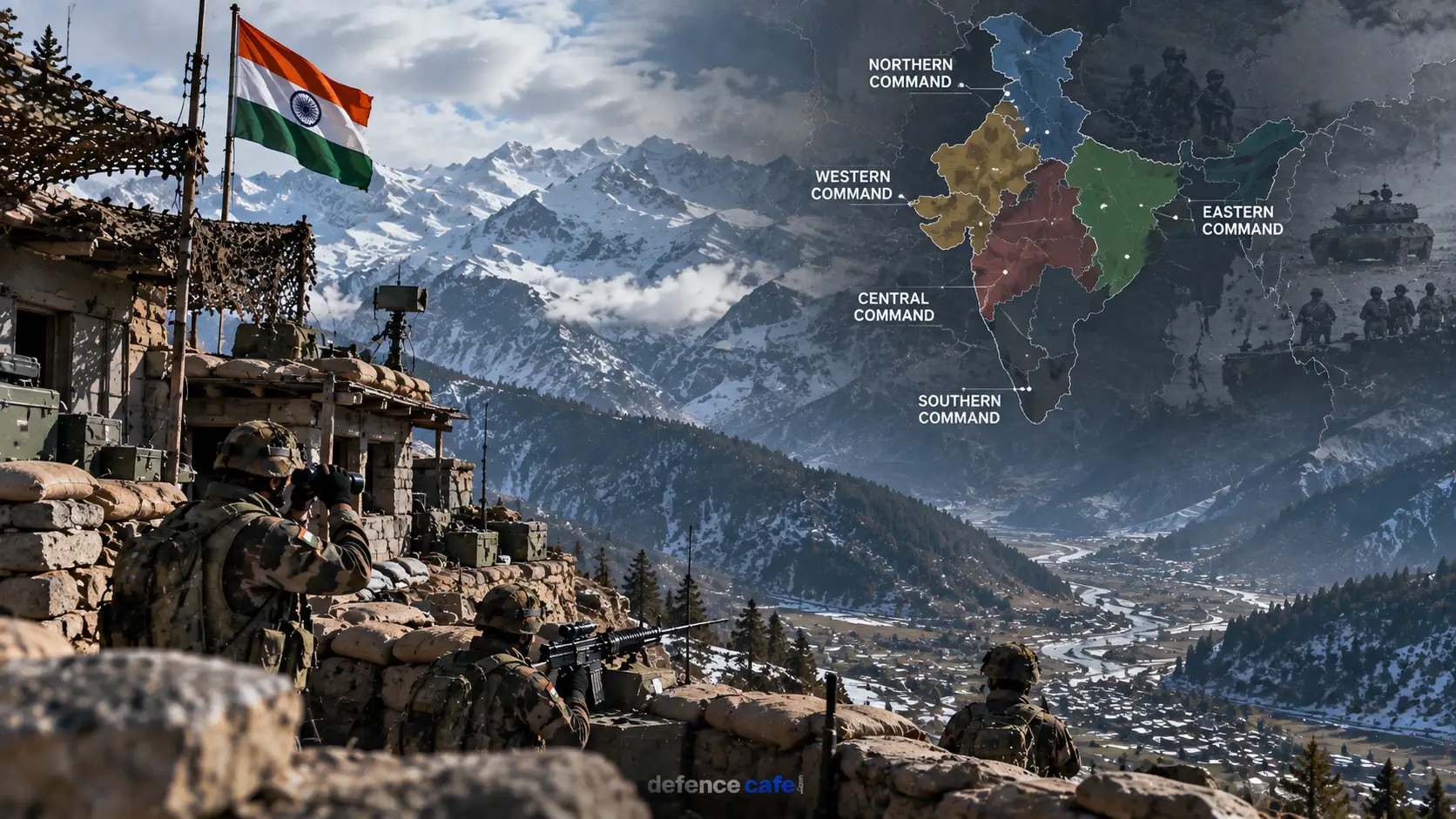
If you have ever read an Indian Army story and wondered what exactly a command, Corps, division, brigade, battalion or regiment actually means, you are not alone.
These terms describe different parts of the Army’s organisation, but they are not interchangeable. A regiment is not simply a smaller command. A battalion is not the same thing as a brigade. And the Army’s seven commands are not all operational formations of the same kind.
The easiest way to understand the Indian Army is to look at it as a layered organisation: senior headquarters provide direction, commands group large areas or functions, field formations bring combat power together, and smaller units execute missions on the ground.
Key takeaway
The Indian Army currently operates through seven commands: six operational commands and the Army Training Command (ARTRAC). Below the command level are field formations such as Corps, divisions and brigades, while battalions and smaller units carry out tactical missions. The regimental system runs across this structure and provides unit identity, lineage and tradition. In 2026, the Army is also pushing toward a more networked, data-centric and technology-enabled force.
Indian Army structure at a glance
There is no single simple ladder that perfectly describes every part of the Army because different arms, services and specialist formations are organised differently. But for understanding most defence reporting, this simplified framework is useful:
This should be treated as a mental model, not a universal one-to-one formula. The organisation of an armoured, artillery, aviation, engineering or other specialist formation can differ substantially from that of an infantry unit.
The seven Indian Army commands
As of 2026, the Indian Army has seven commands. Six are operational commands, while the Army Training Command, or ARTRAC, has a different training and professional-development role. The Army Commanders’ Conference in April 2026 referred to the Army’s seven-command structure and designated 2026 as the Year of Networking and Data Centricity.
| Command | Headquarters | Broad role |
|---|---|---|
| Northern Command | Udhampur | Operational |
| Western Command | Chandimandir | Operational |
| Eastern Command | Kolkata | Operational |
| Southern Command | Pune | Operational |
| Central Command | Lucknow | Operational |
| South Western Command | Jaipur | Operational |
| Army Training Command (ARTRAC) | Shimla | Training / doctrine / professional development |
The locations above are consistent with official government material describing the Army’s command organisation and current government references to the individual commands. ARTRAC is headquartered at Shimla and performs a specialised training and doctrine role rather than functioning as another geographic field command.
Official source: Ministry of Defence / PIB — Army Commanders’ Conference, April 2026
What is a Command?
A command is a major organisational headquarters responsible for directing Army formations and activities across a broad geographical or functional area.
The six operational commands are organised around India’s different strategic and geographical requirements. That matters because the conditions facing troops are not the same everywhere.
A formation operating in the high-altitude Himalayan environment has different operational, logistical and mobility requirements from one operating in plains or desert terrain.
The command level therefore provides a way to coordinate large numbers of formations while allowing subordinate headquarters to deal with more specific operational problems.
ARTRAC is different
The Army Training Command (ARTRAC) is part of the Army’s seven-command structure, but its purpose is different from the geographic operational commands.
ARTRAC is based at Shimla and has a broad role involving professional training, doctrine, concepts of warfare, military leadership and the absorption of emerging technology into training and professional development.
In 2026, the President of India visited Headquarters ARTRAC in Shimla and was briefed on initiatives including drone training, technology absorption, red-teaming, digitisation and automation.
Official source: PIB — President visits Headquarters ARTRAC, May 2026
What comes below a command?
A command is much too large to function as one tactical unit. It contains subordinate formations and organisations, including field formations such as Corps, divisions and brigades.
Corps
A Corps is a major field formation capable of bringing multiple divisions and supporting capabilities together under a common headquarters.
The exact composition of a Corps depends on its mission and operating environment. A Corps may require different combinations of infantry, armour, artillery, engineers, communications, intelligence, aviation, logistics and other capabilities.
This is why the phrase “Corps-level” matters in defence reporting: it normally indicates a level at which major formations and supporting capabilities are coordinated for large-scale operations.
Division
A Division is a major field formation below Corps and normally groups several brigades and supporting elements.
Divisions are not identical. A formation designed for mountain operations can have different requirements from one designed for plains or desert operations.
Terrain, mobility, logistics, communications, fire support, engineering and surveillance all influence how a formation is structured and supported.
Brigade
A Brigade groups several battalions or equivalent units with the supporting capabilities needed for its mission.
The brigade level provides an important bridge between the very large field formations above it and individual battalions below it.
Modernisation can also affect brigade organisation itself. The Army has publicly discussed newer formations and concepts including Rudra Brigades, alongside other specialised formations such as Bhairav Battalions, Drone Platoons, ShaktiBaan Regiments and Divyastra Batteries.
These developments are important because modernisation is increasingly about changing how capabilities are organised and connected, not just adding new equipment.
Official source: Ministry of Defence / PIB — Army transformation and new formations
Battalion
The battalion is one of the most familiar tactical formations in Army reporting.
In the infantry, battalions are closely associated with their parent regiments. Army releases commonly identify formations using both the battalion’s numerical designation and regimental identity.
That distinction becomes important when reading an exercise report or deployment story: the battalion is the unit being employed, while the regiment describes its longer institutional identity.
Where do regiments fit?
This is one of the most misunderstood parts of the Indian Army.
A regiment is not simply the next step in the operational chain between brigade and battalion.
The regimental system is especially important in the infantry, where regiments carry traditions, battle honours, histories, symbols and institutional identity across their battalions.
A battalion can therefore be an operational formation while also carrying the identity of its parent regiment.
Why the distinction matters
Consider a headline that refers to a battalion of the Jat Regiment, Bihar Regiment or Kumaon Regiment.
The battalion is the unit being referenced in the operational context. The regiment identifies its lineage and institutional identity.
This is why “regiment” and “battalion” should not be used as synonyms.
How many infantry regiments are there?
Be careful with old numbers on this subject.
A Government of India reply in December 2021 listed 27 infantry regiments and noted that the Army has numerous regiments across its different arms and services. Because that figure is from a dated parliamentary reply, Defence Cafe does not present “27” as a confirmed 2026 total without a newer authoritative source.
That is an important distinction in defence reference writing: a historical government figure should remain a historical figure unless it has been re-verified.
Official source: PIB — Army Regiments, December 2021
Regiments are only one part of the Army
The Indian Army is much larger than its infantry regiments.
Its capabilities are distributed across different arms and services, each with a specific role in generating combat power and keeping formations operational.
Readers will commonly encounter areas such as:
- Infantry — ground combat and close engagement.
- Armoured formations — protected mobility and armoured warfare.
- Artillery — fire support and long-range effects.
- Engineers — mobility, survivability and combat engineering.
- Signals — communications and information connectivity.
- Army Aviation — aviation support and battlefield mobility.
- Army Air Defence — protection against aerial threats.
The important point is that a modern formation works because these different capabilities can operate together. A battalion or brigade cannot perform a complex mission effectively if communications, logistics, engineering, surveillance and fire support are treated as completely separate worlds.
Why the Army’s structure matters more in the technology era
A military organisation can retain familiar names and formations while changing dramatically in the way those formations operate.
That is exactly what is happening in the Indian Army’s current modernisation push.
In April 2026, the Army Commanders’ Conference designated the year as the Year of Networking and Data Centricity. The conference linked networking and data with modernisation, technology infusion, doctrine, training and operational readiness, while also highlighting unmanned and counter-unmanned systems.
In simple terms, this means an Army unit is increasingly expected to operate as part of a network rather than as an isolated formation.
What does a data-centric Army actually mean?
Imagine a drone detects an object on the battlefield.
In a traditional model, information might move through several separate reporting channels before reaching the person who needs it.
A more networked model tries to move useful information faster between sensors, headquarters, commanders and the systems that can act on that information.
The idea is not simply “more computers”.
It is about creating a shared operational picture in which relevant information can reach the right level quickly and securely.
That puts communications, data processing, electronic warfare, cybersecurity, sensors and secure networks alongside conventional military platforms as important parts of modern combat capability.
2026 modernisation: what is changing?
The Army’s 2026 priorities show that its modernisation effort is broad. It covers both equipment and the way capabilities are integrated.
Counter-drone and electronic warfare
In July 2026, the Defence Acquisition Council gave Acceptance of Necessity, or in-principle administrative approval, for several Army capabilities including the AKASH TARANG anti-UAV electronic warfare system, MPATGM systems, MRSAM, V-SHORADS, active protection systems for tanks and a jet-based kamikaze drone system.
Acceptance of Necessity is important, but it should not be confused with a signed procurement contract. It is an in-principle approval in the acquisition process.
Official source: PIB — Defence Acquisition Council, July 2026
Loitering munitions
The shift is also visible in the artillery ecosystem. In August 2026, the Ministry of Defence signed contracts worth approximately ₹1,577 crore with Tata Advanced Systems Limited and NIBE Private Limited for loiter munition systems, munitions and associated accessories for the Indian Army.
This is a useful example of the interaction between organisational change, new technology and India’s defence-industrial ecosystem.
Official source: PIB — Loiter Munition Systems contracts, August 2026
Mobility, protection and combat support
The modernisation picture is not only about drones and digital systems. In September 2026, the Defence Acquisition Council also gave in-principle approval for Army procurement proposals involving CBRN reconnaissance vehicles, high-mobility vehicles, self-propelled mechanical mine layers, Advanced Light Helicopters, trawl tanks and the Sarvatra Bridge System.
That mix is revealing.
Modern warfare still depends on the fundamentals: mobility, protected movement, engineering support, aviation, reconnaissance and the ability to sustain forces in difficult terrain.
The technology layer sits on top of those fundamentals rather than replacing them.
Official source: PIB — Defence Acquisition Council, September 2026
Indigenisation is changing the capability pipeline
Another major part of the Army’s current transformation is the effort to reduce dependence on imported systems and components while building domestic production capacity.
Government data for FY 2025–26 states that the Army had indigenised 159 of 175 ammunition variants, or about 90.85 percent, with 110 being sourced from a single indigenous source and 49 from more than one indigenous source.
That figure concerns the ammunition inventory described in the official source. It should not be misrepresented as meaning that the Army as a whole is 90.85 percent indigenous.
Official source: PIB — Indian Army capability development and indigenisation
From laboratories to field formations
Modernisation also requires an ecosystem that connects military requirements with research and engineering.
In August 2025, the Indian Army and IIT Madras established Agnishodh, the Indian Army Research Cell, to connect academic research with operational applications.
The initiative was described by the Ministry of Defence as part of the Army’s broader transformation effort and includes work related to areas such as additive manufacturing, cybersecurity, quantum computing, wireless communication and unmanned aerial systems.
The significance goes beyond one research centre. A technology-heavy Army needs a pipeline that can move from identifying an operational problem to developing, testing, adapting and eventually fielding a workable solution.
Official source: PIB — Agnishodh Indian Army Research Cell at IIT Madras
What is changing — and what is not?
It is tempting to think that the modernisation of the Indian Army means replacing traditional formations with technology.
That is not what the current evidence suggests.
The Army is retaining familiar organisational layers—commands, formations, battalions and regimental identities—while adding new capabilities around them.
A battalion can remain a battalion while receiving better sensors, communications and unmanned support. A brigade can remain a brigade while becoming more networked and more specialised. A command can retain its geographic role while gaining access to better information and faster decision-making.
The transformation is therefore less about abandoning the traditional structure and more about making that structure work differently.
The easiest way to remember the Indian Army structure
Think big to small:
Command manages a very large area or function.
Corps coordinates major field formations.
Division brings several brigades together.
Brigade groups battalions or equivalent units.
Battalion is a major tactical unit.
Company → Platoon → Section take the organisation down to smaller tactical elements.
And remember the separate concept of the regiment: it is primarily an institutional and regimental identity, particularly important within the infantry, rather than a universal step in the operational hierarchy.
Frequently asked questions
How many commands does the Indian Army have?
The Indian Army currently has seven commands: Northern, Western, Eastern, Southern, Central, South Western and Army Training Command (ARTRAC).
Is ARTRAC an operational command?
ARTRAC is the Army Training Command. Its role is centred on training, professional development, doctrine and concepts, leadership development and technology absorption rather than functioning as another geographic operational command.
What is the difference between a Corps and a Division?
A Corps is a larger field formation that can coordinate multiple divisions and supporting capabilities. A Division is a subordinate major formation that normally groups several brigades and supporting elements.
Is a regiment the same as a battalion?
No. In the infantry, a battalion is an operational unit, while the regiment provides an important layer of institutional identity, lineage and tradition. The exact relationship varies across different arms and organisations.
How many infantry regiments does India have?
A Government of India reply in 2021 listed 27 infantry regiments at that time. Defence Cafe does not present that historical figure as a verified 2026 total without a newer official source.
What is the Indian Army focusing on in 2026?
The Army has designated 2026 as the Year of Networking and Data Centricity, with emphasis on modernisation, technology infusion, networking, data, UAS and counter-UAS capabilities and operational readiness.
Why this structure is still evolving
The Indian Army’s organisational structure has been built to provide command at different scales. Its modernisation agenda is now adding a second requirement: speed of information and integration of capabilities.
That means the most interesting question is no longer only what the Army buys next.
It is also how those capabilities are connected to soldiers, commanders, formations and decision-making.
In 2026, the Army’s official emphasis on networking and data centricity, combined with investment in drones, counter-drone systems, electronic warfare, mobility, protection and indigenous ammunition, shows a force trying to modernise both what it has and how it uses it.
Understanding the structure is therefore more than memorising a list of commands. It is the starting point for understanding how the Indian Army actually organises combat power—and how that organisation is adapting to a battlefield where information can be as important as the platform carrying the weapon.
Sources & Further Reading
- Ministry of Defence / PIB — Army Commanders’ Conference, April 2026 — current reference for the seven-command structure and the Army’s 2026 networking and data-centricity priorities.
- Ministry of Defence / PIB — President visits Headquarters ARTRAC, May 2026 — current reference for ARTRAC’s location and training, doctrine, digitisation and technology-absorption role.
- CBSE / Government educational material — Army organisation and command headquarters — government reference for the command and headquarters framework.
- Ministry of Defence / PIB — Army Regiments, December 2021 — dated government reference used specifically for historical regiment information.
- Ministry of Defence / PIB — Defence Acquisition Council, July 2026 — Army approvals involving anti-UAV electronic warfare, missiles, active protection and drone capabilities.
- Ministry of Defence / PIB — Loiter Munition Systems contracts, August 2026 — current reference for Army loitering-munition procurement contracts.
- Ministry of Defence / PIB — Defence Acquisition Council, September 2026 — current reference for Army approvals involving mobility, engineering, aviation and CBRN capabilities.
- Ministry of Defence / PIB — Indian Army capability development and indigenisation — reference for ammunition indigenisation and capability-development information.
- Ministry of Defence / PIB — Agnishodh Indian Army Research Cell at IIT Madras — reference for the Army’s academic and technology-development collaboration.
