


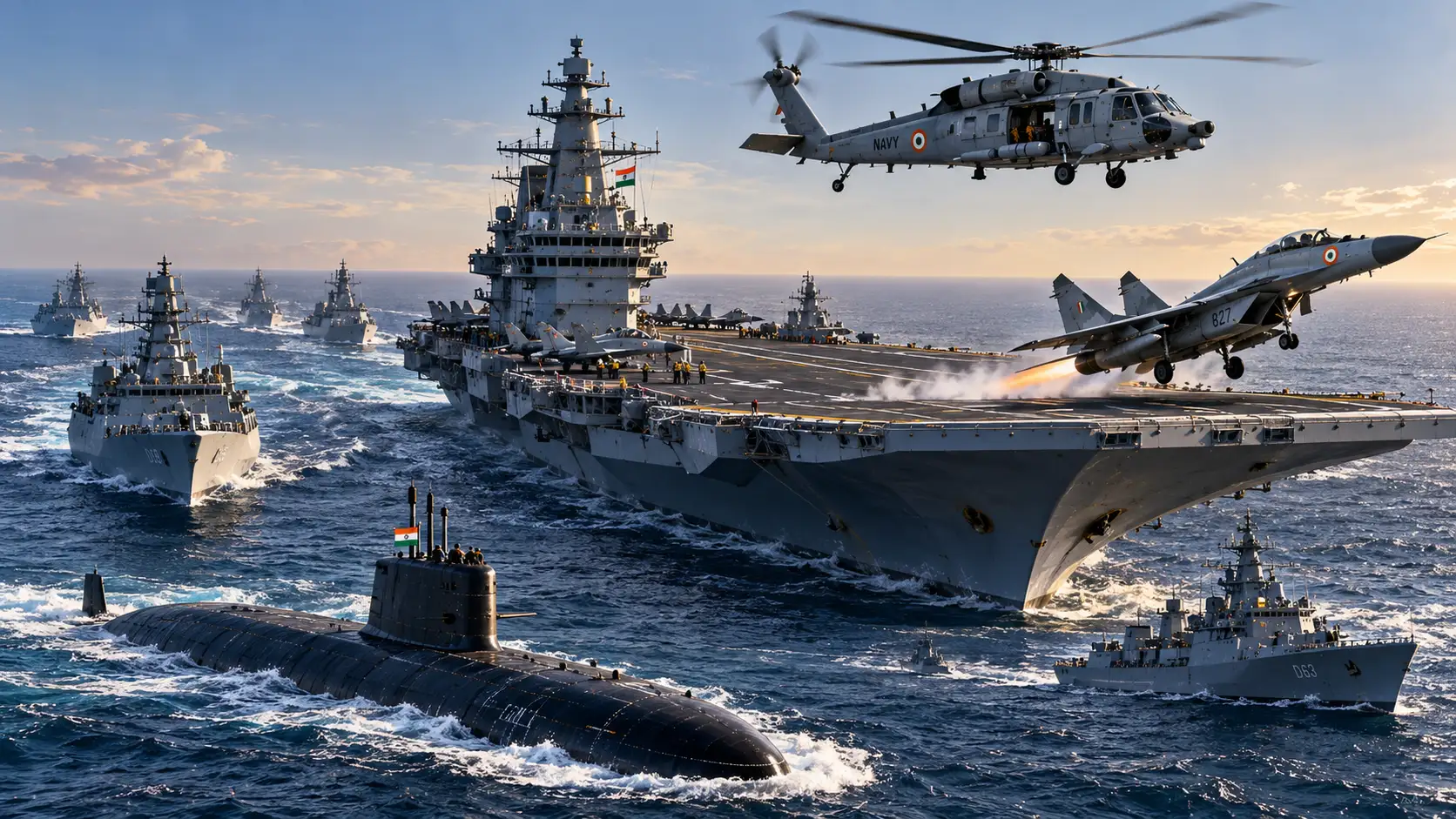
The Indian Navy is much more than a fleet of grey warships. Its fighting power comes from several layers working together: aircraft carriers provide mobile air power, submarines operate below the surface, destroyers and frigates protect and escort high-value forces, and naval aviation extends surveillance and strike capability far beyond the coastline.
At the organisational level, the Navy is built around three commands : Western, Eastern and Southern supported by two major operational fleets, specialist arms, naval air stations and a nationwide network of bases and support facilities. The Western and Eastern Naval Commands are operational commands, while the Southern Naval Command is the Navy’s training command. A parliamentary overview of the service’s organisation describes this command structure and the headquarters relationship in similar terms.
As of 2026, the Navy is also in the middle of a major technological and industrial transition. Recent years have seen the commissioning of the indigenous aircraft carrier INS Vikrant, the completion of the six-submarine Project 75 programme, the induction of new Project 15B destroyers and Project 17A stealth frigates, the expansion of MH-60R helicopter capability, and continued investment in uncrewed systems, artificial intelligence and indigenous shipbuilding.
How the Indian Navy Is Organised
The first thing to understand is the difference between a command and a fleet.
A command is primarily a geographic and administrative-operational organisation. A fleet is an operational grouping of ships designed to work together at sea. This distinction matters because the Navy does not simply divide all its ships into three geographic piles.
| Organisation | Headquarters | Primary function |
|---|---|---|
| Western Naval Command | Mumbai | Operational command responsible for maritime operations on the western seaboard and Arabian Sea. |
| Eastern Naval Command | Visakhapatnam | Operational command responsible for maritime operations on the eastern seaboard and Bay of Bengal. |
| Southern Naval Command | Kochi | Primarily the Navy’s training command. |
The Sansad Television overview of the Indian Navy describes the Western and Eastern Commands as operational commands and the Southern Command as the training command.
Western and Eastern Fleets
The two operational commands are associated with the Navy’s principal fleets: the Western Fleet and the Eastern Fleet. Fleet units can be assigned to deployments, exercises and task groups depending on operational requirements.
That means a carrier, destroyer, frigate, submarine or replenishment ship does not operate in isolation. A naval force can be assembled around a mission and then supported by ships and aircraft with different specialties.
The Navy also maintains specialist capabilities such as the submarine arm, naval aviation, logistics and training organisations. The result is an interconnected force rather than a simple list of individual platforms.
Aircraft Carriers: India’s Floating Airfields
An aircraft carrier is essentially a mobile airbase. Instead of depending entirely on land-based airfields, a carrier allows a navy to take fighter aircraft, helicopters and other aviation assets to sea.
This becomes particularly important in a country with a long coastline and major maritime interests extending well beyond coastal waters. A carrier can provide air defence for ships, support maritime operations, generate reconnaissance and surveillance sorties, and contribute to strike missions.
The Indian Navy currently operates two aircraft carriers: INS Vikramaditya and INS Vikrant. Government material also confirms that both form the basis of India’s current carrier aviation capability.
| Aircraft Carrier | Origin / significance | Carrier aviation |
|---|---|---|
| INS Vikramaditya | Formerly the Russian carrier Admiral Gorshkov, adapted for Indian service. | Operates carrier-borne fighter and helicopter aviation. |
| INS Vikrant | India’s first indigenous aircraft carrier, designed by the Navy’s Warship Design Bureau and built by Cochin Shipyard Limited. | Designed around a mixed fixed-wing and rotary-wing air wing. |
A Ministry of Defence backgrounder on INS Vikrant identifies it as India’s first indigenous aircraft carrier and notes that the carrier can operate an air wing comprising fighters and helicopters.
How INS Vikrant Launches and Recovers Aircraft
INS Vikrant uses a STOBAR arrangement, Short Take-Off But Arrested Recovery. Aircraft use a ski-jump at the bow to assist take-off, while arrester wires help recover landing aircraft on the deck.
This is different from the catapult systems used on larger aircraft carriers such as the US Navy’s nuclear-powered carriers. India’s carriers are conventionally powered and use ski-jump-assisted flight operations.
For a naval aviator, landing on a carrier is an entirely different problem from landing on a runway. The usable deck is moving, the ship is pitching and rolling, and the aircraft has to arrive at precisely the right point and speed for the arresting system.
The MiG-29K and the Next Fighter Generation
The MiG-29K is the Navy’s established carrier-borne fighter. It has been integrated with INS Vikrant and is also used from the Navy’s other carrier.
The next major step is the induction of Rafale-Marine aircraft. India signed an Inter-Governmental Agreement with France in April 2025 for 26 Rafale-Marine aircraft for the Indian Navy, along with training, simulators, weapons, associated equipment and support. Government material states that deliveries are planned to be completed by 2030.
The Government of India’s Rafale-Marine backgrounder says the aircraft are intended to operate from INS Vikrant and INS Vikramaditya.
Why a Carrier Does Not Fight Alone
A carrier is valuable because it is part of a larger formation. The carrier provides the aviation component, while escorts and support vessels contribute air defence, anti-submarine warfare, anti-surface warfare, logistics and surveillance.
This is why the term Carrier Battle Group or Carrier Battle Group-style force is useful. The exact composition changes according to the mission, but the basic principle is straightforward: combine different platforms so that the strengths of one can compensate for the weaknesses of another.
Submarines: The Underwater Component
Submarines solve a different problem from aircraft carriers. Their greatest advantage is that they can operate with far less visibility on the surface.
Modern submarines can conduct surveillance, track surface vessels, search for other submarines, support sea-denial missions and, in the case of strategic nuclear-powered submarines, contribute to national deterrence.
The Indian Navy’s submarine force therefore contains more than one type of boat, with different missions and propulsion systems.
| Submarine category | Primary role | Indian context |
|---|---|---|
| Diesel-electric attack submarine | Stealth, surveillance, anti-surface and anti-submarine warfare. | Includes the Kalvari-class submarines under Project 75. |
| SSBN | Nuclear-powered ballistic missile submarine used for strategic deterrence. | Arihant-class boats form India’s publicly acknowledged indigenous SSBN programme. |
| AIP-equipped conventional submarine | Extends submerged endurance compared with a conventional diesel-electric boat. | Project 75(I) envisages six modern conventional submarines with air-independent propulsion. |
Project 75: The Kalvari-Class Submarines
Project 75 is one of the most important submarine programmes in modern Indian naval history. The programme produced six Kalvari-class submarines based on the Scorpene design through collaboration between Mazagon Dock Shipbuilders Limited and Naval Group of France.
The six boats are:
- INS Kalvari
- INS Khanderi
- INS Karanj
- INS Vela
- INS Vagir
- INS Vaghsheer
The sixth and final boat, INS Vaghsheer, was delivered in January 2025 and was subsequently commissioned into the Navy. This completed the six-submarine Project 75 series.
The Ministry of Defence release on INS Vaghsheer records its delivery after successful completion of mandatory sea trials. A subsequent government review records the commissioning of all six Project 75 submarines.
What Is Air-Independent Propulsion?
A diesel-electric submarine normally needs atmospheric oxygen to run its diesel generators while recharging batteries. Air-independent propulsion, or AIP, reduces the need to regularly surface or use a snorkel by allowing additional electrical power generation while the submarine remains submerged.
AIP does not make a conventional submarine nuclear-powered. Instead, it is a technology intended to improve submerged endurance and reduce the frequency with which the boat needs to expose itself to the surface environment.
India’s DRDO has been developing an indigenous AIP system intended for integration with the Navy’s conventional submarine fleet. The technology is part of the wider effort to increase domestic submarine capability.
Arihant-Class Strategic Submarines
Separate from conventional attack submarines is India’s indigenous Arihant-class nuclear-powered ballistic missile submarine programme.
INS Arihant established India’s indigenous strategic submarine capability, while INS Arighaat, the second Arihant-class submarine, was commissioned in August 2024.
The strategic purpose of an SSBN is different from that of an attack submarine. Instead of concentrating primarily on hunting ships or submarines, an SSBN forms part of the country’s nuclear deterrent architecture.
The distinction is important: SSK, SSN and SSBN do not simply describe different submarine sizes. They describe different propulsion and mission concepts.
Warships Beyond Aircraft Carriers and Submarines
The bulk of a modern navy’s visible combat capability comes from its surface fleet. But even here, one ship class does not do everything.
| Warship type | What it does | Indian Navy examples |
|---|---|---|
| Destroyer | Large multi-role surface combatant used for fleet air defence, anti-surface warfare, anti-submarine warfare and escort missions. | Visakhapatnam-class and Kolkata-class destroyers. |
| Frigate | Multi-role escort and combat platform, often optimised for a balanced combination of air, surface and underwater warfare. | Nilgiri-class Project 17A and other Indian frigate families. |
| Corvette | Smaller combatant suited to coastal and littoral operations, including anti-submarine and anti-surface missions depending on class. | Several indigenous corvette classes. |
| Patrol / offshore patrol vessel | Surveillance, maritime security, patrol and constabulary missions. | Offshore and patrol platforms of several classes. |
| Amphibious ship | Moves troops, vehicles, equipment and supplies between sea and shore. | Includes large amphibious transport and landing platforms. |
| Fleet tanker / support ship | Replenishes fuel, stores and other essentials at sea, extending endurance. | Fleet support and replenishment vessels. |
| Survey vessel | Hydrographic and oceanographic survey, charting and seabed data collection. | Sandhayak-class and related survey vessels. |
Destroyers: The Heavy Surface Combatants
Destroyers occupy the upper end of the conventional surface-combatant hierarchy. Modern Indian destroyers combine sensors, long-range weapons, air-defence systems, anti-submarine capability and command functions.
The Visakhapatnam-class destroyers represent the Navy’s Project 15B generation. The four-ship class culminated with INS Surat, commissioned in January 2025.
A destroyer can therefore protect a carrier, escort a task group, conduct independent operations or contribute to a wider network of ships and aircraft.
Frigates: The Multi-Role Workhorses
Frigates are generally smaller than destroyers but can still carry sophisticated sensors and weapons. Their value lies in the balance between combat capability, endurance and versatility.
India’s Project 17A Nilgiri-class is a major example of this trend. The class is designed for anti-air, anti-surface and anti-submarine missions, with stealth features and a high level of automation.
By July 2026, six of the seven Project 17A frigates had been commissioned, with INS Vindhyagiri still under construction according to the latest government background material available at the time.
The six commissioned ships are INS Nilgiri, INS Udaygiri, INS Himgiri, INS Taragiri, INS Dunagiri and INS Mahendragiri.
The Government of India’s 2026 Project 17A backgrounder describes the programme as a seven-ship indigenous stealth frigate programme and lists Vindhyagiri as the remaining ship under construction.
Smaller Combatants Still Matter
Modern naval warfare is not only about the largest ships. Smaller platforms can perform highly specialised missions close to shore.
For example, the Navy’s Arnala-class Anti-Submarine Warfare Shallow Water Craft are designed for anti-submarine warfare in coastal and shallow-water environments. Survey vessels, patrol ships and support platforms likewise perform jobs that large combatants cannot efficiently handle on their own.
In other words, a navy is an ecosystem. A large destroyer cannot replace a survey ship, and a submarine cannot replace a replenishment tanker.
Naval Aviation: The Navy’s Eyes, Ears and Air Arm
Naval aviation is one of the easiest parts of the Indian Navy to misunderstand because not every naval aircraft operates from a carrier.
Broadly, Indian naval aviation can be divided into several roles:
| Aircraft category | Primary purpose | Representative Indian Navy platforms |
|---|---|---|
| Carrier-borne fighters | Fleet air defence, maritime strike and carrier air-wing missions. | MiG-29K; Rafale-M is being inducted in the future. |
| Long-range maritime patrol aircraft | Wide-area surveillance, anti-submarine warfare and maritime strike support. | Boeing P-8I. |
| Maritime reconnaissance aircraft | Coastal surveillance, reconnaissance, search and rescue and support to surface forces. | Dornier 228. |
| Shipborne helicopters | Anti-submarine warfare, surface surveillance, search and rescue and logistics. | MH-60R, ALH and other naval helicopters. |
| Airborne early warning / surveillance helicopters | Extending the fleet’s detection and situational-awareness envelope. | Ka-31 family. |
| Uncrewed aerial systems | Persistent surveillance and maritime domain awareness. | Drishti-10 and shipborne unmanned systems. |
P-8I: Long-Range Maritime Surveillance
The Boeing P-8I is one of the most important non-carrier aircraft in the Indian Navy.
It is designed for long-range maritime reconnaissance and anti-submarine warfare and can support surface surveillance, search and rescue and the wider maritime picture.
Because the P-8I operates from land bases rather than a carrier deck, it can search very large maritime areas without occupying carrier aviation space. It is therefore complementary to carrier aviation rather than a substitute for it.
The Navy commissioned its second P-8I squadron, INAS 316, at INS Hansa in 2022. The official commissioning material describes the P-8I as a long-range maritime reconnaissance and anti-submarine warfare platform.
MH-60R Seahawk
Helicopters are particularly important because they can operate directly from warships.
The MH-60R is designed for multiple missions including anti-submarine warfare, anti-surface warfare, search and rescue, medical evacuation and vertical replenishment.
The Indian Navy commissioned its first MH-60R squadron, INAS 334, in March 2024 at Kochi. Its second MH-60R squadron, INAS 335, was commissioned at INS Hansa, Goa, in December 2025.
The Ministry of Defence release on INAS 335 records the commissioning of the second MH-60R squadron and its role in strengthening the Navy’s integral aviation capability.
Uncrewed Systems
Uncrewed systems are becoming increasingly important because they can provide persistent surveillance without placing an aircrew directly into every mission.
The Navy has inducted Drishti-10 MALE remotely piloted aircraft and shipborne unmanned aerial systems for surveillance and maritime domain awareness. In 2026, the Defence Acquisition Council also cleared procurement of a Naval Shipborne Unmanned Aerial System with advanced sensors intended to improve situational awareness.
This is part of a broader change in naval warfare: finding a vessel is often just as important as attacking it. Sensors, communications and data links can determine how effectively a fleet understands its surroundings.
How the Indian Navy Finds and Tracks Threats
A modern naval force is effectively a distributed sensor network.
A submarine’s sonar looks underwater. A surface warship’s radar scans the air and surface environment. Maritime patrol aircraft search broad ocean areas. Shipborne helicopters investigate contacts at shorter range. Satellites and communications systems provide additional information. Uncrewed systems can add persistence.
The information from these systems can then be combined into a shared operational picture.
Radar
Radar uses radio waves to detect and track objects. In a naval environment, radar can help identify aircraft, ships and other contacts and provide information needed for navigation and air-defence operations.
Sonar
Sonar performs a broadly similar function underwater using sound rather than radio waves. It is central to anti-submarine warfare because radio waves do not propagate through seawater in the same way they do through the atmosphere.
Electronic Warfare
Electronic warfare involves the use of the electromagnetic spectrum to detect, understand, protect against or interfere with hostile systems.
This means modern naval combat is not simply a contest between missiles and guns. The ability to detect first, understand the contact and maintain a reliable picture is fundamental.
India’s Naval Modernisation in 2026
The Indian Navy’s modernisation is happening on several fronts simultaneously. The visible part is the construction of new ships, but the deeper change involves sensors, software, uncrewed systems, indigenous equipment and the ability to connect multiple platforms into a common operational picture.
1. More Indigenous Warships
Indigenous shipbuilding has become a central feature of the Navy’s expansion.
In 2025, the Navy commissioned a series of major platforms including INS Surat, INS Nilgiri, INS Vaghsheer, INS Arnala, INS Tamal, INS Udaygiri and INS Himgiri. The momentum continued in 2026 with ships such as INS Taragiri, INS Dunagiri and INS Mahendragiri.
At the end of 2025, a Ministry of Defence year-end review stated that more than 177 ships and submarines had been built and commissioned in India to date. The same review said all 52 warships then planned for induction were being built in India, while orders for 75 more ships and submarines were in the final stages of approval. These are end-2025 government figures, not a current fleet count.
The Ministry of Defence’s 2025 Year-End Review provides the underlying figures and commissioning record.
2. Project 17A Stealth Frigates
Project 17A is a major example of the Navy moving from conventional hull construction toward more integrated and automated shipbuilding.
The seven-ship programme is designed around improved stealth, survivability, sensors, automation and multi-role combat capability. With six ships commissioned by July 2026, the programme illustrates the speed at which India’s shipbuilding ecosystem is now delivering complex frontline combatants.
3. Carrier Aviation Renewal
The introduction of Rafale-Marine will provide a new carrier-borne fighter capability while India continues work toward an indigenous future deck-based fighter.
The significance extends beyond simply replacing one aircraft with another. Carrier aviation requires a complete ecosystem of pilots, deck crews, maintenance, weapons, simulators, training and ship-aircraft integration.
4. Underwater Capability
The completion of Project 75 delivered six conventional Kalvari-class submarines, while strategic submarine development continues through the Arihant programme. The Navy also has a longer-term conventional submarine pipeline associated with projects such as Project 75(I).
The Defence Acquisition Council had earlier granted Acceptance of Necessity for three additional Scorpene-class submarines under the Buy (Indian) category. An AoN is an acquisition milestone, not the same thing as a completed contract or commissioned submarine.
The 2023 Ministry of Defence announcement on the additional Scorpene submarines records that approval.
5. Artificial Intelligence and Data
The modern navy increasingly depends on software as much as steel.
At its 2026 Commanders’ Conference, the Navy identified uncrewed systems, artificial intelligence, data-driven technologies and seamless operations among the areas receiving attention as part of future capability development.
The Indian Navy’s 2026 Commanders’ Conference release provides the official description of these priorities.
The direction is significant because a future fleet will increasingly depend on how quickly different sensors and platforms can share information, rather than relying on individual platforms to operate as isolated units.
Why the Indian Navy Needs All These Platforms
It is tempting to compare a carrier, destroyer and submarine as though they compete for the same job. They do not.
A carrier is useful because it can move aviation power with the fleet. A destroyer provides a heavily armed multi-role surface combat capability and can contribute to fleet air defence. A frigate offers a versatile escort and combat platform. A submarine contributes stealth underwater. A P-8I can search enormous areas from a land base. A helicopter can investigate a contact from a ship. A tanker allows the force to remain at sea longer.
What matters is how these capabilities combine.
What Makes Naval Warfare Different From Land Warfare?
Distance is one of the most important differences.
At sea, there are usually fewer physical reference points, contacts may be hundreds of kilometres apart, and the environment is constantly moving. Weather, sea state and geography influence radar performance, aircraft operations, submarine detection and logistics.
This is why naval forces place such a strong emphasis on maritime domain awareness — knowing what is happening across a very large ocean area.
For India, this has implications far beyond military operations. Commercial shipping, energy imports, undersea infrastructure, fishing, humanitarian assistance, disaster response and freedom of navigation all depend on a secure maritime environment.
What to Watch Next
Several developments will shape the Indian Navy’s next phase of modernisation.
- Carrier aviation: progress toward the induction of Rafale-Marine and the continued evolution of India’s indigenous deck-based fighter ambitions.
- Surface fleet: completion of the remaining Project 17A ship and continued delivery of new indigenous combatants and support vessels.
- Underwater capability: progress on future conventional submarine programmes and the continued development of indigenous submarine technologies.
- Uncrewed and digital warfare: expansion of shipborne UAS, AI-enabled decision support and data-driven maritime operations.
The direction of travel is clear even where individual programme timelines can change: India’s naval modernisation is increasingly focused on combining indigenous shipbuilding with advanced sensors, aviation, undersea systems and networked technology.
Frequently Asked Questions
How many aircraft carriers does the Indian Navy have?
The Indian Navy currently operates two aircraft carriers: INS Vikramaditya and INS Vikrant. Government material identifies Vikrant as India’s first indigenous aircraft carrier.
What is the difference between a destroyer and a frigate?
Both are multi-role surface combatants, but destroyers are generally larger and carry broader or heavier combat and air-defence capabilities. Frigates are usually smaller and are particularly useful as flexible escort and multi-role platforms.
How many Project 75 submarines does India have?
Project 75 produced six Kalvari-class submarines for the Indian Navy. The sixth, INS Vaghsheer, completed the series and was commissioned in January 2025.
What is the role of an aircraft carrier?
An aircraft carrier provides a mobile base for fixed-wing aircraft and helicopters at sea. It allows a navy to generate air power in maritime areas beyond the immediate reach of land-based airfields.
What is an SSBN?
SSBN stands for Ship, Submersible, Ballistic, Nuclear. It refers to a nuclear-powered submarine designed to carry ballistic missiles and contribute to strategic deterrence.
What aircraft does Indian naval aviation operate?
The Navy operates several categories of aircraft, including MiG-29K carrier fighters, P-8I long-range maritime patrol aircraft, Dornier 228 maritime reconnaissance aircraft, MH-60R helicopters, ALH variants and unmanned surveillance systems.
What is Project 17A?
Project 17A is India’s seven-ship programme for indigenous next-generation stealth frigates. By July 2026, six had been commissioned, with INS Vindhyagiri listed as the remaining ship under construction in the latest official government backgrounder.
Conclusion
The Indian Navy is best understood not as a collection of famous ships, but as an interconnected force.
Aircraft carriers provide mobile air power. Destroyers and frigates escort and protect the fleet. Submarines bring underwater stealth. Maritime patrol aircraft expand surveillance across huge distances. Helicopters connect ships to the underwater and surface battlespace. Uncrewed systems and digital networks are increasingly helping the Navy build a more persistent picture of the sea.
India’s naval modernisation is therefore about more than adding new hulls. It is about building the ability to detect, decide, deploy and sustain operations across a vast maritime environment — while gradually increasing the share of systems designed and built within India.
Sources & Further Reading
- Sansad TV — Saksham Bharat: Former Navy Chief — Indian Navy command and organisational structure
- Ministry of Defence / PIB — Indian Navy Commanders’ Conference 2026
- Ministry of Defence / PIB — INS Vikrant: India’s First Indigenous Aircraft Carrier
- Ministry of Defence / PIB — Rafale-Marine: Enhancing India’s Naval Strength
- Ministry of Defence / PIB — Delivery of Sixth Scorpene Submarine INS Vaghsheer
- Ministry of Defence / PIB — Indian Navy Commissions Second MH-60R Helicopter Squadron
- Ministry of Defence / PIB — Project 17A Nilgiri-Class Stealth Frigates
- Ministry of Defence / PIB — Year End Review 2025: Indian Navy, Warship Construction and Modernisation
- Ministry of Defence / PIB — 2026 Defence Acquisition Council approvals including Naval Shipborne Unmanned Aerial Systems
